

Salesforce CPQ End of Sale: What It Means and Your Options
Salesforce CPQ is in maintenance mode, not end of life. Existing customers can stay on CPQ, move to Revenue Cloud Advanced, or choose a narrower Salesforce-native alternative.
Last updated September 13, 2026


Download the 12 Must-Have Charts for Your Salesforce Dashboard eBook today!
Salesforce confirmed on 19 March 2025 that Salesforce CPQ was entering an end-of-sale phase. It is not end of life: existing customers can continue using it, renew licenses, add users, and receive support.
What has largely stopped is new product development. Salesforce CPQ is now in maintenance mode, while Salesforce directs product investment and innovation to Revenue Cloud Advanced.
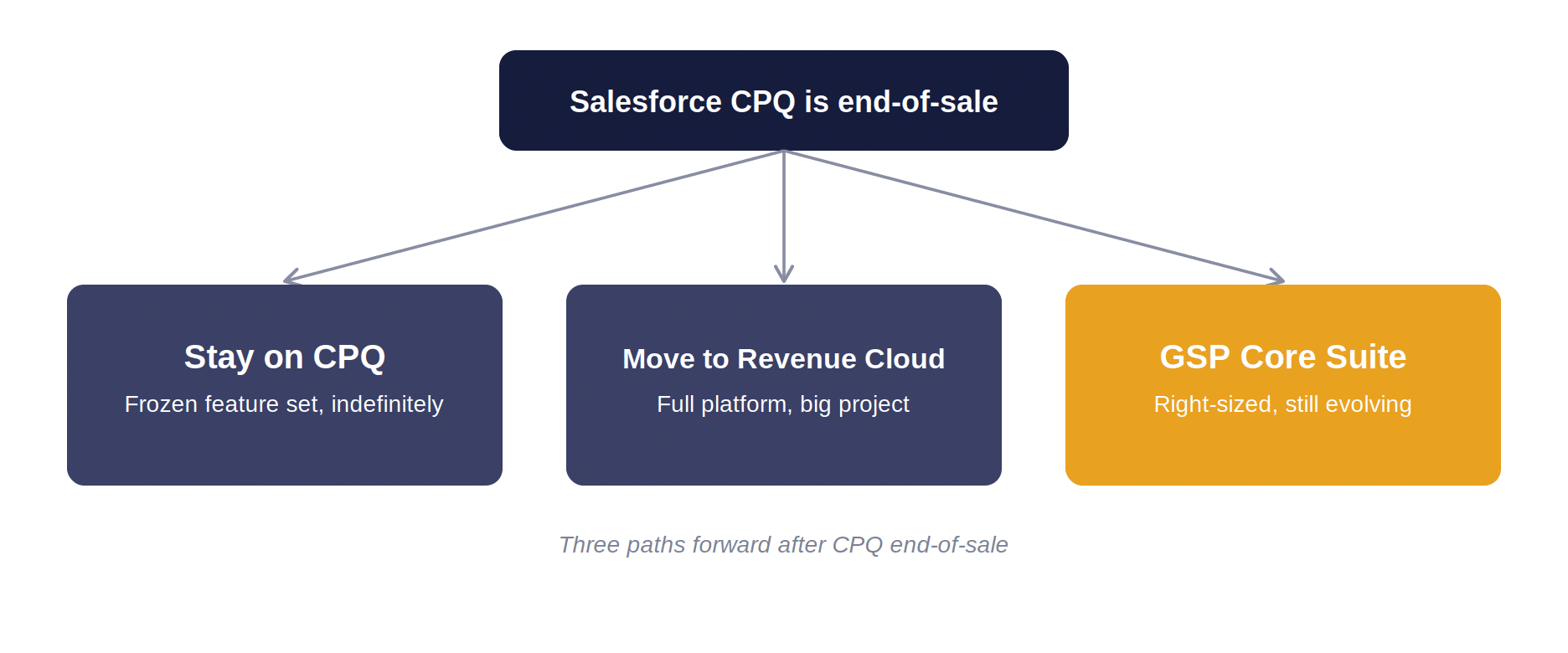
That leaves three practical choices: stay on CPQ as it is, move to Revenue Cloud Advanced, or choose a narrower alternative focused on product selection and bundling, volume pricing, and subscription management.
For sales and RevOps teams that need those capabilities—but not the cost and complexity of a full revenue platform—GSP’s Core Suite offers a simpler, lower-risk alternative that continues to be actively developed.
Salesforce put CPQ into end-of-sale(opens in new tab) in March 2025. That means new customers can't buy it. However, if you're already using it, you can keep renewing and adding seats as normal — Salesforce has announced no end-of-life date or forced migration.
Existing customers will continue to receive support and critical fixes, but they should not expect significant new product capabilities. Salesforce’s product innovation is now focused on Revenue Cloud Advanced.
That's a bigger deal than the headlines suggest. Not being able to buy CPQ is a one-off problem, and only for people who don't already have it. However, if your pricing models change, your reporting needs change, your go-to-market changes, and the tool you rely on for quoting won't change with any of it.
Whatever gaps you're patching with spreadsheets and manual workarounds today, you'll still be patching in three years.
Salesforce’s strategic successor to CPQ is Revenue Cloud Advanced, part of the Agentforce Revenue Management suite. For large, complex revenue operations—including multiple business units, subscription and usage-based billing, and deep finance integration—that is a strong option.
For many sales teams, though, it may offer considerably more scope, complexity, and cost than they need.
What Does 'End of Sale' Actually Mean?
Three different things get mixed up in this conversation, and the distinction matters:

- End of sale — new customers can no longer purchase licenses. Existing customers keep renewing and adding seats.
- End of new development — CPQ won't get significant new features. Salesforce’s product investment and innovation are now focused on Revenue Cloud Advanced.
- End of life — the date Salesforce stops patching and supporting it. That hasn't been set, and Salesforce has explicitly said that CPQ is not end-of-life.
So, there's no renewal deadline forcing your hand — that part hasn't changed. What has changed is that no deadline doesn't mean no urgency. The feature freeze has been in place since March 2025, regardless of whatever end-of-life date eventually gets attached to it.
Is Revenue Cloud Advanced the Right Replacement for CPQ?
Revenue Cloud is built to manage the whole revenue lifecycle: quoting, product and pricing, contracts, subscriptions, orders, billing, all in one connected system. If you operate at that scale, it's a strong platform.

But most CPQ conversations start from a much narrower need: sales reps need to add products to a quote without a mess of spreadsheets, pricing needs to calculate automatically instead of manually, and someone needs visibility into recurring revenue. That's it.
Moving to Revenue Cloud to solve that is like buying an ERP system to fix your expenses process. It'll do the job — eventually, at high cost, and after a project that runs many months longer than the problem justified.
The better question isn't “What replaces CPQ?” It's “What do we need CPQ, or anything like it, to do?”
Doing nothing isn't neutral, either. Every quarter you leave sales reps quoting off spreadsheets because CPQ can't grow with the business is a quarter when the debt gets bigger.
| Remain on Salesforce CPQ | Existing customers with a stable implementation that still meets their needs | Supported, but in maintenance mode with no significant new innovation |
| Revenue Cloud Advanced | Businesses needing broader revenue lifecycle capabilities, multiple channels, complex products or billing integration | Greater scope, cost and implementation effort |
| GSP Core Suite | Teams primarily needing easier product selection and bundling, volume pricing and subscription management | Not a complete CPQ, contracting, ordering or billing platform |
Why GSP's Core Suite is a Simpler Alternative
We built three Salesforce-native apps that cover the capabilities many sales teams need from CPQ — without the scale, cost, or implementation time of Revenue Cloud.
GSP Product Manager (opens in new tab) — Add products, bundles, and groups to opportunities and quotes in a couple of clicks. Replaces the standard “add products” screen with something built for how sales teams sell.
GSP Volume Pricing(opens in new tab) — Set up tiered and banded pricing once. It's applied automatically the moment products are added to an opportunity or quote — no spreadsheets, no manual calculation, no waiting on finance to check the numbers.
GSP Subscription Manager (opens in new tab)— Manage subscription products, automate renewal creation, and track the recurring revenue metrics RevOps needs to report on.

To be clear, the GSP Core Suite is not a like-for-like replacement for Salesforce CPQ or Revenue Cloud Advanced. For example, it does not provide complex configuration rules, contract lifecycle management, extensive approvals, order management, or end-to-end billing. It is designed for companies whose essential requirements are product selection, tiered or banded pricing, and subscription and renewal management inside Salesforce.
That narrower scope covers the capabilities that many businesses initially consider when evaluating CPQ, without attempting to provide an end-to-end quote-to-cash platform.
Why Do Teams Choose the Core Suite Over Revenue Cloud?

Choosing the Core Suite is a different kind of decision from choosing Revenue Cloud: a smaller scope, a smaller commitment, and a smaller price tag.
- No full-scale transformation project. These are native Salesforce apps you configure, not a platform you implement. Most customers go live in weeks, not months.
- A fraction of the cost. You're not paying for capabilities you don't use — just the parts of CPQ most teams rely on day-to-day.
- Annual subscription with no multi-year lock-in. If your needs grow into something Revenue Cloud is built for, you're free to move. Nothing here ties you into a multi-year commitment to find that out.
- Still actively developed. CPQ's roadmap has stopped. Ours hasn't — so the gaps you're covering with workarounds today keep shrinking instead of growing.
What Should You Do About Salesforce CPQ’s End of Sale?
If you already use CPQ and it continues to meet your requirements, there is no immediate need to move. However, its maintenance status means you should assess whether its existing capabilities will continue to support your changing products, pricing models, and revenue processes.
Whether you are an existing CPQ customer considering its long-term suitability or a new customer evaluating Revenue Cloud Advanced and other alternatives, start by defining the capabilities your business actually needs.
For many sales and RevOps teams, that’s three apps, not a platform. If you're considering your options, a conversation is probably the next best step — get in touch, and we'll help you work out what fits.