

What AI Means for Your Sales Team in 2026: Role Design, Headcount, and the Future of B2B Selling
AI will reshape B2B sales teams more through role redesign than wholesale job replacement, shifting human work toward problem-solving, stakeholder orchestration, judgment, trust, and customer value realization.
Last updated August 27, 2026

In This Guide
AI isn't going to wipe out sales teams — but it will change how they work, with an increasing emphasis on problem-solving, stakeholder orchestration, and value realization.
Buyers now research products more on their own, which pushes the sales team engagement further down the buying cycle. AI will accelerate the trend. Nevertheless, complex deals still need people to orchestrate stakeholders and build the trust buyers rely on.
The impact on sales team headcount will vary. In commoditized markets, where the majority of purchases are already made via a portal, the impact on team size will be modest.
In more complex B2B sales cycles, if AI increases the volume of qualified opportunities beyond what a team can handle, sales teams will need more people, not fewer.
Will AI Replace Salespeople—or Transform the Role Like the Internet Did?
The internet didn't kill the salesperson. Neither will AI. But it will change what they do.
When the internet arrived, the prevailing concern was that it would eliminate sales teams. Why would a buyer need a salesperson when they can research and purchase online?
What actually happened was more interesting.
In transactional or highly commoditized markets, salespeople were indeed largely removed from the process.
But in medium-to-high complexity sales, they weren't. Their role changed, though.
As buyers began doing more of their own research, they pushed meaningful sales engagement further down the buying cycle(opens in new tab). The rep, who was once involved from the first conversation, now joins the conversation after the buyer has a shortlist.
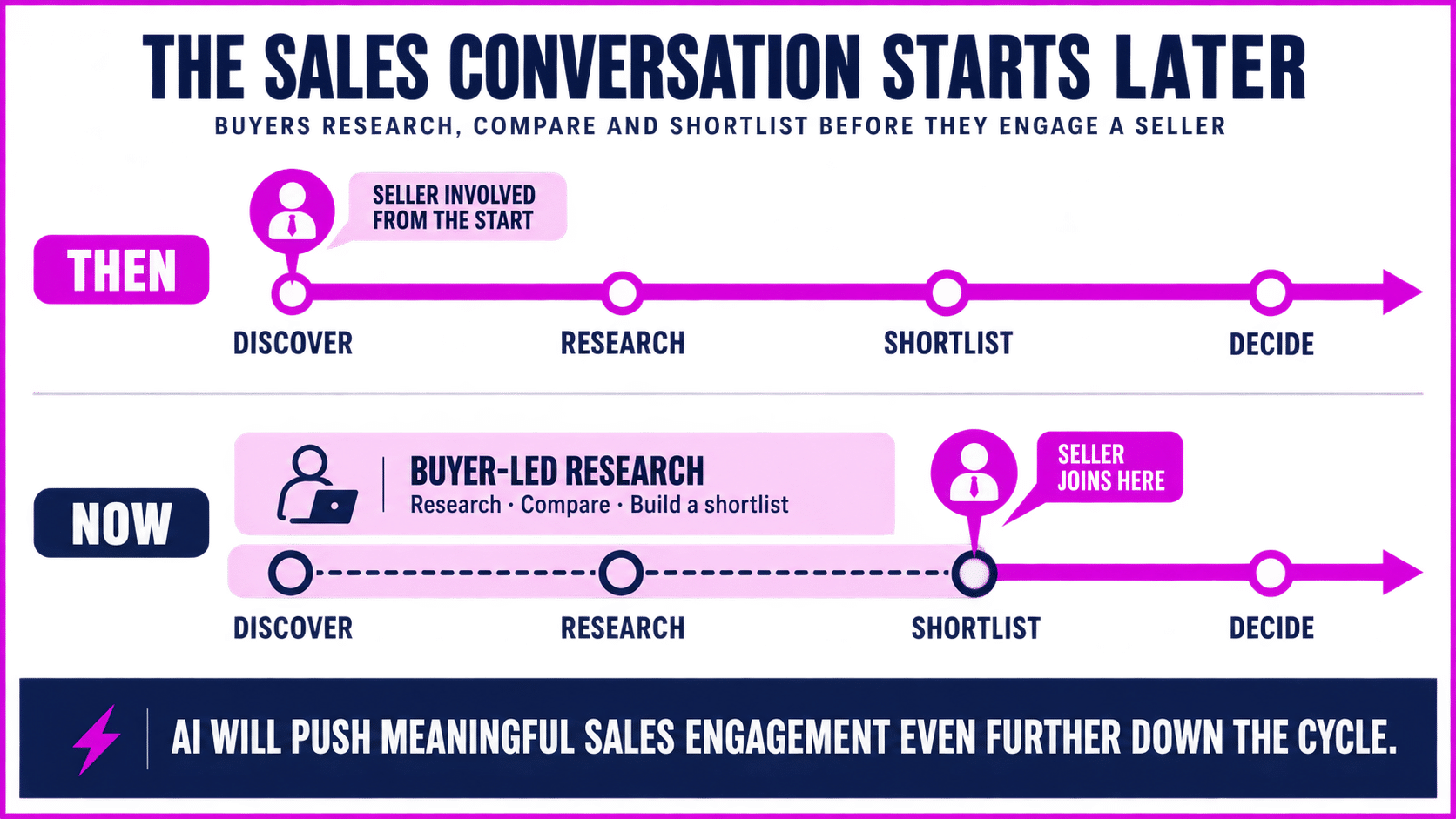
AI will accelerate the shift, changing how sales teams work.
Volume strategies were already running out of road before AI arrived, as Jeb Blount explained in his Sales Gravy article(opens in new tab) (June 2026), and AI will make them even less effective.
Sending more emails, booking more calls, or adding more touchpoints — which AI makes so much easier and consequently, so tempting — won't work. For buyers who do more work themselves before engaging with a salesperson, it's just more noise. They need a reason to believe the conversation will be worth having.
Will AI Change Salesperson-Buyer Interaction?
Most conversations about AI in sales focus on one question: what can AI do for the salesperson? Better research. Better personalization. Faster proposals. Smarter recommendations. All useful.
But the buyer has access to AI too. They can research your company before speaking to you, compare alternatives, analyze your proposal, challenge assumptions, prepare questions, and build their own internal recommendation.
Every new advantage AI gives the seller also gives the buyer new ways to research, compare, challenge, and filter. We call it Newton’s Law of AI - for every advantage to the seller, there’s an equal and opposite advantage to the buyer.
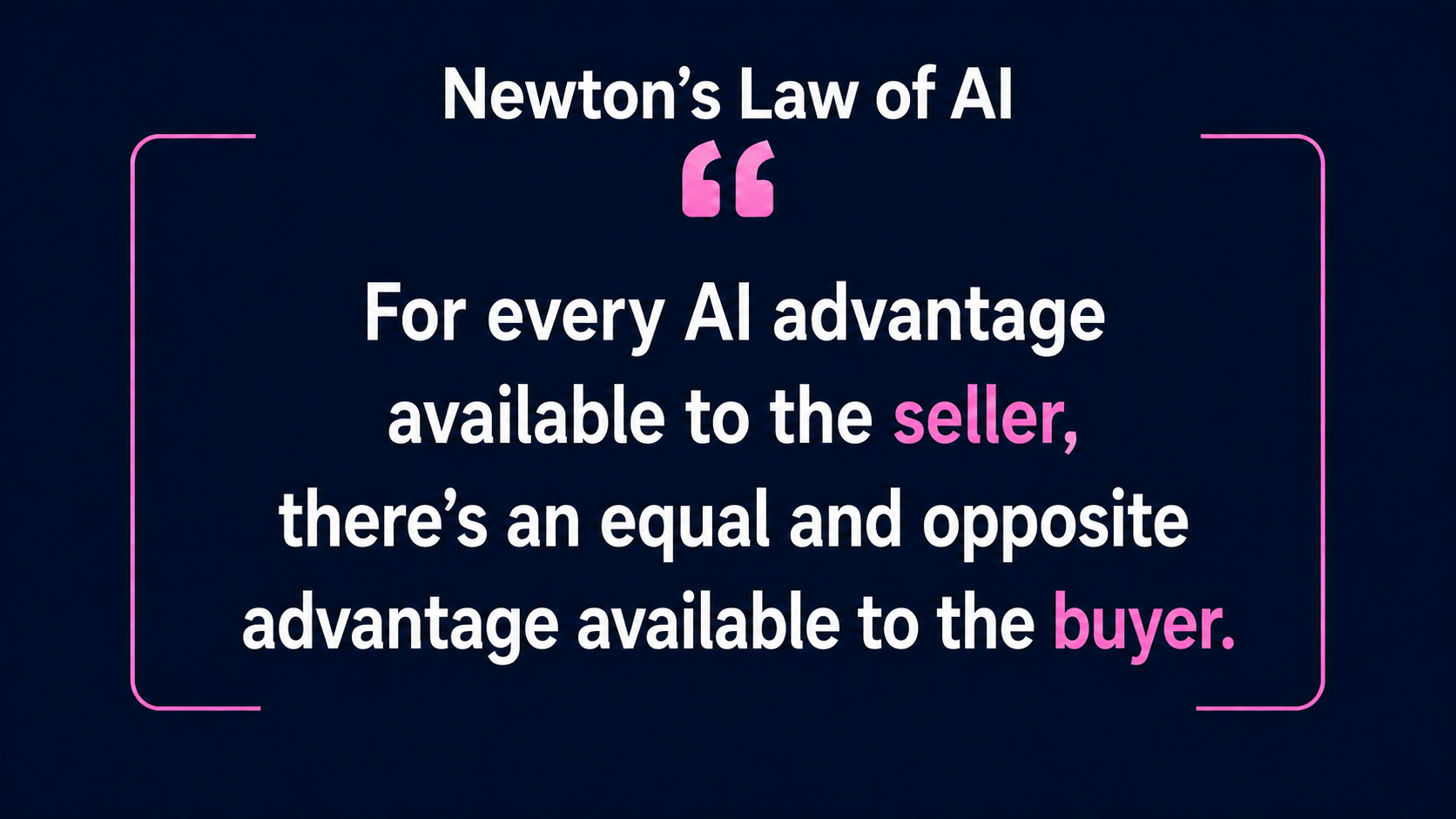
AI is accelerating a shift that began with the internet. Buyers can do more of the work themselves, pushing meaningful salesperson engagement later in the buying cycle.
| Research the buyer and account | Research the seller and vendor |
| Personalize the message | Filter and interrogate the message |
| Produce proposals faster | Analyze proposals and claims faster |
| Generate more outreach | Ignore generic outreach faster |
This means advantage shifts toward work that cannot be won through speed and volume alone: diagnosing the problem, navigating competing interests, exercising judgment, and helping the customer act. In many industries, this makes the role of the salesperson more critical, not less.
Why Do People Still Buy from People in Complex B2B Deals?
People still buy from people. The more complex the sale, the more this holds. This is down to two things: the complexity of managing multiple stakeholders, and the trust buyers place in the person guiding them through the decision.
According to Forrester (2026)(opens in new tab), up to 13 stakeholders are involved in B2B buying decisions on the buyer's side. They bring different priorities, concerns, and levels of enthusiasm for change. They have political relationships with one another that shape decisions, regardless of what the formal process looks like.
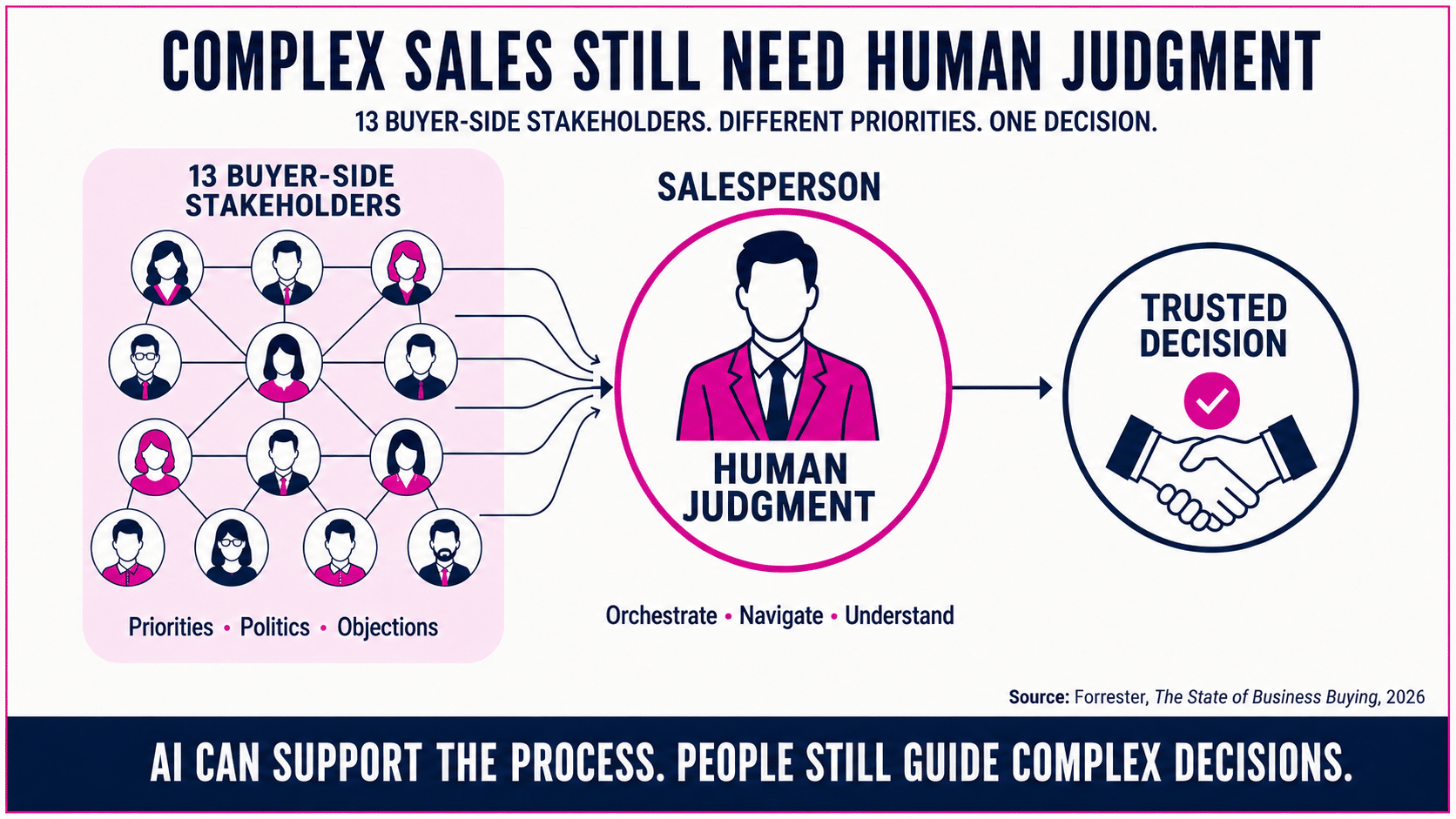
The salesperson's job in complex deals — orchestrating multiple stakeholders, navigating internal politics, understanding where the real objections live, and who actually holds the decision — requires precisely the kind of contextual human judgment that current AI handles poorly.
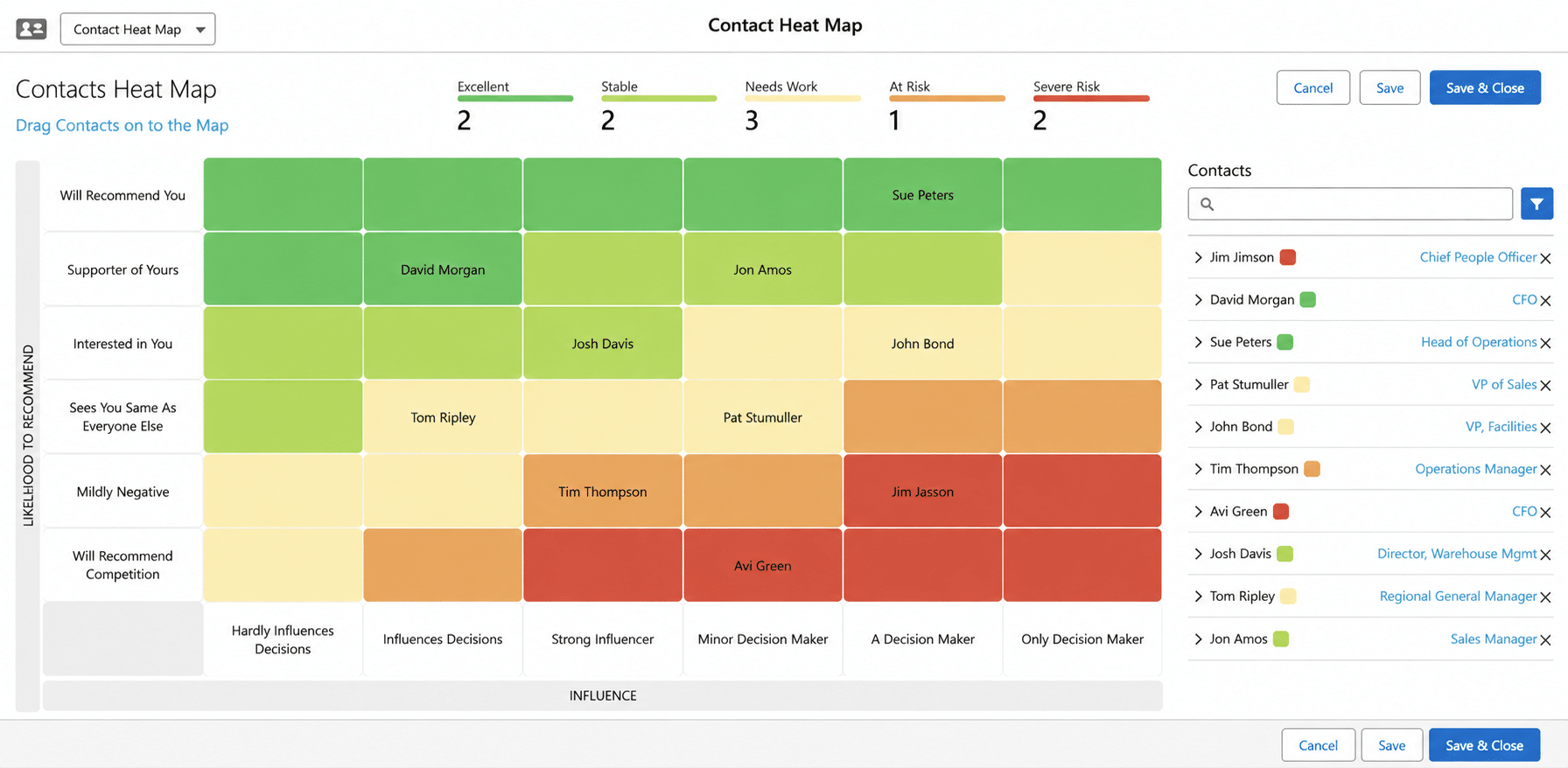
It's a fundamental capability gap, which means a fully populated Contact Heat Map(opens in new tab) is even more critical to a successful sales outcome.
There's also a trust dimension.
First-time purchases of significant products or services involve risk that buyers manage, at least in part, by building trust in the people they're buying from. The higher the cost of getting a decision wrong — financially, operationally, reputationally — the more buyers look to a trusted salesperson to help them navigate it.
None of that is going away. If anything, it's becoming more important.
As AI-generated content floods the market and buyers become more skeptical of what they receive, the authentic relationship between a skilled salesperson and a senior buyer becomes more distinctive.
So, AI may provide data and analysis, but accountability for the recommendation still tends to sit with a human. That's not going to change quickly.
How Will AI Affect Sales Teams in Commoditized Markets?
In industries where the product or service is already commoditized, and the buying process is largely transactional, sales leaders think about AI less as a growth engine and more as a cost-management tool — using it to protect margins rather than generate incremental revenue.
In these businesses, the account manager matters more than the traditional salesperson, because the buying process is routine and increasingly handled through portals or automated systems.
What changes is that those account managers will have considerably richer information at their fingertips — account performance, buying signals, risk indicators — than they've ever had before.
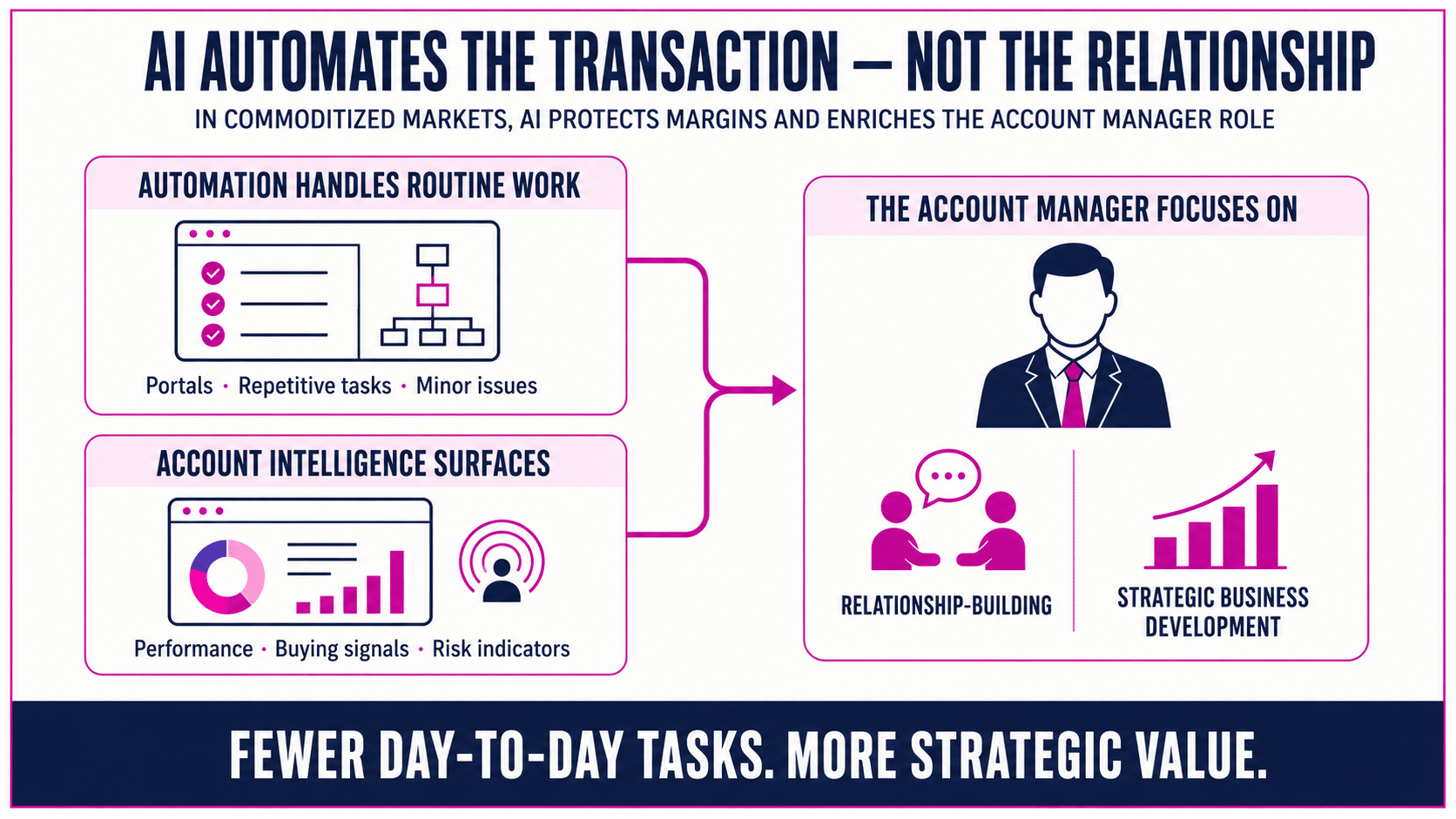
The impact is likely to enrich the role of the account manager, reducing the number of day-to-day tasks and minor problems to resolve, and increasing the importance of relationship-building and strategic business development.
How Will AI Affect Sales Team Headcount?
In some companies, AI will have a significant impact on the sales team headcount. But not how many think.
It depends on how the company uses AI.
GSP's TSAR framework groups AI's sales applications into four levels of increasing ambition and effort: Table Stakes, Solutions, Automation, and Reimagine.
At the Table Stakes and Solutions levels of the framework — where teams are using off-the-shelf tools like ChatGPT alongside platform features such as account summaries and next-best-action prompts — the effect on headcount is modest. When everyone has access to the same tools, the productivity gains cancel out, and any competitive edge disappears.
Businesses that operate at the Automation level, where agentic AI acts autonomously and replaces existing processes to generate incremental gains that the existing team couldn't have produced on its own, will see genuine structural change in their sales teams.
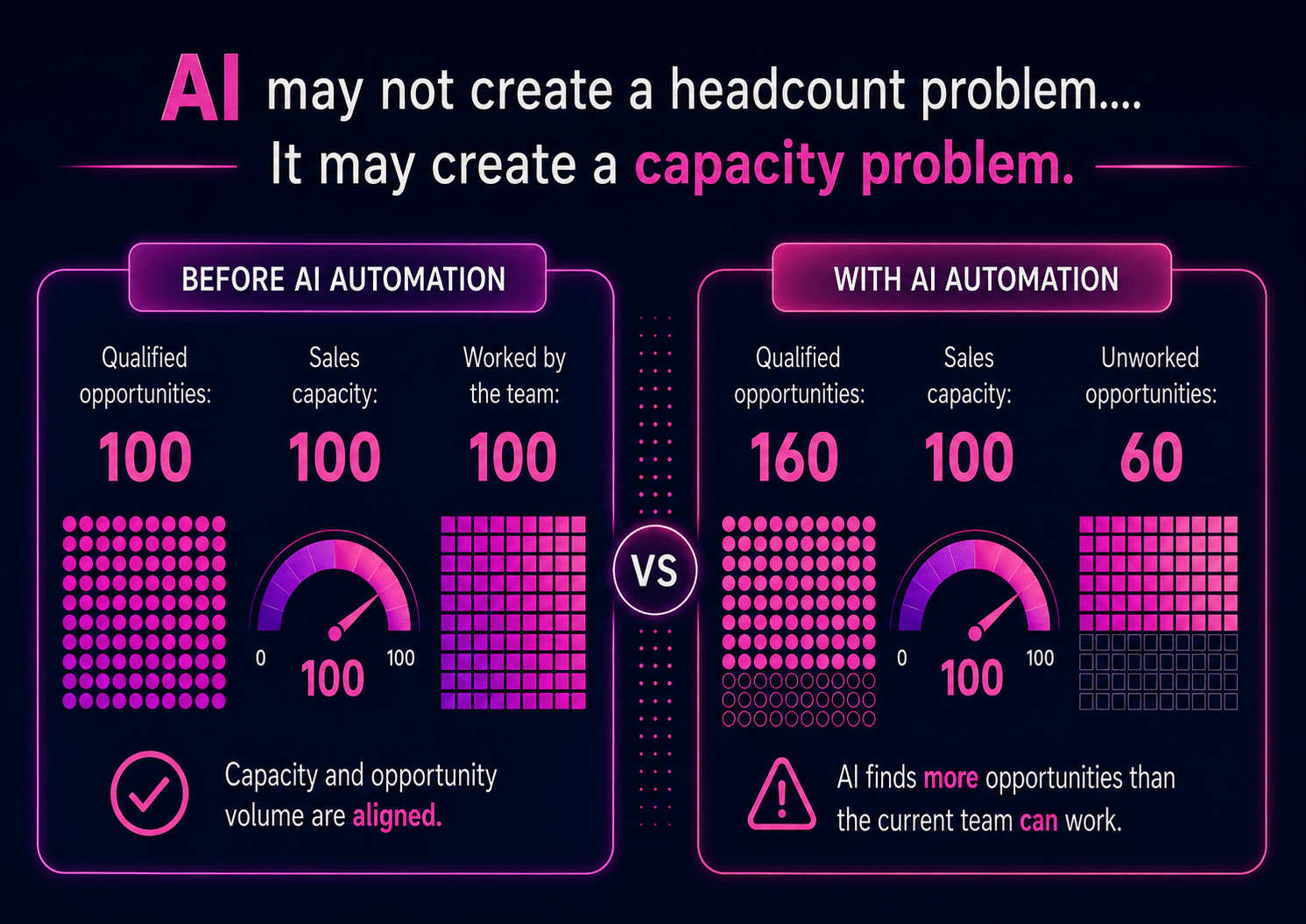
If AI gains translate into more qualified opportunities, you will need more salespeople, not fewer, to handle the pipeline the AI agents are generating.
Changes at the Reimagine level are harder to predict. Companies that attempt to redefine their business using AI technology entirely will also dramatically change the nature and number of roles within their organizations. And some companies that reimagine an entire industry will be start-ups that don't embed sales, support, or operational roles as we think of them today.
Reaching the Automation and Reimagine levels starts with the right foundation. Get in touch to learn how GSP Solutions can help you build it.
How Will AI Transform Sales Compliance and Regulation?
Regardless of the market type, AI is good at enforcing rules, so introducing it will enhance regulatory compliance. This will free up sales teams to concentrate on high-impact work AI can't do.
In many sales environments, a lot of time gets eaten up just checking that what's being proposed is actually allowed. Internal rules about which products can be combined, external regulations from trade bodies or government departments, contractual restrictions — that sort of thing.
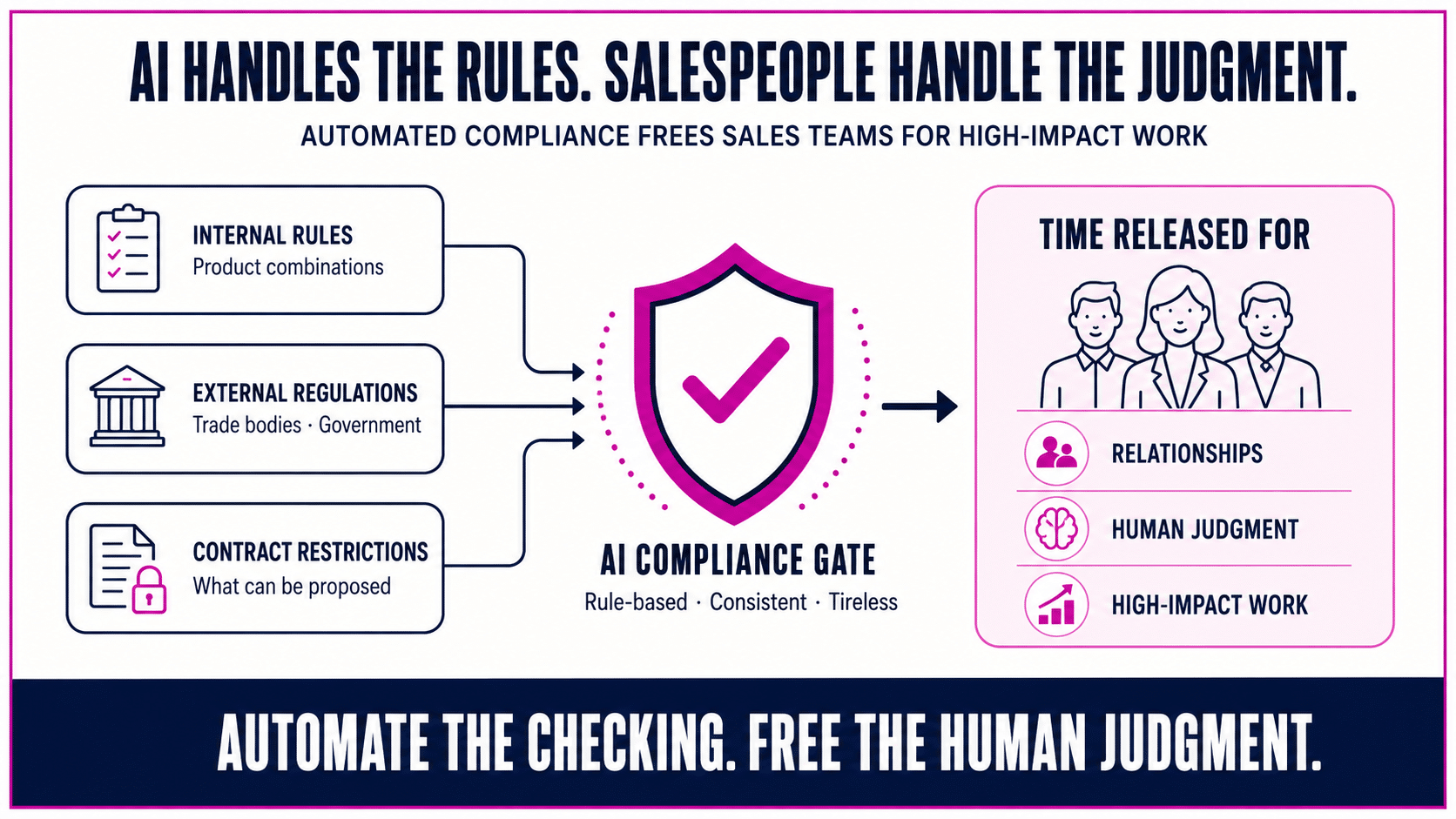
AI is well-suited to this work: it's rule-based, it's consistent, and it doesn't get tired or cut corners under end-of-quarter pressure.
As AI takes on more of this, the expectation that salespeople will personally manage compliance and regulatory adherence will diminish. This will free up time for the things humans are better at.
What Changes: The Shape of the Role, Not Its Existence
The most significant impact on sales teams won't be a reduction in headcount but a redesign of roles, as observed by Prabhakant Sinha, Arun Shastri, Sally Lorimer, and Murali Mantrala in their 2025 HBR article, Why Some Sales Teams Are Actually Growing Alongside AI(opens in new tab).
Customers won't need a salesperson to explain what a product does, but to help them choose the best solution for their problems, navigate complex dynamics in B2B sales decisions, and realize the full value of the product.
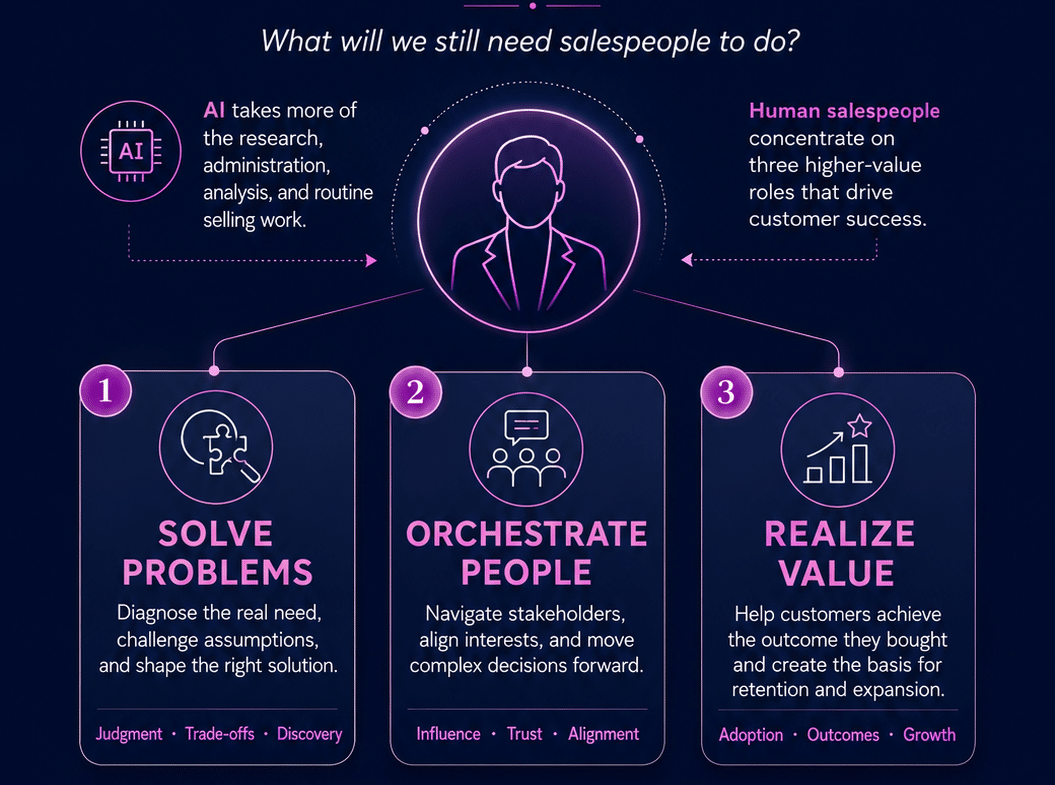
The traditional rep archetype, defined primarily by activity metrics and territory coverage, is already under pressure.
What replaces it are roles organized around three things: problem-solving, stakeholder orchestration, and value realization.
- Problem-solving: Diagnosing customers' situations accurately and configuring a solution that fits.
- Orchestration: Managing human politics, vested interests, and power dynamics in B2B buying decisions.
- Value realization: Ensuring the customer gets what they paid for, thereby protecting retention and driving account expansion. So, the salesperson's role no longer ends when the contract is signed.
| Defined by | Activity metrics and territory coverage | Problem-solving, stakeholder orchestration, value realization |
| Core skills | High activity, persistence, product knowledge | Curiosity, judgment, navigating ambiguity, managing complex human dynamics |
| Customer requirements | Explaining what the product does | Helping choose the best solution, managing complex B2B decision dynamics, realizing full product value |
| Role ends | At signature | Extends through ensuring the customer gets what they paid for |
This has practical implications for how sales leaders think about hiring, training, and reward. The skills that made someone a successful rep a decade ago — high activity, persistence, product knowledge — are necessary but no longer sufficient.
The skills that will differentiate in an AI-augmented environment — curiosity, judgment, the ability to navigate ambiguity, and the ability to manage complex human dynamics — are harder to hire for and train. But they're worth investing in, because they're also harder for AI to replicate.
What Should Sales Leaders Be Thinking About Now?
As a VP of Sales or RevOps leader, your focus should be on redesigning roles, recognition schemes, and recruitment criteria, and on having honest conversations about the changes taking place due to AI.
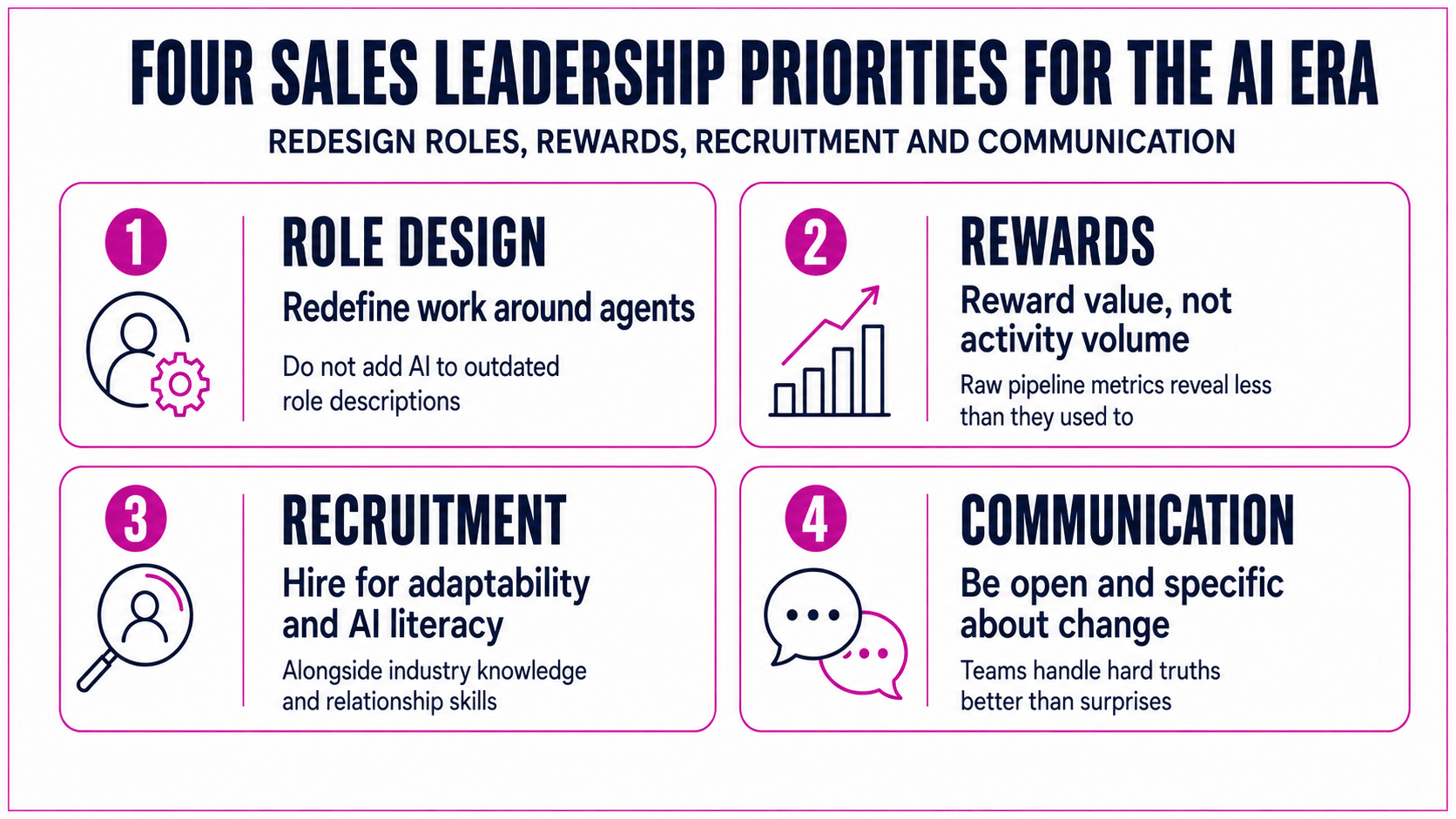
- Job role design with fresh eyes. Ask what the role needs to be in an environment where agents handle a significant portion of opportunity identification, qualification, and pipeline management. Don't just add AI tools to existing role descriptions.
- Different reward and recognition structures. Reward the value salespeople are asked to create, and not the activity metrics, like meetings booked or demos delivered. AI changed the volume equation, and if an agent is generating three times as many opportunities, raw pipeline metrics tell you less than they used to.
- Recruitment criteria. Put AI literacy alongside industry knowledge and relationship skills. The people you're hiring today need the adaptability to work effectively alongside systems that didn't exist when they started their careers.
- Honest communication. Don't hesitate to talk openly and specifically about what's changing. In my experience, sales teams can handle hard truths. They're less forgiving of surprises.
And the time to start thinking about these changes is now.
The Bigger Picture
AI will change B2B sales. It already is. But the changes are more nuanced than either the most bullish predictions or the most anxious ones suggest.
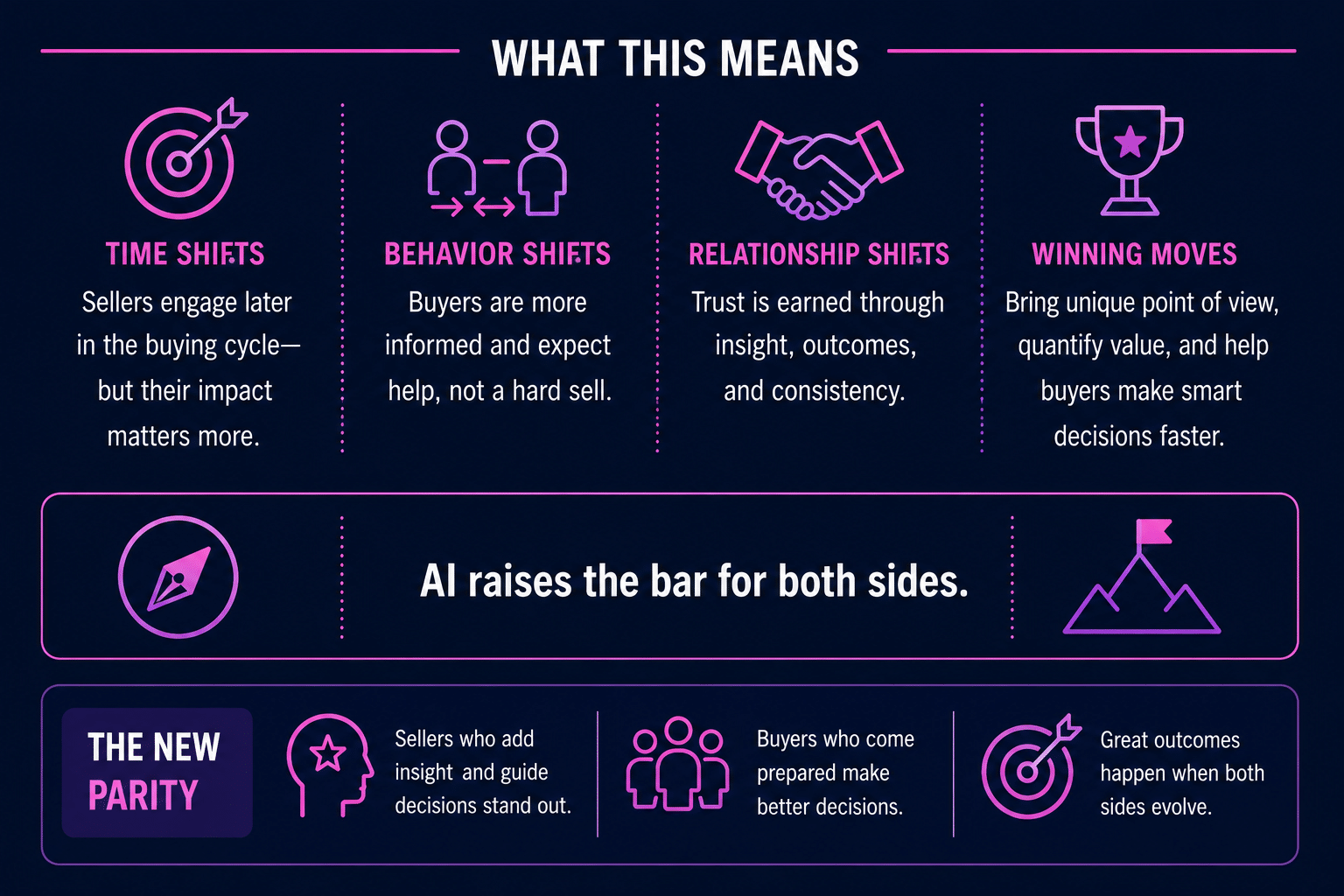
Salespeople aren't going away. But the salespeople who thrive in an AI-augmented environment will be those who use the tools to amplify what they're better at — building trust, navigating complexity, helping buyers make difficult decisions — rather than competing with agents at the things agents do better: consistency, scale, and tireless attention to data.
Where Should You Go from Here?
If you've read this far, you're probably someone trying to figure out how to implement AI in your Sales organization.
At GSP Solutions, AI in sales implementation is core to what we do — built on decades of Salesforce consultancy and deep expertise in how B2B sales organizations work.
Whether you are at the very beginning of the AI implementation journey, have already tried but haven't realized the benefits, or are ready to move fast and are looking for the expertise to get there without reinventing every wheel, we can help. Get in touch or scan the QR code and book a free call.

What AI Means for Sales Teams FAQs
AI will change sales teams. How they're structured, how roles are defined, and how performance gets measured are all up for grabs. It won't simply replace salespeople, though, and that idea misreads both the technology and what complex B2B selling actually involves. Buyers doing more research themselves has pushed meaningful sales engagement further down the buying cycle rather than removing it. Up to 13 stakeholders are typically involved(opens in new tab) in a B2B buying decision. Someone still has to navigate that, build trust across it, and read the politics of it. AI isn't good at any of that yet.
At the Table Stakes and Solutions levels, the impact on sales team headcount is modest because the productivity or sales efficacy advantages cancel out when everyone has the same tools. The real structural changes show up at the Automation and Reimagine levels. Potentially, these projects may mean you need more people to work the pipeline, not fewer, if AI generates opportunities the team couldn't have found on its own.
In many organizations, role design changes more than headcount. In these companies, there is less focus on activity and territory coverage, and more on problem-solving, stakeholder orchestration, and looking after the account once the deal is signed. Roles and reward structures need to be rethought with that in mind.
- AI in Sales: A Complete Guide for Sales Leaders — The full pillar guide
- The Four Levels of AI Benefit: The TSAR Framework — A deeper look at Table Stakes, Solutions, Automation, and Reimagine
- Why AI in Sales Projects Go Wrong (and What to Do Instead) — The failure modes at each level of the TSAR framework
- Best Practices for Implementing AI in Sales — Ten practical recommendations from real implementations
- The GSP ARMS RACE Framework — The four Design Pillars and four Architecture Layers explained in full