

Best Practices for Implementing AI in Sales in 2026: 10 Recommendations from the Field
Best practices for implementing AI in B2B sales: combine high-value process selection and design with measurable outcomes, defined human oversight, relevant data, user adoption, scalable architecture, and a dedicated implementation capability.
Last updated August 30, 2026

In This Guide
Implementing AI in sales works when you start with the business problem rather than the technology, go deep on a small number of high-value processes, and resource the people side as seriously as the build itself.
Sophisticated technology is rarely the main driver of benefits in successful AI projects.
Everything we've written about elsewhere — the levels of benefit, the reasons projects fall short, the framework for building things properly — points toward a set of practical recommendations.
This post describes those recommendations.
- Lead with both the business problem AND the technology
- Select high-value processes
- Map your existing sales process
- Define success measures and KPIs in advance
- Decide early on human / AI engagement
- Prepare and organize relevant data
- Embed AI into the tools sales already use
- Take people with you
- Adopt a scalable architecture
- Create a dedicated AI implementation team
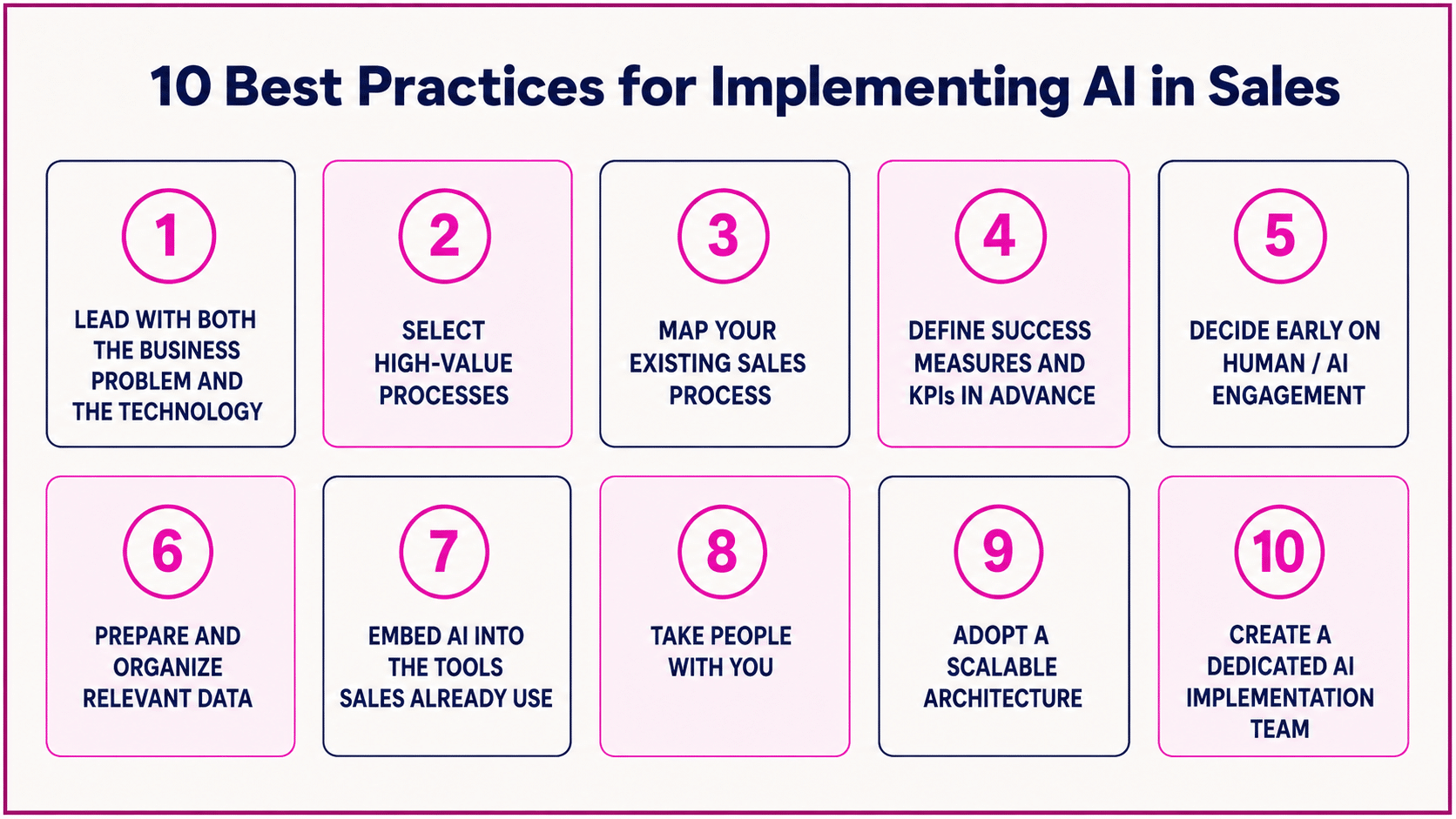
Taken together, they're where the ARMS RACE framework — our model for building AI in sales, covering both design principles and architecture — puts the rubber on the road.
1. Lead With Both the Business Problem and the Technology
Best practice: As a default, lead with the business problem — but stay alert to situations where a new AI capability opens up an option you would have never thought to ask for, and let that steer occasionally.
Conventional IT wisdom says: start with the business problem, then find the technology to solve it. It's good advice, and for most situations it still applies.
But AI sometimes reveals possibilities nobody was asking for, because nobody knew what to ask.
That's a new version of the old Henry Ford line about faster horses: if you only ever ask people what problem they want solved, you'll get answers shaped by what they already know is possible, and some of what AI can now do falls outside that frame entirely.
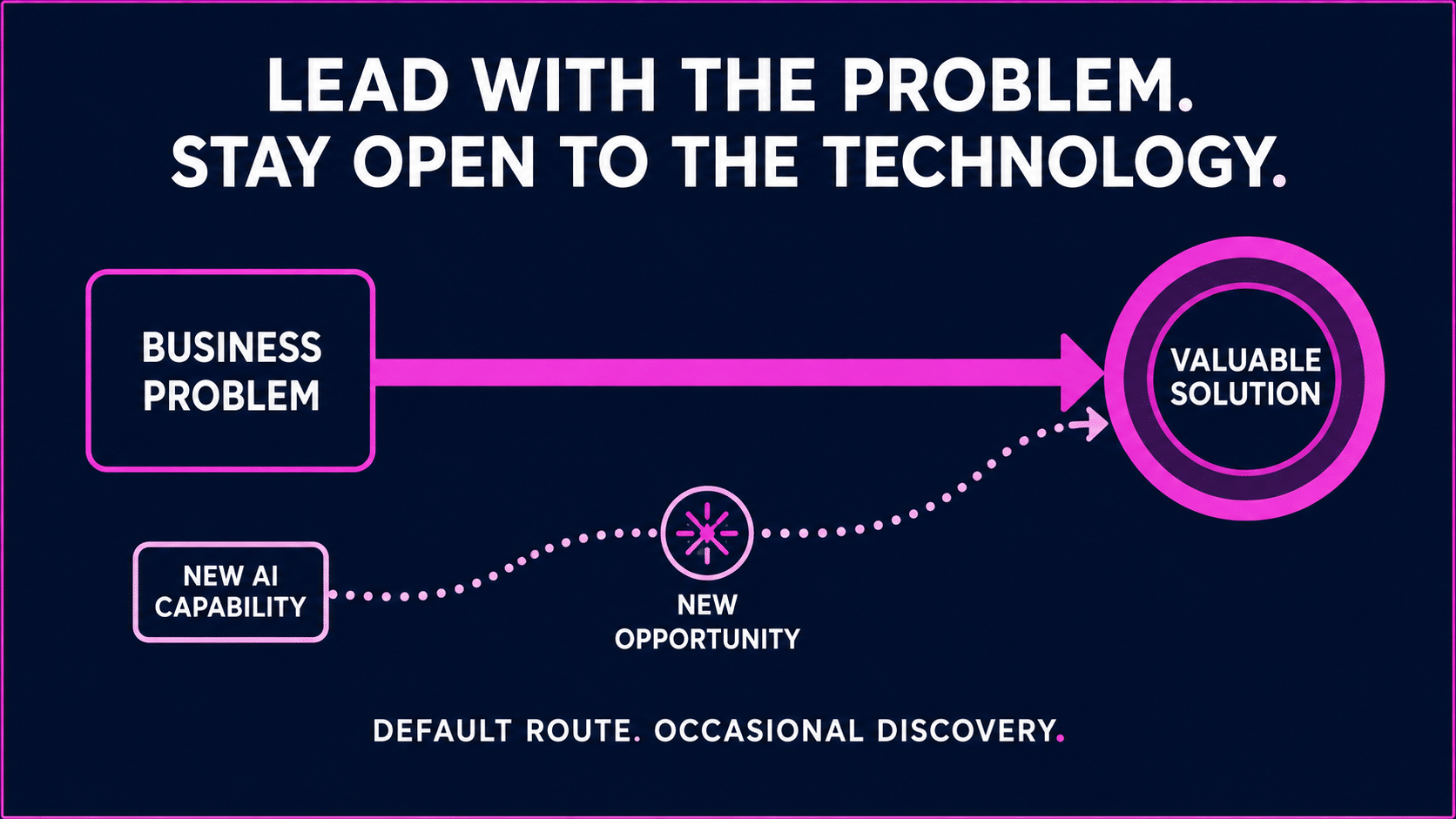
This doesn't mean throwing out the business-problem-first principle — "we have this technology, what should we do with it" is a route to expensive solutions looking for problems.
But it does mean staying open to situations where seeing a capability for the first time changes what you think is worth solving. Be selective about it. But don't be so wedded to the traditional sequence that you miss something the technology can now do.
2. Select High-Value Processes
Best practice: Focus on a few high-value processes. For each one, choose the level of TSAR needed to deliver the desired outcome, then implement it in stages that prove the concept and build momentum.
This best practice becomes particularly important when your ambitions extend beyond Table Stakes into Solutions, Automation, or Reimagine.
By “high-value,” I mean a process that materially affects how the business acquires or retains revenue.
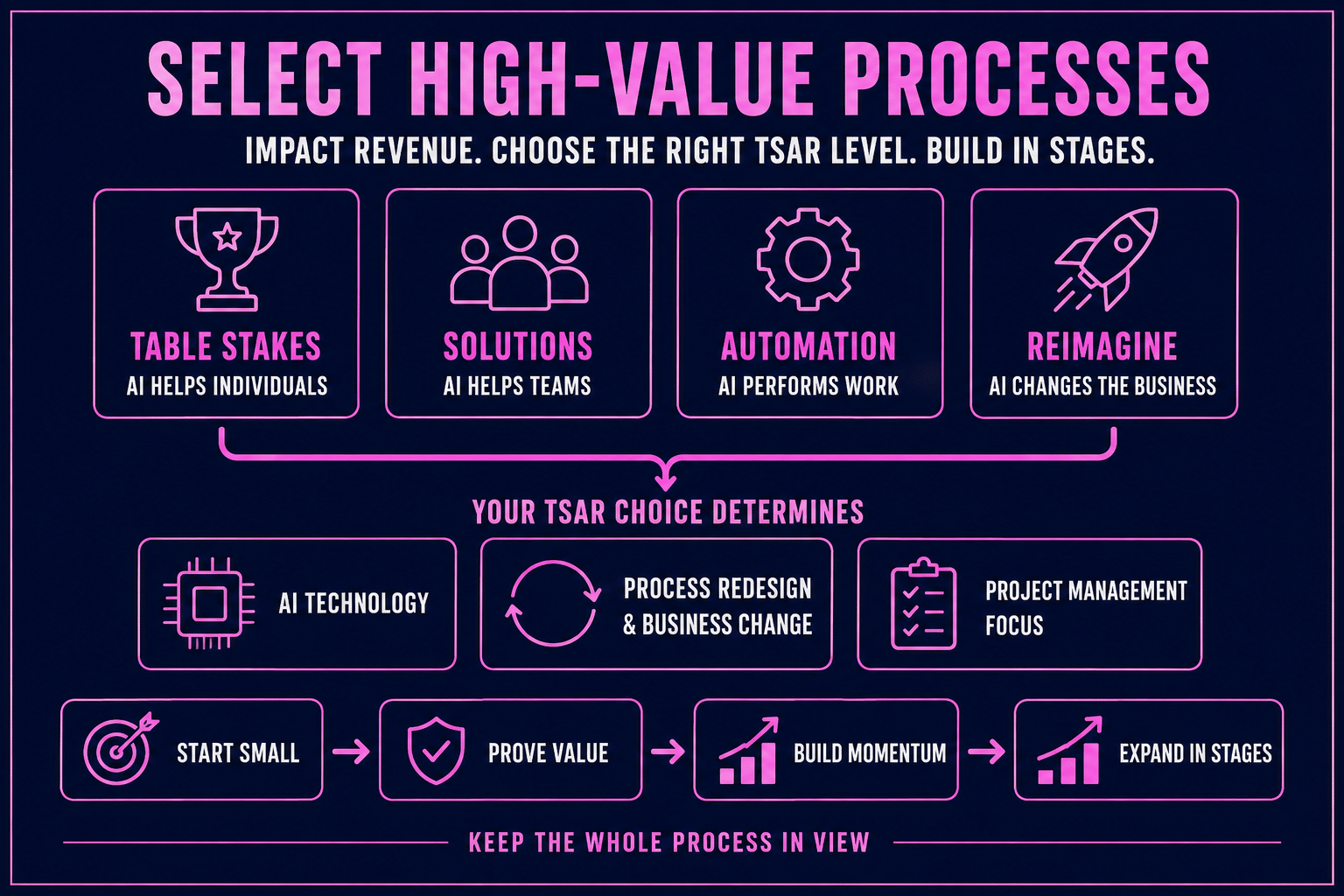
Selecting the right process is only half the decision. You must also decide how far AI should go in improving it. The same process can be improved at different levels of TSAR.
Table Stakes tools might help individuals work faster. A Solutions-level capability could improve team performance. Automation might allow AI agents to carry out specific tasks at scale. Reimagine could involve redesigning the entire process around what AI makes possible.
That choice determines more than the technology. It also dictates the process redesign, business change, project management, and organizational commitment needed to deliver the solution and realize tangible benefits.
In the early stages of AI adoption, taking on a full end-to-end process is often too ambitious. Too many stakeholders, too much organizational change, and too much risk for an organization that has not yet proved it can deliver AI projects successfully.
The practical path is often staged: implement one part, prove it works, build confidence, and use that as the foundation for the next—while keeping the strategic focus on the whole process.
Our manufacturing client’s first AI agent only flagged active equipment that needed support coverage but lacked it. Not exactly groundbreaking, but it proved the concept worked, gave stakeholders something tangible to assess, and laid the groundwork for everything that came after.
3. Map Your Existing Sales Process
Best practice: Treat business process mapping and design as core implementation work, not a precursor to it — the quality of these conversations determines whether the AI that follows produces valuable output or noise.
Mapping your sales process — properly, end-to-end — is one of the highest-value activities in the entire implementation.
Done properly, it surfaces existing bottlenecks and inefficiencies — which is useful information in its own right — and it identifies the points where AI could genuinely help.
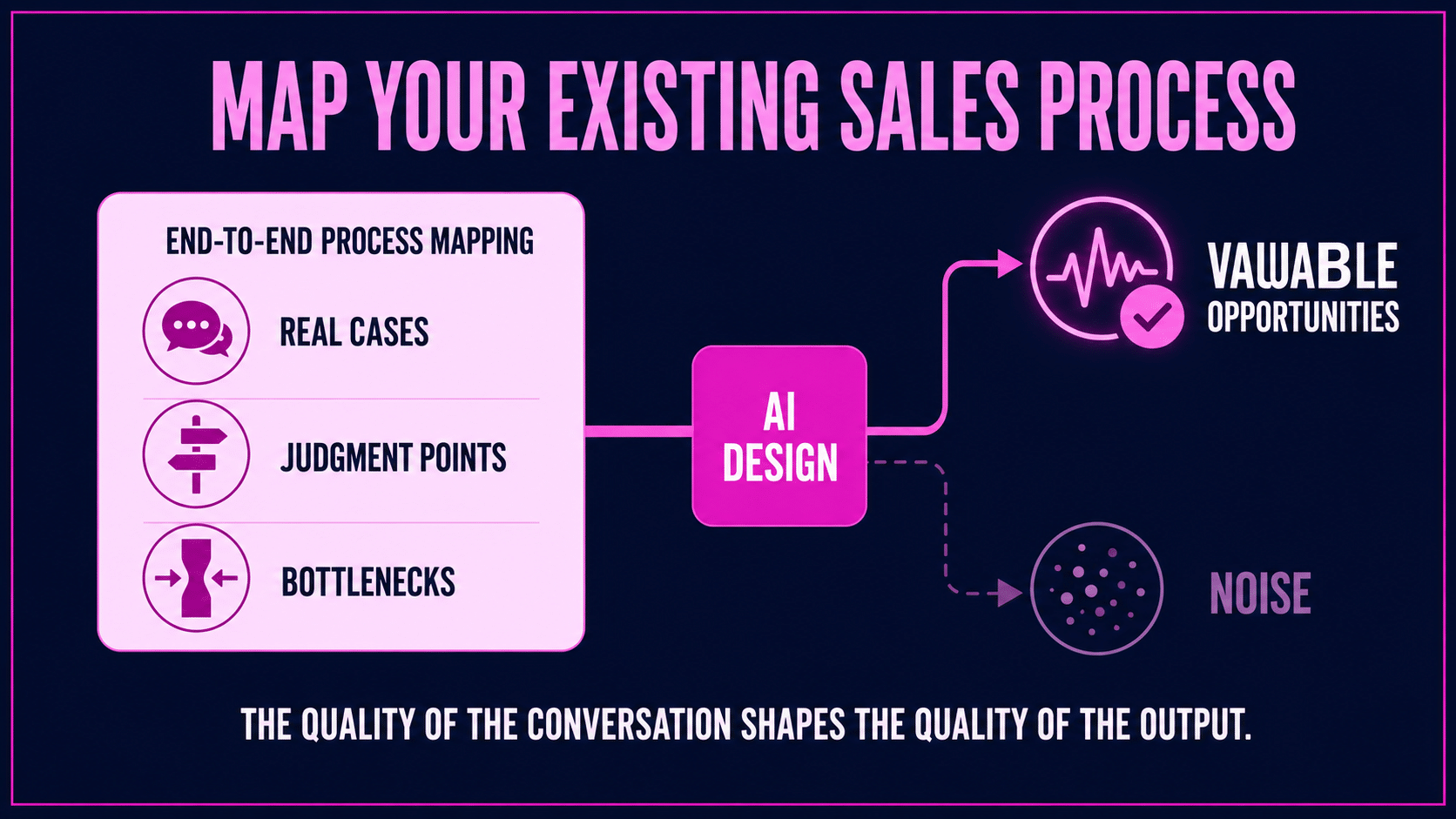
Skimp on that work, and the agents that follow generate noise instead of opportunities — and a sales team that quickly stops paying attention to anything the system produces.
That's why, at the workshops we ran at our manufacturing client, the sales team worked through, case by case, what constituted a legitimate opportunity and what didn't.
4. Define Success Measures and KPIs in Advance
Best practice: Define success metrics at both the overall benefit and individual-agent levels before launch — and use the fact that agent actions are tracked to monitor performance continuously.
Too many organizations run AI projects without agreeing on what success looks like. Foundry's State of the CIO 2026(opens in new tab), published in June 2026, found that fewer than half of organizations (47%) had established formal metrics for AI.
Answer these simple questions:
- What is this agent supposed to do?
- How will we know if it's working
- What does failure look like, and at what point do we intervene?
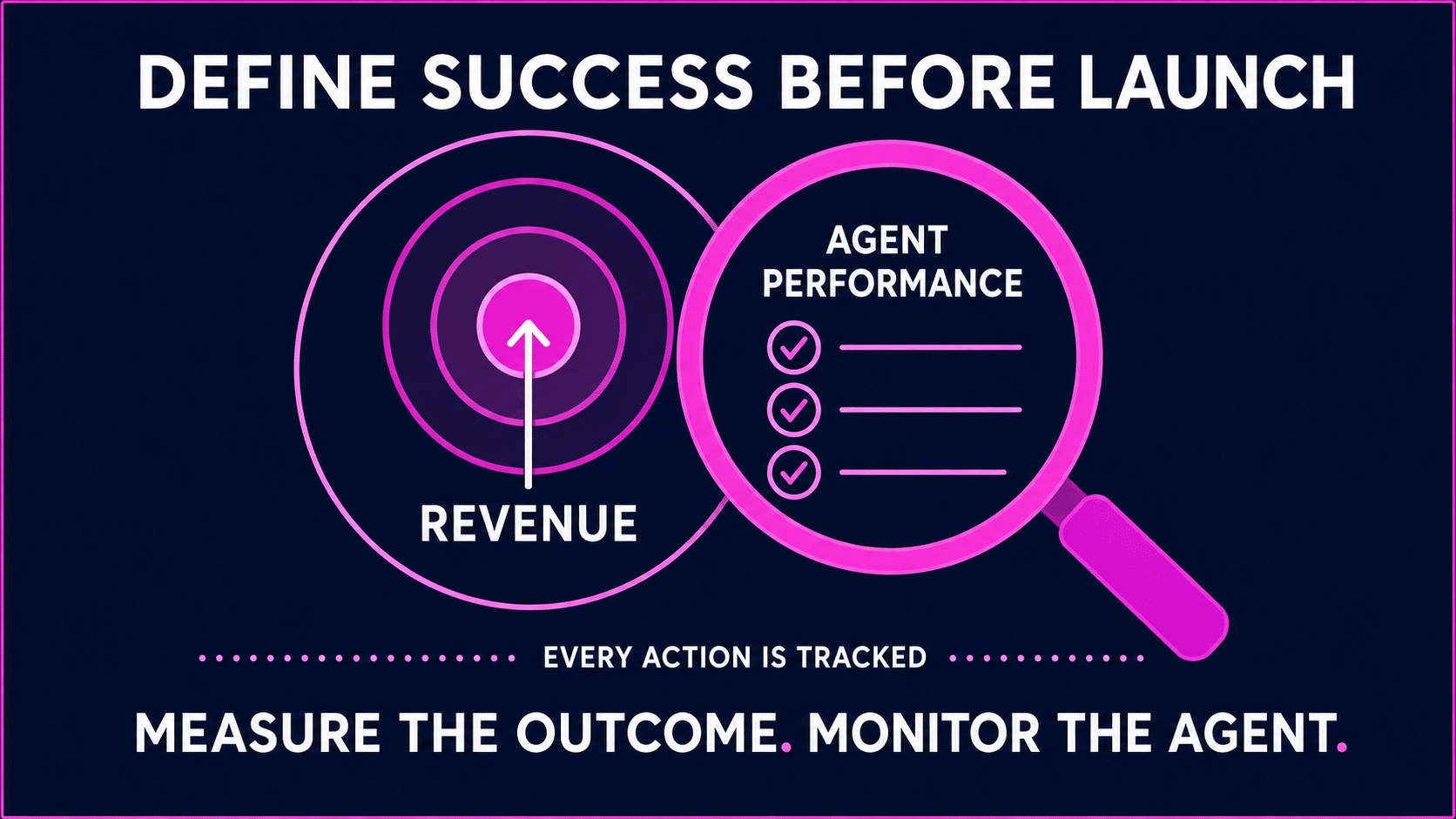
Success in AI for sales ultimately means revenue. But that's a lagging indicator. You also need leading ones to assess how well the agent completes its tasks.
| Overall benefit | Revenue | Opportunities won, deals closed, costs reduced |
| Agent | Task performance | How accurately does an agent complete its task? When it should have flagged something for human review, did it? When it escalated, was the escalation appropriate? |
Agent-level measurement is possible in ways that weren't viable with previous generations of sales technology because every agent action is logged and auditable.
With the right dashboards, you can see whether the overall numbers are moving and whether individual agents are performing as expected, drifting over time, or needing recalibration — before the problem affects the headline figures.
5. Decide Early on Human / AI Engagement
Best practice: Spell out exactly where a person sits in the workflow and what they must review. Recognize that this will shift over time as trust in the system builds.
Before you build anything, decide exactly where humans fit in the process. Be specific about:
- At which point does a human review an AI output?
- What are they checking for?
- What happens if they disagree?
In our manufacturing client example, a salesperson reviews every sales opportunity an agent generates before anything happens with it.
They sense-check it: Is this genuine? Does it make sense? Is this the right customer at the right moment? The AI helps, but it's a human who makes the phone call or writes the email.
The threshold for where humans sit will move over time, and eventually, agents will send quotes and covering emails directly. But not yet — not because the technology can't do it, but because the organization doesn't yet have confidence that every output will be appropriate.
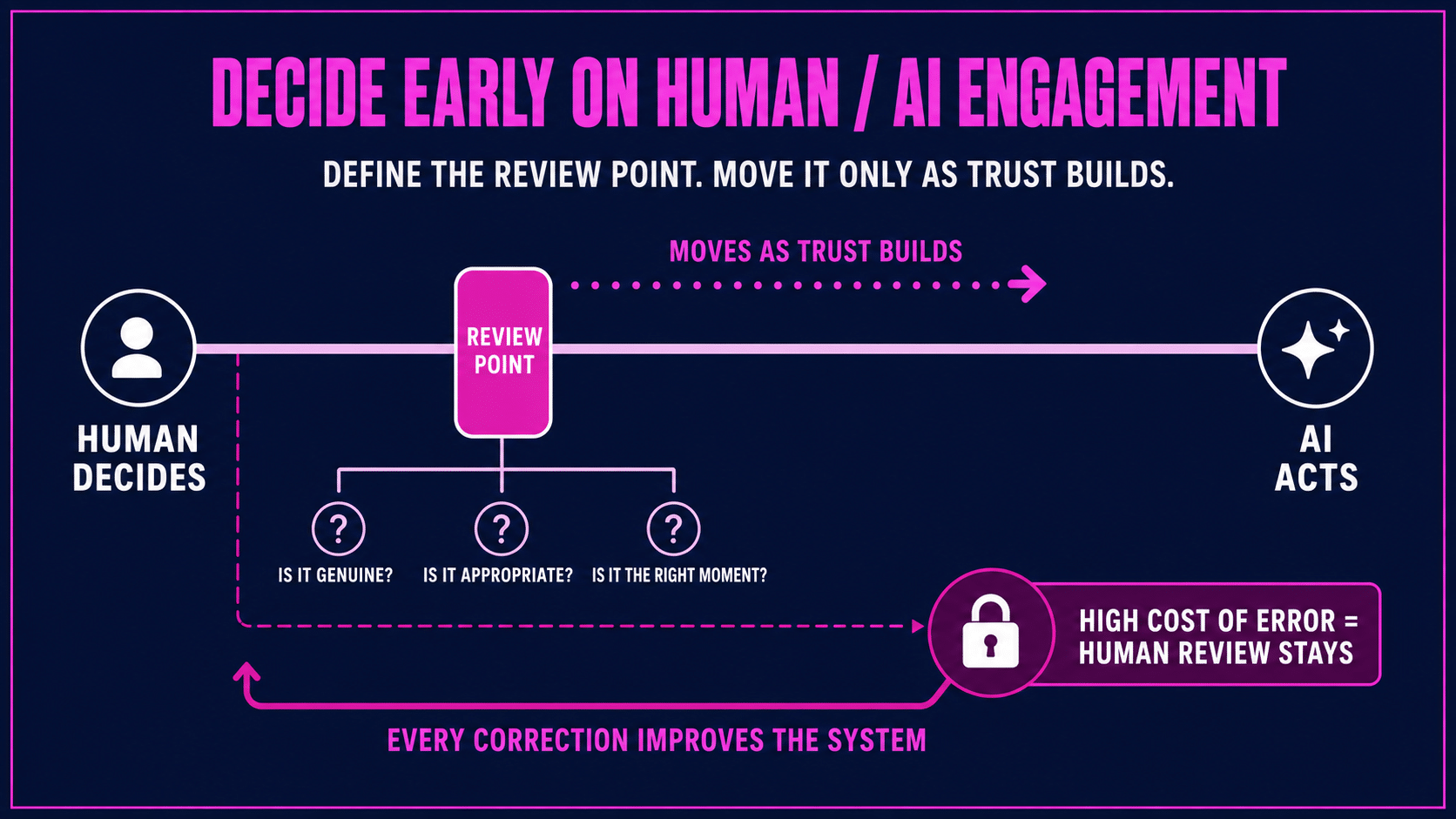
When setting the human-oversight threshold, consider the cost of getting things wrong.
Where that cost is high — financially, reputationally, or to the customer relationship — human review remains in place regardless of how confident the technology seems.
Finally, there's another reason to keep humans in the loop: that's how the agents get better. Every human review and correction is feedback that improves the system.
6. Prepare and Organize Relevant Data
Best practice: Start with the business problem and address only the data quality issues you need to implement a solution. Don't wait for the AI implementation to finish — work on both at the same time.
Generative AI needs a lot of data. Agentic AI — where the system decides what needs to be done and then does it — needs even more.
If you want agents producing outputs that salespeople trust enough to act on, the data underneath those agents needs to be good — and in most organizations, it isn't, at least not yet. In a July 2026 study of 1,000 technology leaders by Teradata and Wakefield Research(opens in new tab), 77% said that 20% or less of their enterprise data was ready for AI agents to use reliably.
This is no surprise.
For years, companies haven't treated data as an asset in its own right. It was a by-product of doing business, rather than something actively curated for its value.
The result is a patchwork: some areas well-maintained, others riddled with duplicates, gaps, and information untouched for years.
Here's where it gets counterintuitive: the instinct is to think that AI in sales must start with a data clean-up program.
It doesn't. Success starts with clarity about which business problems are worth solving — and only then working backward to the data those solutions need. Otherwise, you risk spending resources improving information that was never going to be relevant to the use case anyway.
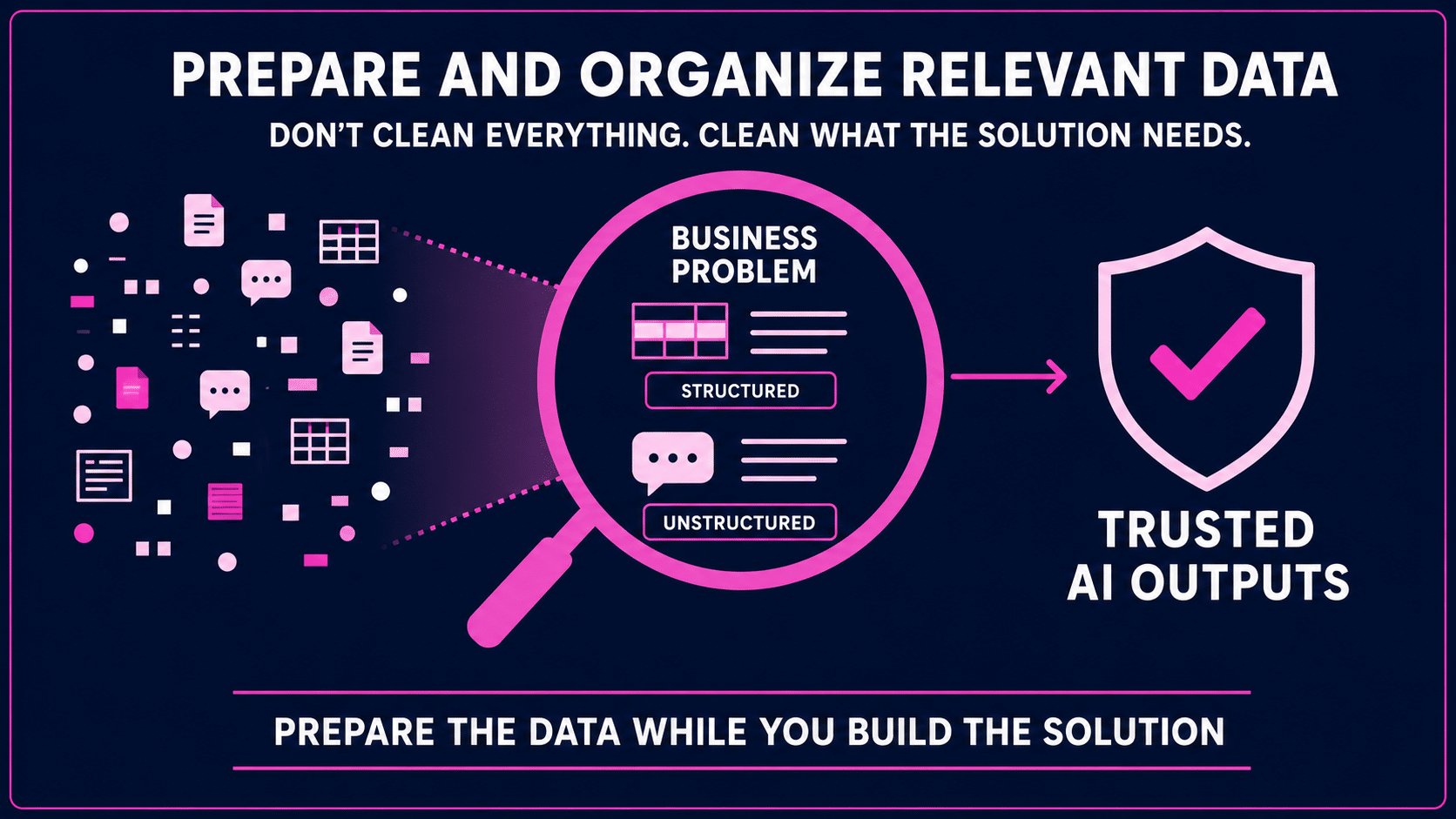
Once you know what you're trying to do, the data work breaks into two distinct efforts:
- One-off deduplication, enrichment, and correcting the most obvious and damaging errors.
- Ongoing maintenance that prevents the fixed problems from reappearing in six months.
Note that "data" in this context is broader than the fields in your CRM — that's just structured data. And of course, it's important. But in a B2B sales environment, some of the richest signals live in unstructured data.
| Examples | Opportunity records, contract values, renewal dates, product holdings | Call transcripts, meeting notes, email threads, free-text descriptions on support tickets |
| What it tells you | Relatively unambiguous customer information | Why a deal is stalled, what a customer is worried about, whether a relationship is healthy or fraying |
| What it needs first | Deduplication, enrichment, and correcting the most obvious and damaging errors | Tagging and organizing before an agent can make sense of it |
One final thought: don't let data issues delay starting. Run data work in parallel with everything else on this list.
7. Embed AI Into the Tools Sales Already Use
Best practice: Put AI recommendations where reps already work every day — and prototype the experience before you build it to make sure the team will use the solution once it goes live.
As a rule, salespeople aren't early adopters of new software. Ask a sales team to log into a standalone AI tool to check its suggestions, and they won't, because they already have enough to do.
So the outputs have to land inside the tools reps are in anyway, without asking them to change how they work.
Many CRM and sales automation platforms are already doing some of this. Next-best actions, account summaries, and similar capabilities are increasingly built into the core product (check out Salesforce's library of prebuilt Agentforce use cases(opens in new tab) for examples).
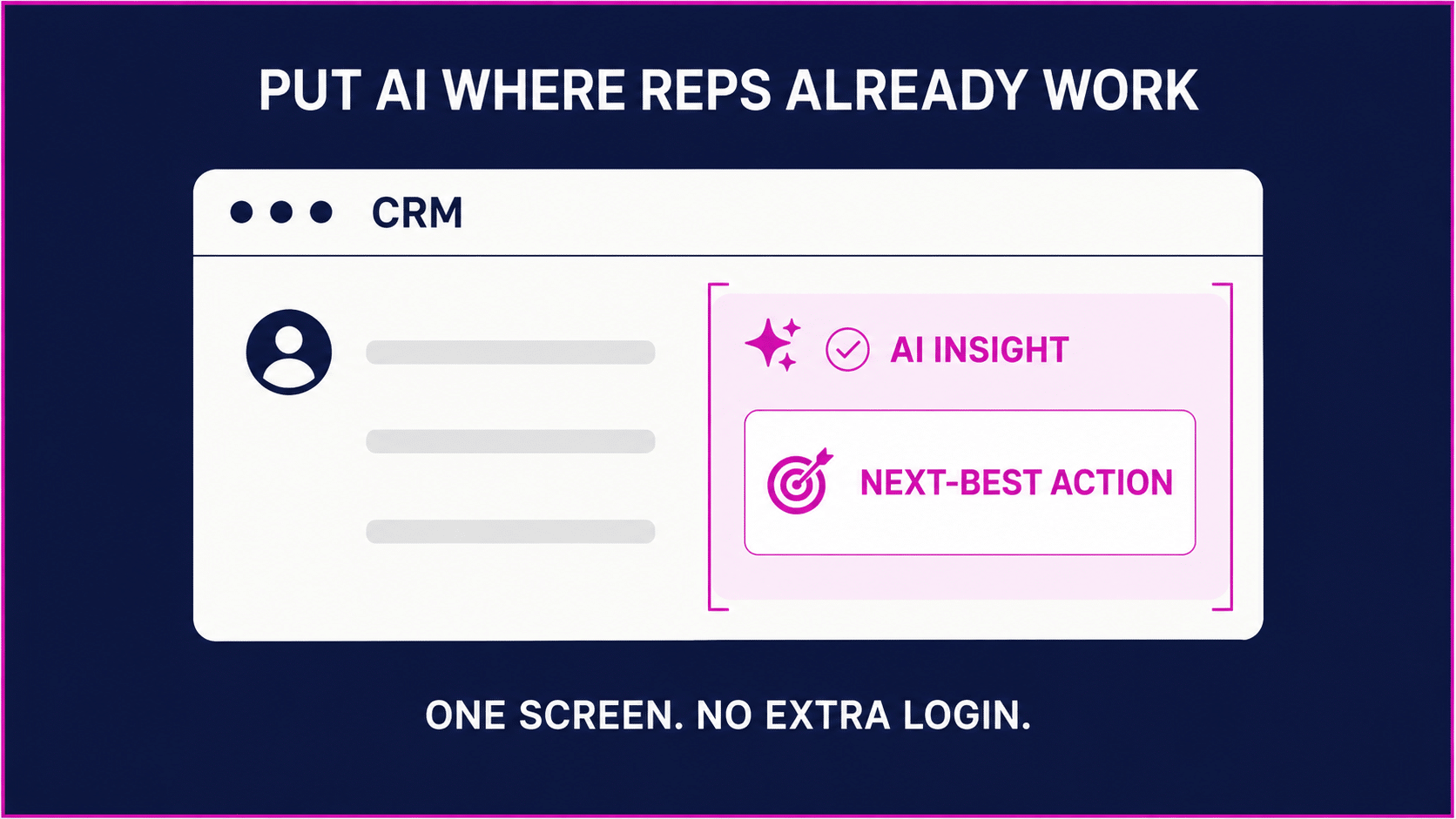
But for more bespoke solutions, displaying agent outputs directly within the existing interface requires custom development.
For our manufacturing client, which runs on Salesforce, this involved creating Lightning Web Components — custom panels that sit inside the standard Salesforce interface — that placed AI-generated insights directly on the screens salespeople already had open.
Before any of that was built, the team mocked up the experience in Figma(opens in new tab). This lets the team test and refine how insights are presented and used before committing to building it.
8. Take People With You
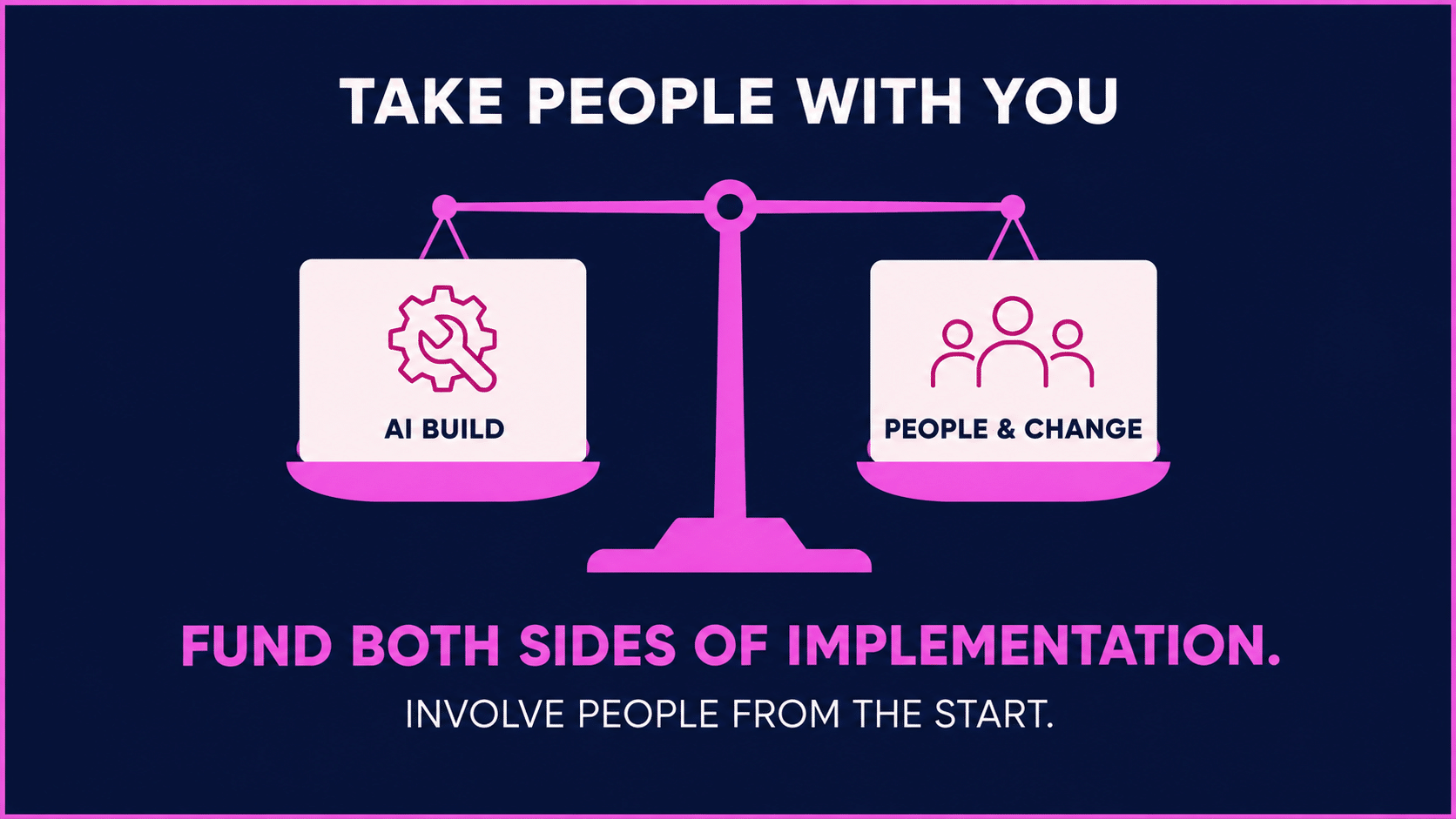
Best practice: Fund the human side of implementation as heavily as the build. Bring the people closest to today's process into shaping what comes next, and communicate with them from the start about what will change.
Prosci’s 2025 research(opens in new tab), involving 1,107 professionals across frontline, management, and executive roles, found that 63% of AI implementation challenges stem from human factors rather than technical limitations. User proficiency alone accounted for 38% of the problems identified, compared with 16% attributed to technical challenges.
One explanation: it's easier to get budget approved for building an AI solution than for the work required to scale it — training, role redesign, change management, all the things that determine whether anyone uses what's been built. So be sure to include all the ancillary costs when you go to the board for funding.
Another reason: internal resistance, even among the people who stand to benefit.
Salespeople who could see meaningful upside from an AI tool can still be wary of it, because the underlying question in everyone's mind is: "What does this mean for me?"
That's not unreasonable.
To address the tension, clear communication is vital. In practice, this means:
- Get salespeople involved in deciding what agents should and shouldn't do.
- Tell people early how their roles might change, even if the honest answer right now is "we're not sure yet."
- Watch how leadership talks about this, because one badly phrased comment, like "lower-value human capital" by the Standard Chartered CEO Bill Winters(opens in new tab), can undo months of careful groundwork.
9. Adopt a Scalable Architecture
Best practice: Build for scale from day one. Lean on the functionality that already exists, set up repeatable patterns that later agents can slot into, and keep a simple register of everything you have built.
Even if you're starting small, build with the end goal in mind. Think through, even at an early stage, what the eventual set of agents might look like, so that the decisions you make now don't become obstacles later.
This directly connects to the Reuse Before Rebuild and Modular by Design principles in our ARMS RACE framework.
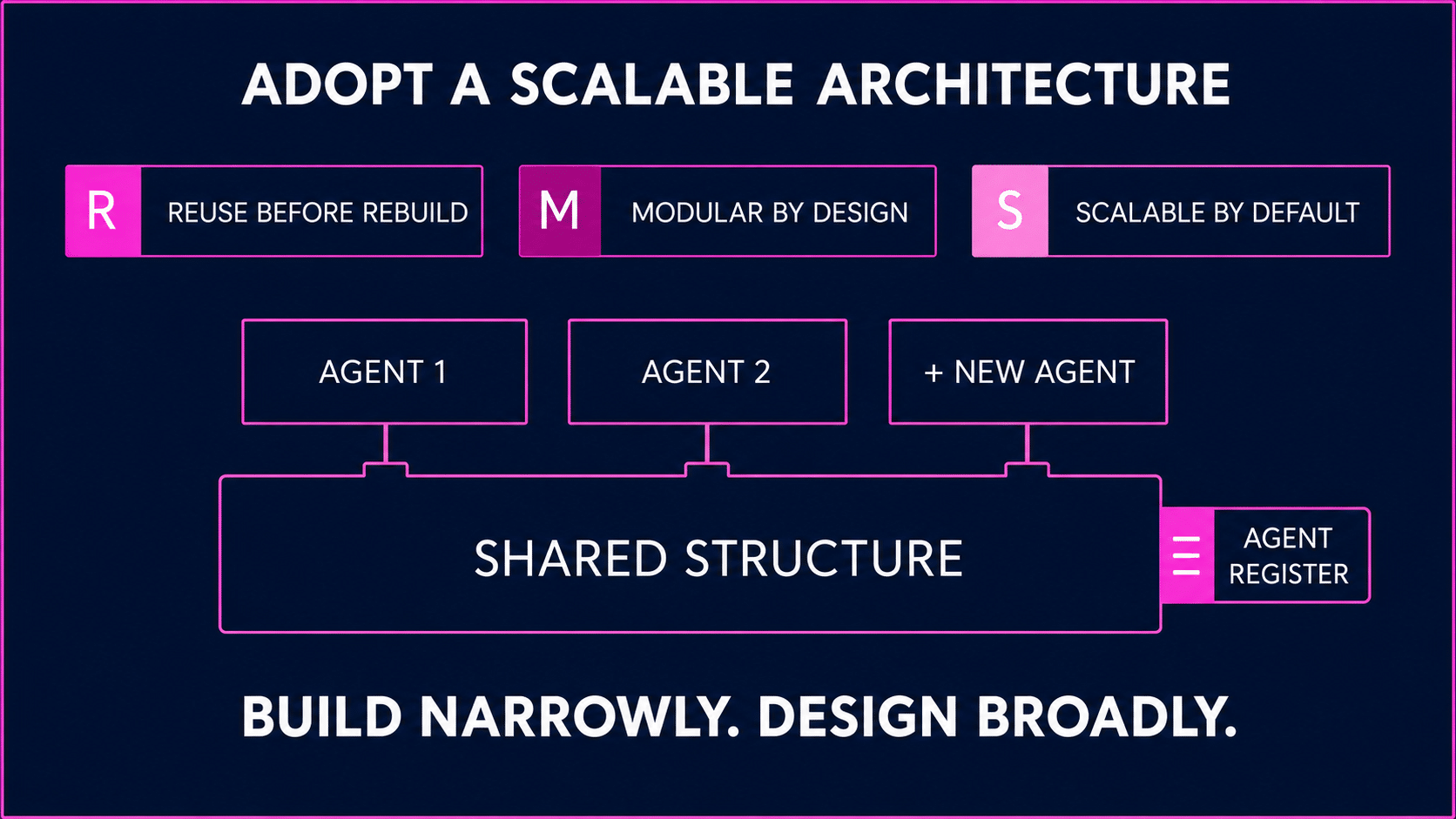
Before building a new agent, check whether existing functionality already does the job — and if so, leave it alone. The most efficient way to scale is often to copy a productive agent into a new context rather than designing something from scratch each time.
With our manufacturing client, each agent writes the insights it produces into a purpose-built custom object inside Salesforce. As new agents have been added, they feed into the same structure. The result is a system where new capability slots into an existing architecture rather than each addition requiring its own bespoke design.
Maintain a single shared list of all agents and their roles. It's one of the cheapest things you can do to avoid multiple teams building overlapping agents because nobody can see what already exists, which can easily happen in large organizations.
10. Create a Dedicated AI Implementation Team
Best practice: Instead of making every team relearn the same lessons on their own, set up a small, dedicated team that builds and holds the AI implementation know-how project to project. Pair them with people in the business who have domain expertise.
Let's be honest about something the industry hasn't always been: building custom AI agents is genuinely difficult. You don't just plug it in, point it at your data, and watch the magic happen, as the early vendor messaging promised (more recent commentary, including from some of the same vendors(opens in new tab), has taken a noticeably more cautious tone).
The solution is partly in how projects are scoped:
- Favor the lightest approach that shows real progress in weeks, not quarters.
- Build small agents for specific tasks rather than one large, unwieldy system.
- Use an orchestration agent to pull the outputs together.
The other part of the solution is organizational. Building custom agents involves a particular kind of expertise — in the underlying technology, and in how to apply it to your specific business, data, and processes.
That expertise takes time to build, and it's expensive to rebuild from scratch every time a new team decides to have a go.
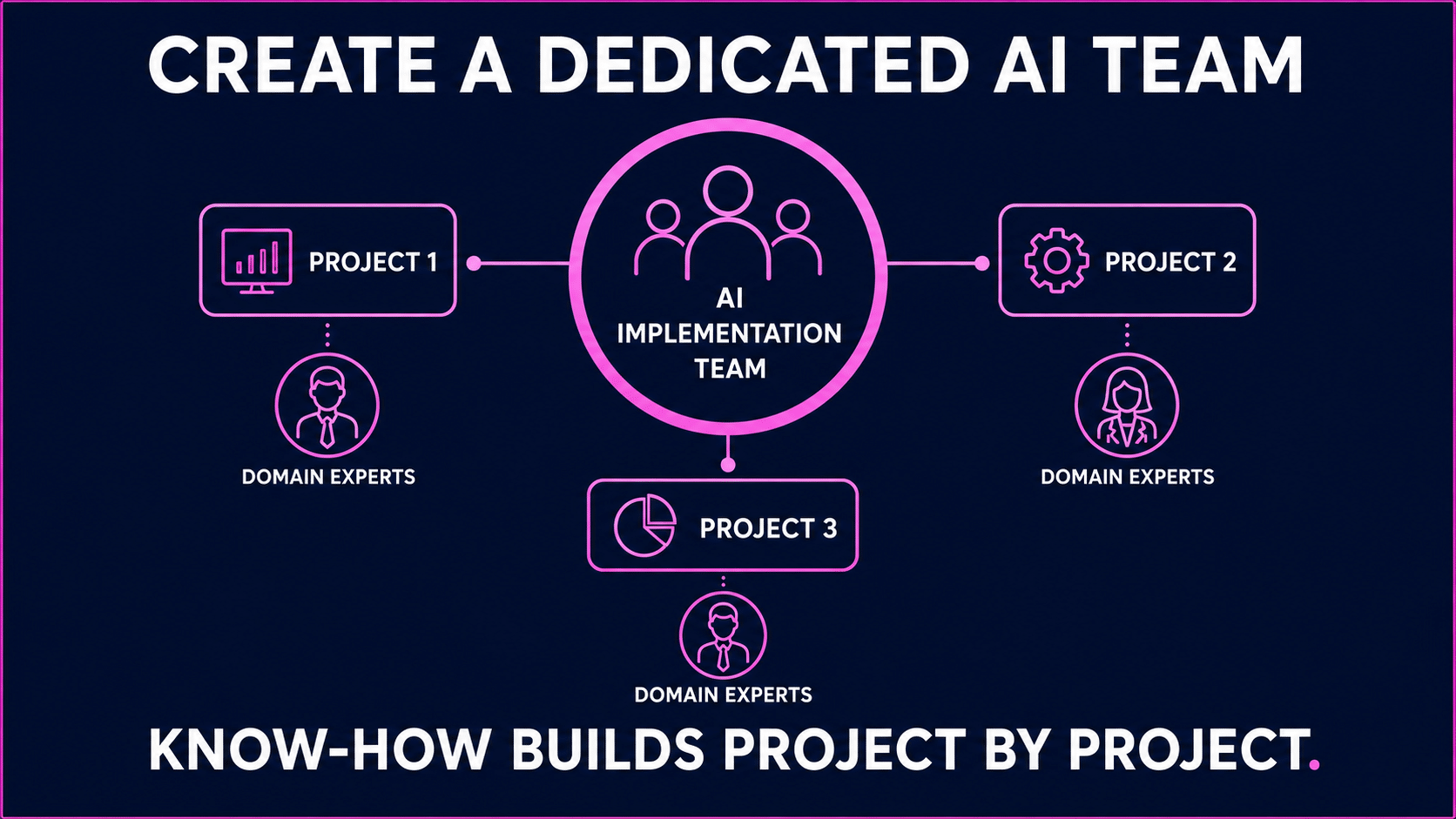
Instead, build a small, dedicated team that carries this expertise across projects — learning from each one and avoiding the same mistakes elsewhere in the organization.
Pair that core team with your most experienced salespeople holding specific knowledge, and you get the combination that works.
Pulling It Together
These ten practices form a connected approach to AI implementation — an approach where you start with the business problem, build the architecture to scale, address the people challenges honestly, and define and measure success from day one.
The organizations that get AI in sales right are the ones that do the unglamorous work properly: the process mapping, the workshops with salespeople, the careful data quality improvements, the honest conversations about what's changing and why.
Implementing AI in Sales is by no means easy. Many organizations don't have the know-how to manage projects internally and instead seek help from experienced consultancies.
If that’s what you’re considering, get in touch with GSP Solutions.(opens in new tab)
Best Practices for Implementing AI in Sales FAQs
Sales team AI projects often go wrong when they're treated as a pure technology rollout rather than a change project. The TSAR level and the specific process being targeted need to be agreed upon first. A few credible reps should be involved early. The pilot needs a real before-and-after measure and a proper time box. Scaling should wait until that pilot has shown something, not just good vibes from the people trying it.
Ownership matters as much as any of that. Someone has to own the adoption specifically, not just the procurement decision. A project delivering a correctly configured tool can still fail if nobody's job is to get reps using it.
- AI in Sales: A Complete Guide for Sales Leaders — The full pillar guide
- The Four Levels of AI Benefit: The TSAR Framework — Understanding what kinds of benefits are available and at what cost
- Why AI in Sales Goes Wrong — The failure modes ARMS RACE is designed to address
- Best Practices for Implementing AI in Sales — Ten practical recommendations from real implementations
- What AI Means for Your Sales Team — Role design, headcount, and the future of B2B selling