

Why AI in Sales Projects Go Wrong (and What to Do Instead)
AI in sales projects usually fail because organizations underestimate the business design, process change, data readiness, and people commitment required—and the specific failure mode changes across the four TSAR levels.
Last updated August 30, 2026

In This Guide
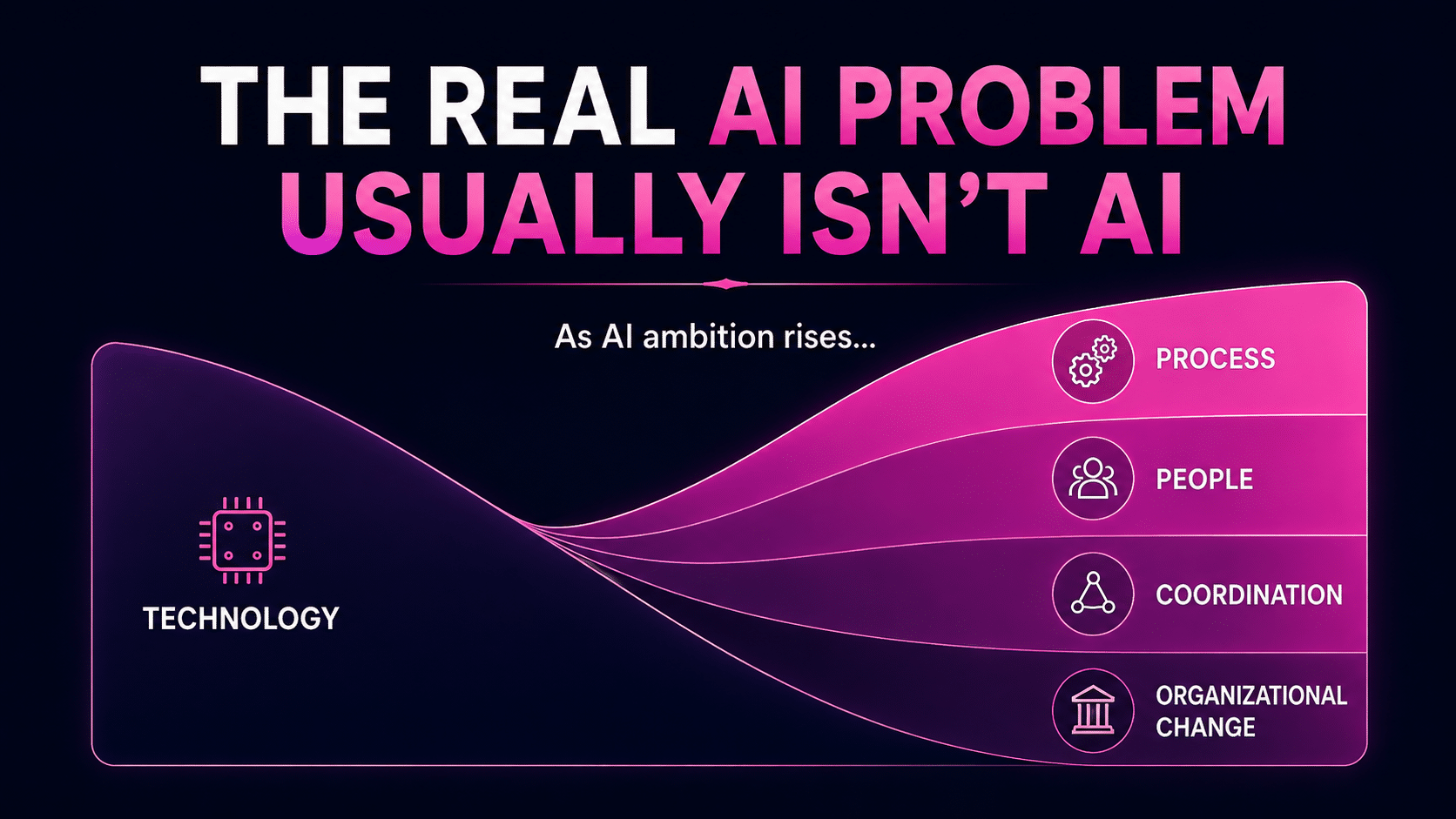
AI in sales team projects rarely fail for technical reasons. They fail because the business design work around them was never done. The pattern differs at each of the four TSAR levels: Table Stakes largely work; Solutions disappoint because vendor-packaged tools lack organizational context; Automation stalls on bottlenecks, data quality, and people; and Reimagine fails for the same reasons any transformation program fails.
A (opens in new tab)2026 Gartner survey(opens in new tab) found ROI returns split almost down the middle: 25% of sales organizations report a return of 50% or more on their AI spend, and 20% report a loss of the same magnitude. Only 30% of CEOs told (opens in new tab)PwC's 29th Global CEO Survey(opens in new tab), published in January 2026, that they felt confident about revenue growth this year, and most said their AI investment had yet to pay off financially.
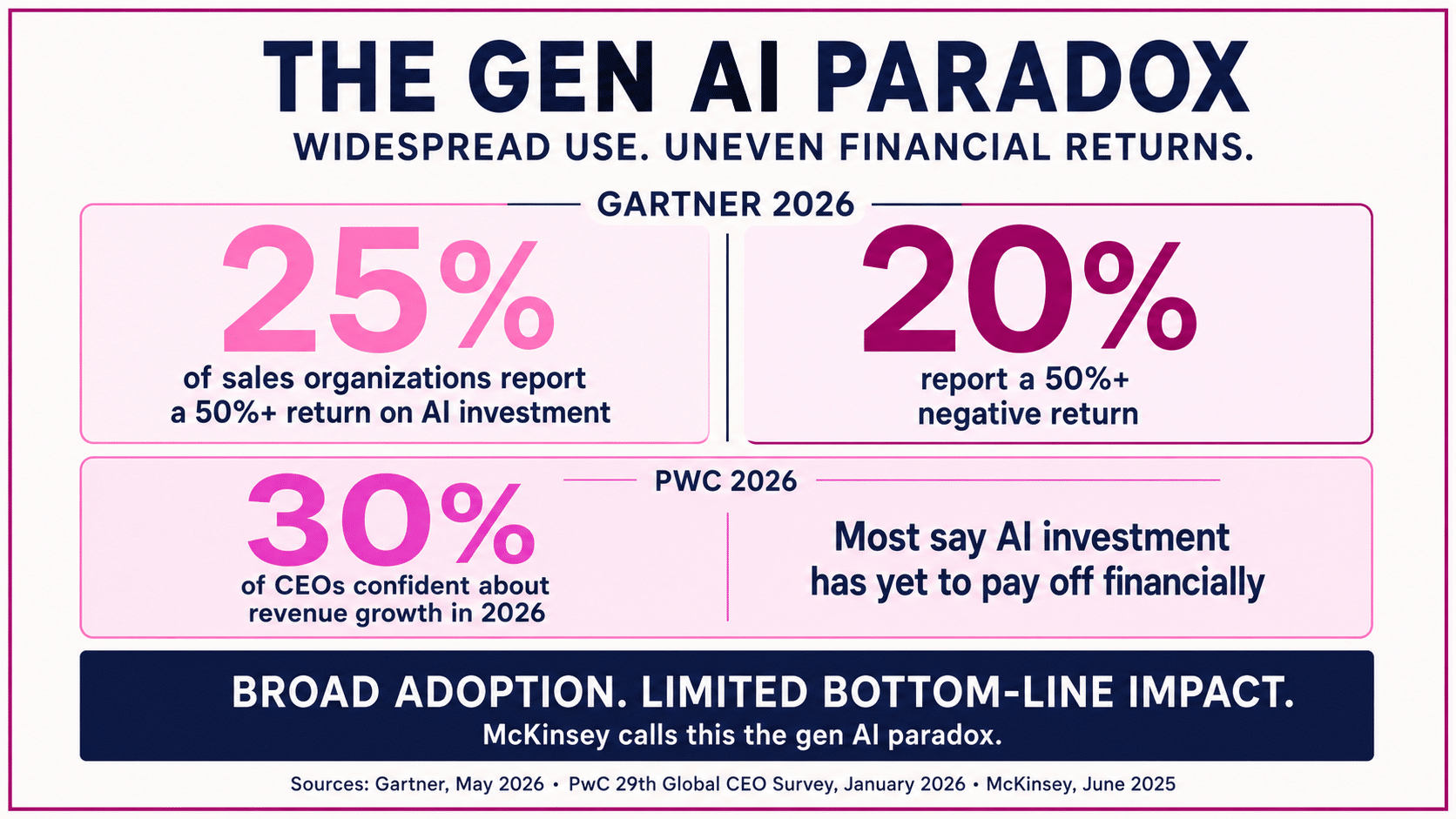
McKinsey, in a June 2025 report, has a name for the gap between how widely AI is used and how little of it translates into bottom-line impact: the gen AI paradox(opens in new tab).
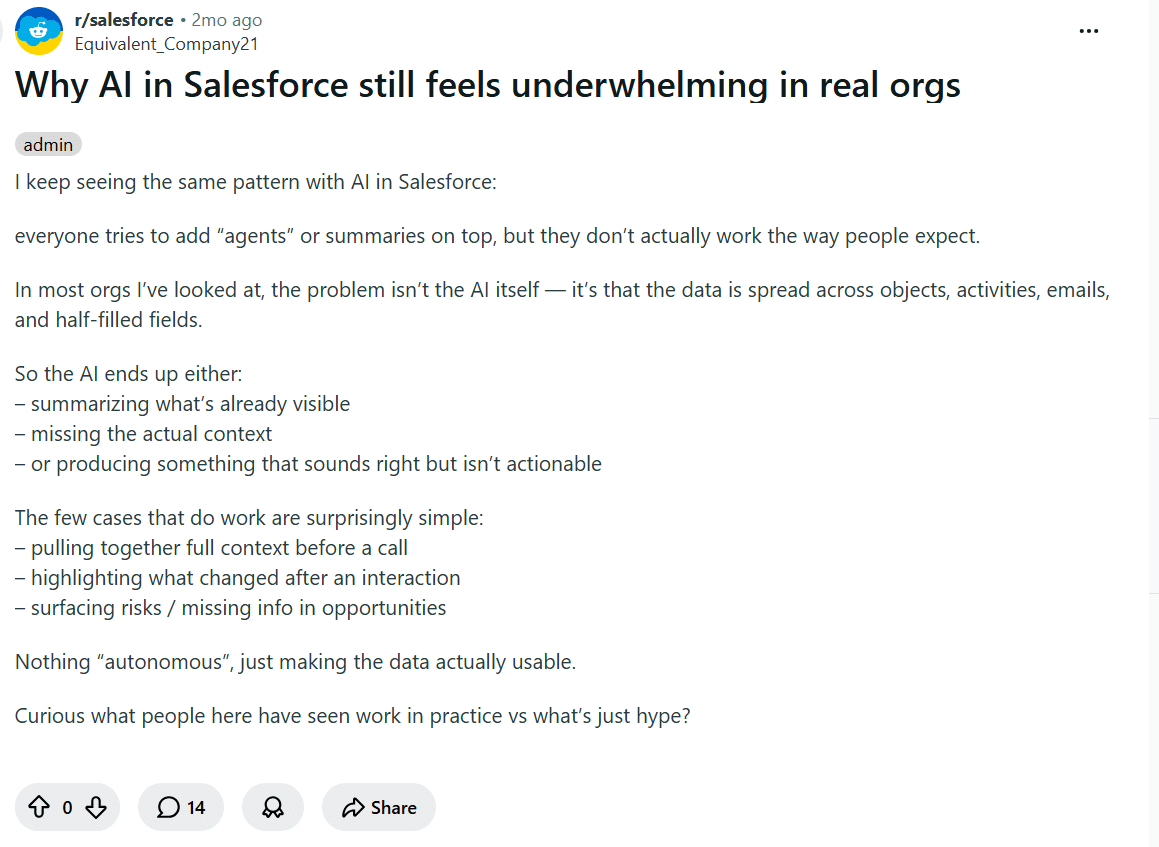
And it's not just the big consultancies saying so. Spend ten minutes on Reddit, and you'll find no shortage of people (opens in new tab)describing their AI implementations in ways that would make a vendor's marketing team wince.
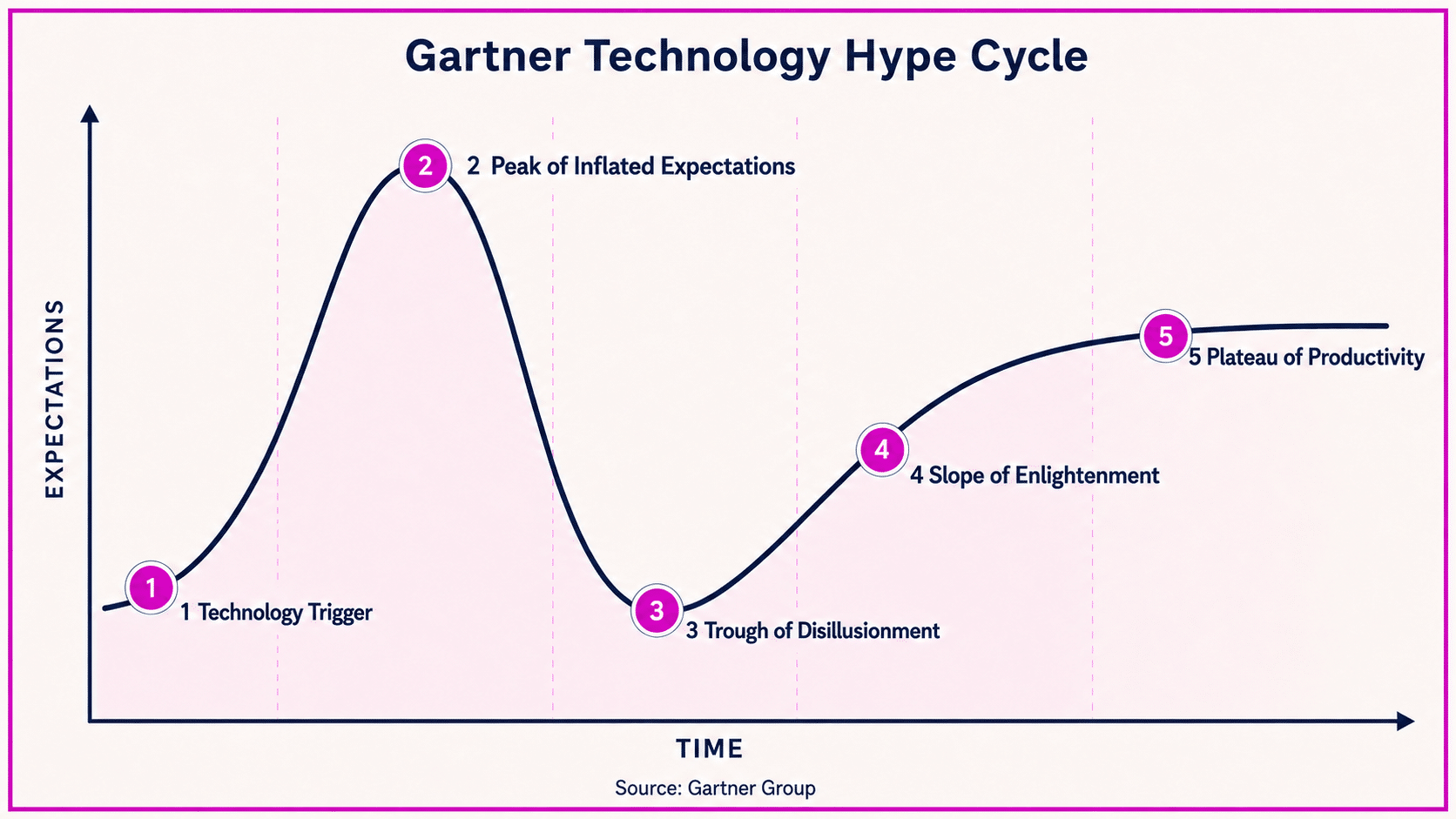
There's a (opens in new tab)recognized pattern to this kind of technology cycle(opens in new tab). Right now, AI in sales has almost certainly passed the peak of inflated expectations stage in Gartner's Hype Cycle and is somewhere in the trough of disillusionment — the uncomfortable middle ground where the hype has faded but the genuine, durable value hasn't fully materialized yet.
The trouble is that most AI-failure research generalizes.
Looking at failure through the lens of the four benefit levels in the TSAR framework gives a much sharper picture of where AI in sales is actually delivering, and where it's letting organizations down — and why.
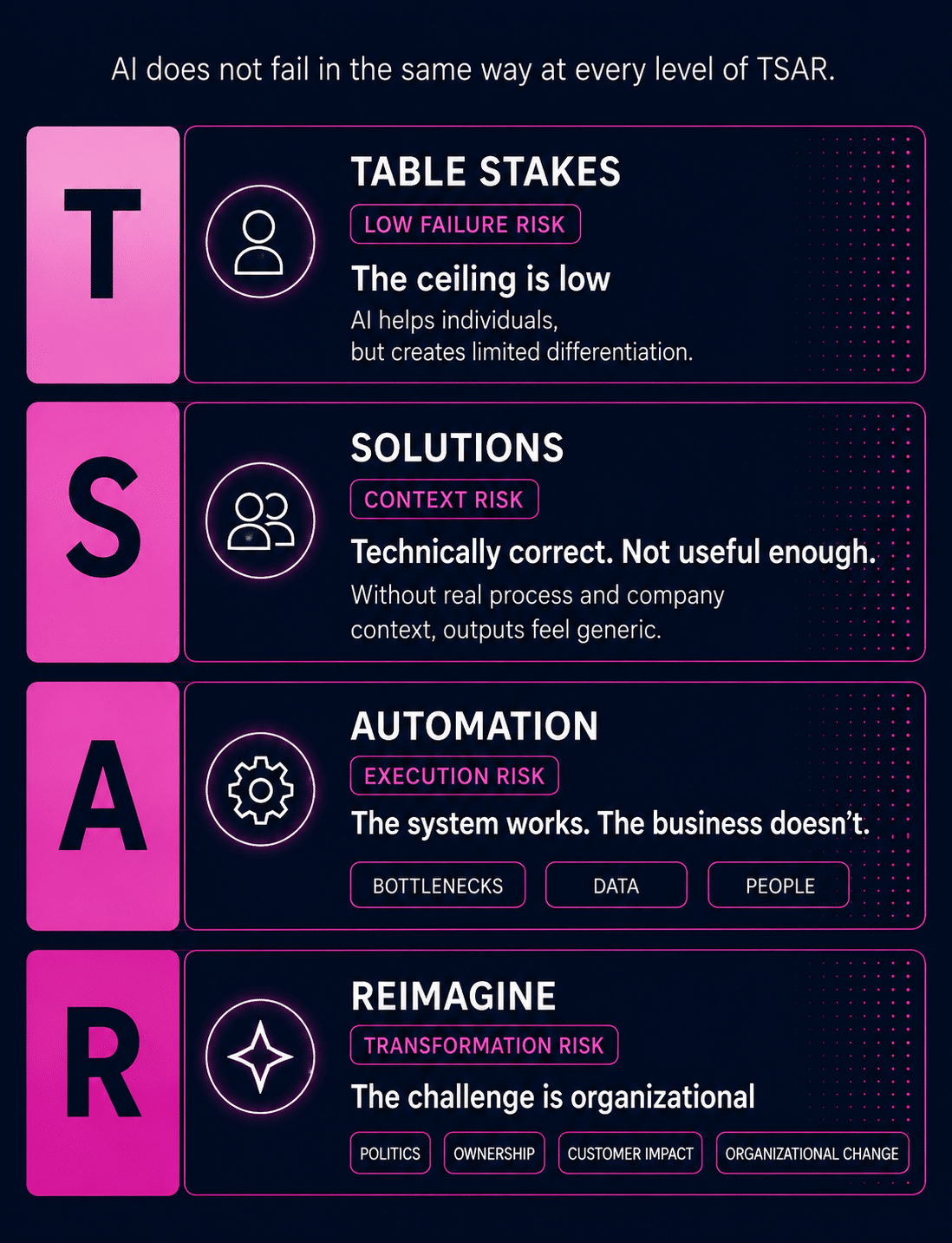
Based on our client experience and a detailed review of independent research, the pattern of failure differs at each level.
Why Does AI at the Table Stakes Level Mostly Work?
Table Stakes is the one TSAR level where AI in sales is broadly succeeding. Adoption happened faster than employers could formalize it, and the tools do what individual reps need. The classic adoption barrier that sinks many technology rollouts never happened.
Salespeople have adopted AI tools — ChatGPT, Claude, Perplexity, and others — with a speed and enthusiasm that has outpaced their employers' ability to keep up.
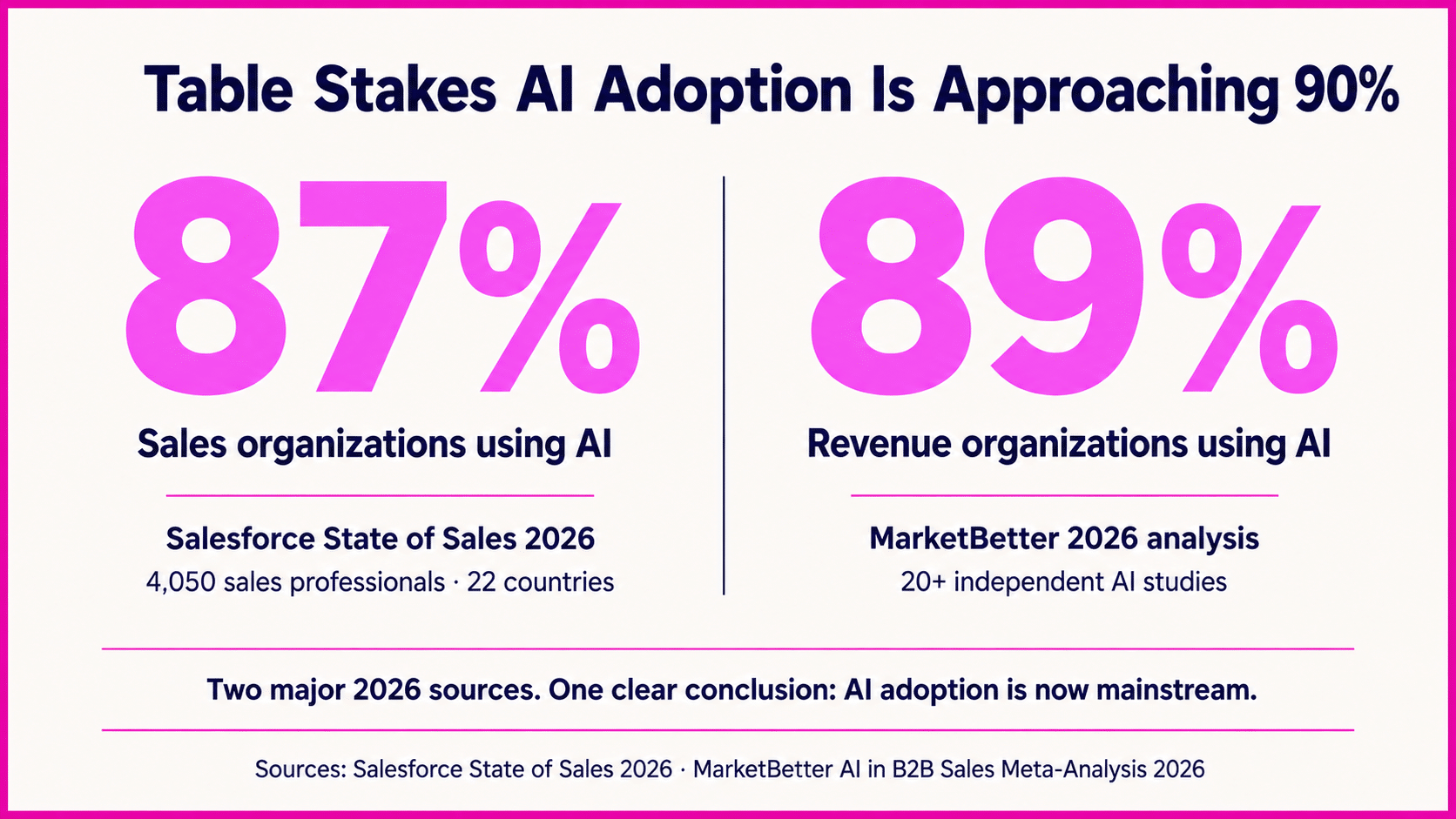
The Salesforce State of Sales Report(opens in new tab), published in February 2026, based on a survey of 4,050 sales professionals across 22 countries, put adoption at 87%. A 2026 analysis by sales technology firm MarketBetter, drawing on more than 20 independent AI studies(opens in new tab), puts the figure at 89%.
Our own experience broadly supports this. B2B salespeople have figured out how to use AI to sharpen emails, improve proposals, and get up to speed on prospects faster than they could before.
Is there room to improve? Yes — particularly around prompt quality(opens in new tab), which we cover in more detail in the Table Stakes section of our guide to the four levels of AI benefit.
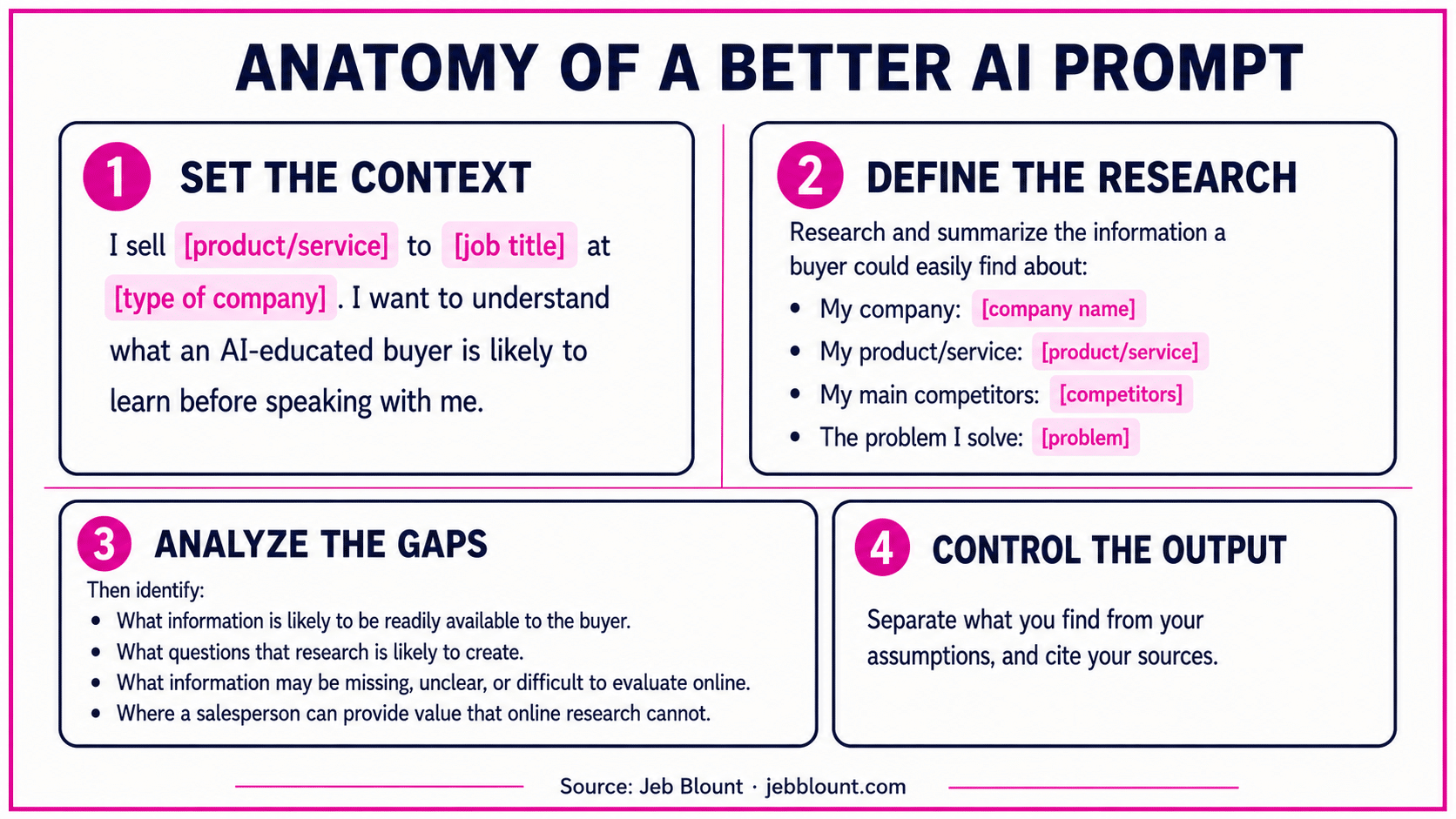
But success at the Table Stakes level only goes so far. The limitation here is that these tools deliver micro-productivity gains available to every salesperson at every competitor, making them individually useful but strategically inert.
The ceiling is low, and clearing it doesn't change outcomes at an organizational level.
So: largely working — but it's the least ambitious — and least interesting — level in the framework. The failures worth studying start one level up.
Why Has the Reception to Solutions-Level AI Been So Cool?
Solutions-level AI underdelivers for one dominant reason: the outputs are too generic to be useful. Vendors package these tools to work across hundreds of clients and industries. Still, without a thorough grounding in an organization's specific sales process, they deliver broad recommendations that a rep could have reached on their own in 30 seconds.
Distrust and professional pride compound the problem, but context is the root of it. A next-best action is only as good as the AI's read on where the deal actually stands and what should happen next.
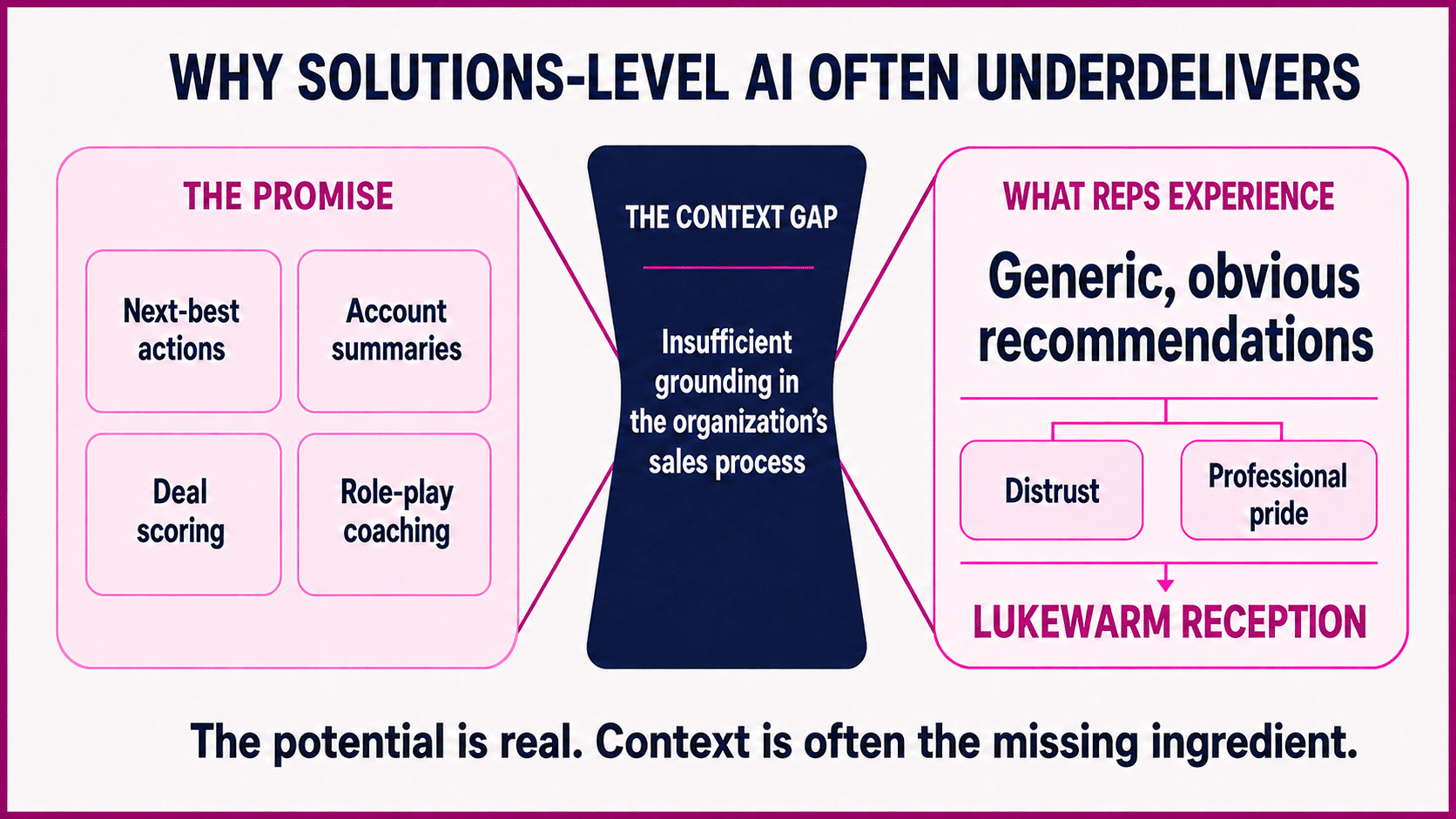
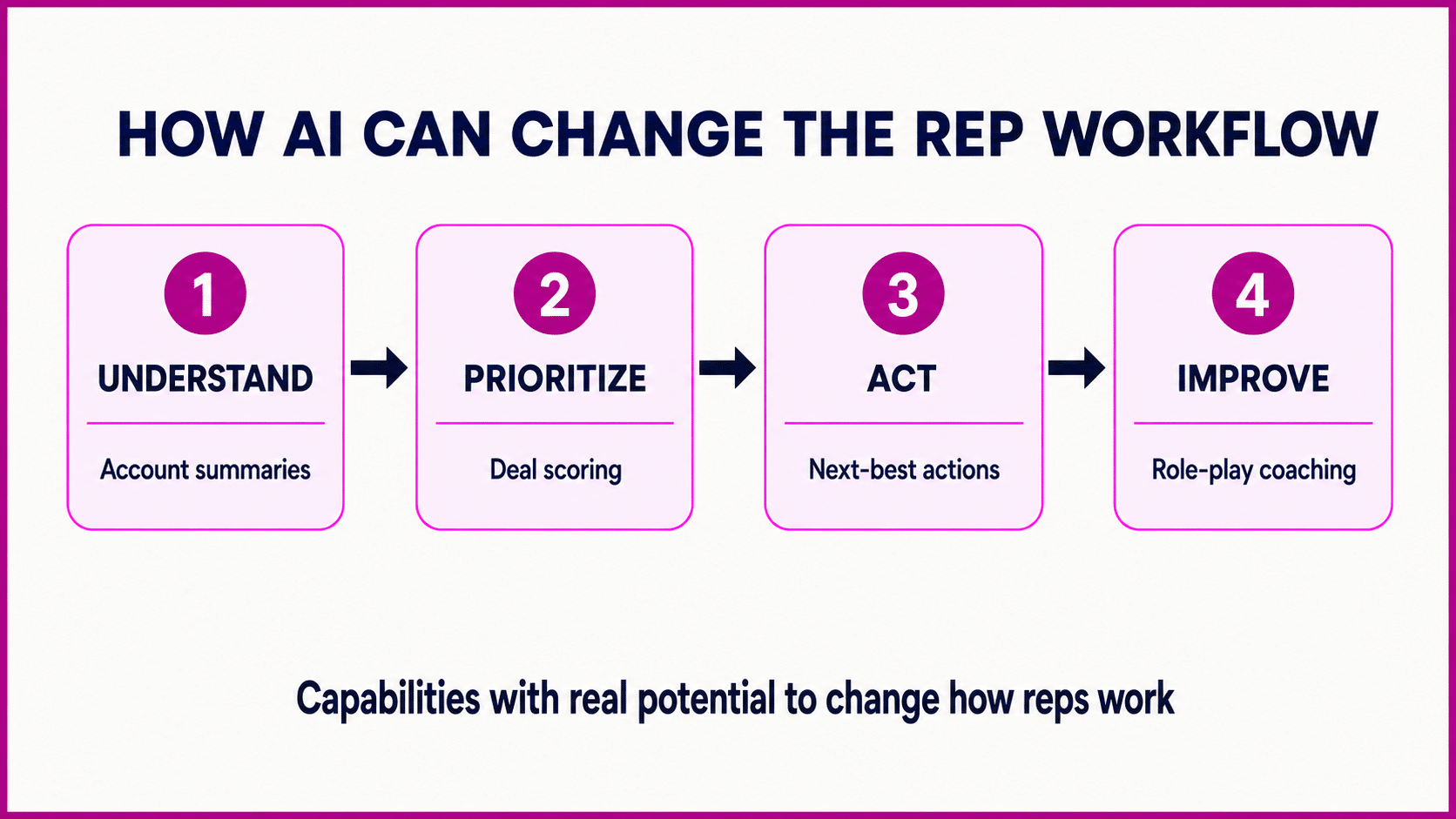
However, on paper, this is where AI in sales should start to get genuinely interesting: next-best actions, account summaries, deal scoring, role-play coaching — capabilities with real potential to change how reps work.
In practice, the results have been mixed, and the reasons are worth understanding.
Many of these implementations begin as pilots. That's a reasonable way to start, but it creates an immediate measurement problem: the scale is too small to attribute hard outcomes — incremental revenue, measurable salesperson productivity gains — with any confidence. So assessment defaults to something softer: are reps using it, and what do they think?
On both counts, the response is often lukewarm.
The reasons for that unenthusiastic reception cluster around three things:
- Distrust. Salespeople who've been burned by a few poor recommendations quickly learn to distrust the system, and once that skepticism sets in, it's hard to shift.
- Professional pride. Experienced sales reps have spent years developing instincts about people, timing, and the unspoken dynamics of a deal. Being told what to do next by software that has never sat across a table from a difficult procurement lead is, for many, not a compelling proposition.
- Outputs that are too generic to be useful. Not wrong so much as obvious: the kind of guidance a rep could have arrived at themselves in thirty seconds. The most common of the three in our experience.
That last point gets to the root of the problem: Most AI solutions at this level are (opens in new tab)pre-packaged by vendors(opens in new tab).
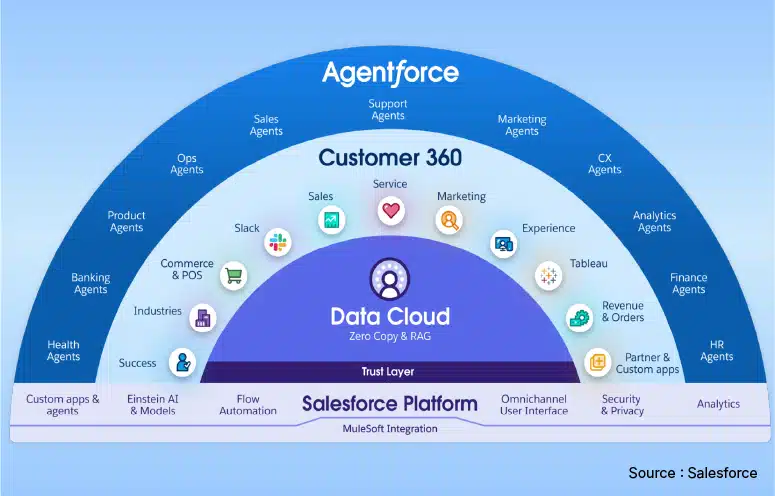
The packaging makes commercial sense — a product built for hundreds of clients and industries has to rely on broad assumptions.
But those assumptions produce results that don't help a rep three months into a complex enterprise deal, navigating internal politics and customer-specific objections.
For AI solutions at this level to be genuinely useful, they need context from multiple sources:
- CRM data
- Emails and call notes
- The rep's own undocumented knowledge of the situation
- The company's sales methodology and playbook
That last input is where organizations come unstuck. A well-defined, consistently applied sales process is rarer than vendors assume, and a written playbook that reflects how reps actually sell — rather than how leadership thinks they sell — is rarer still. Without that foundation, the AI has only limited information to reason from.
None of this means Solutions-level AI is failing outright.
Adoption is growing, the tools are improving, and better implementations — those built with genuine organizational context — are delivering real value.
But right now, the gap between what's being promised and what organizations are experiencing is wider than many vendor presentations suggest.
| Why Solutions-level AI feels generic: packaged vs context-built | ||
|---|---|---|
| Built for | Hundreds of clients across many industries | One organization's actual sales motion |
| Assumptions | Broad, necessarily generic | Specific to the deal, customer, and process |
| Inputs available | CRM fields | CRM, emails, call notes, rep knowledge, sales methodology |
| Typical rep reaction | "I could have worked that out in thirty seconds" | Recommendation reflects where the deal actually stands |
| Prerequisite | A licence | A defined sales process and a playbook that reflects reality |
Why Do Automation Projects Fail More Often?
Automation is where returns become real, but failure rates also climb. When it works, the benefits show up in incremental revenue growth, productivity gains, and genuine cost savings. When it doesn't, the cause is rarely the technology but rather downstream bottlenecks, inadequate data quality, or poor communication about the changes.
This is the level where you can measure the impact of AI implementation rather than rely on a rep's anecdotal sense that their day got a bit easier.
The problem is that getting it right requires a level of organizational commitment that businesses underestimate at the outset.
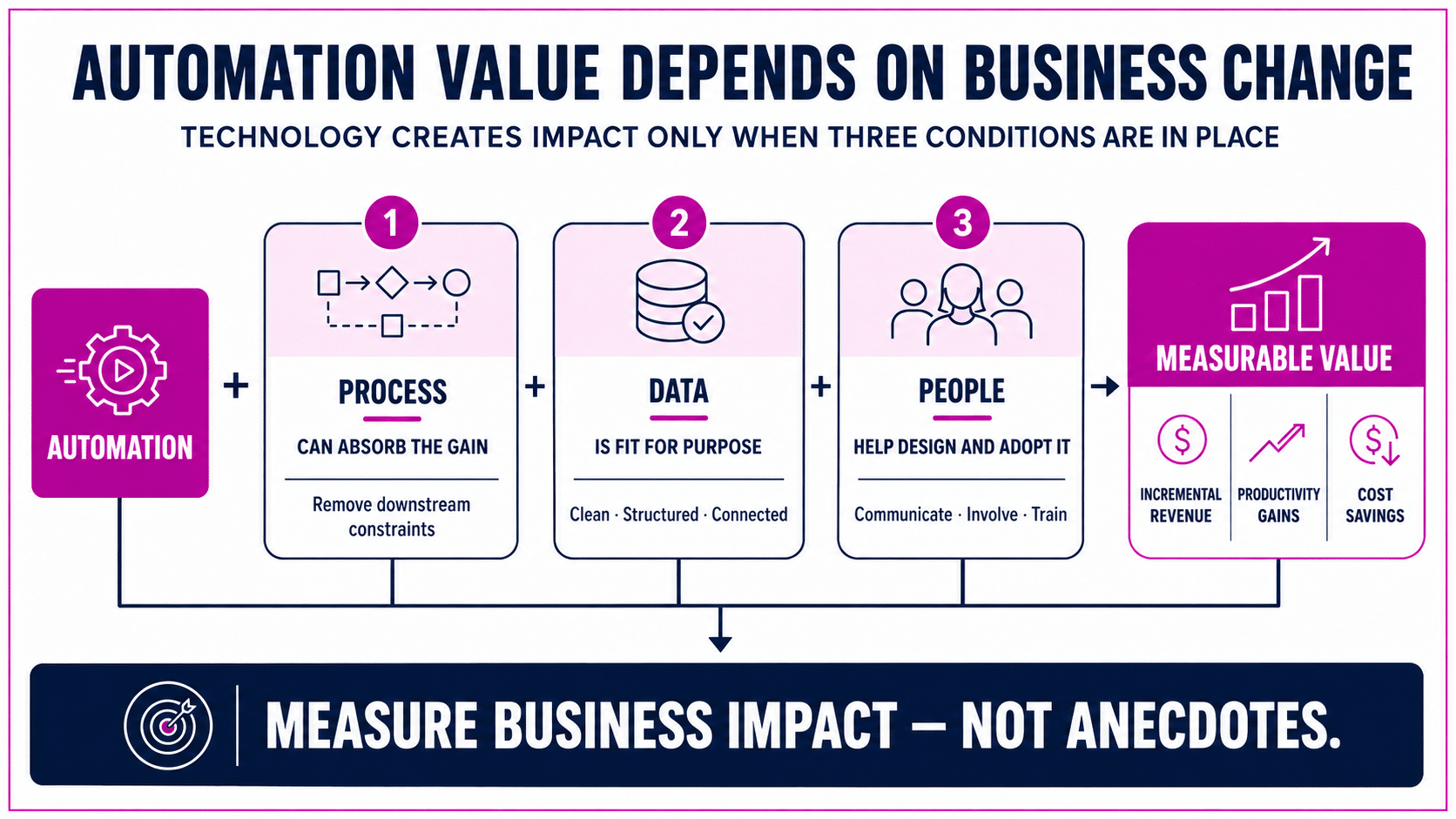
The causes tend to cluster into three broad categories when these projects fall short:
- Bottlenecks elsewhere in the process. The automated piece works exactly as designed, but the benefit gets absorbed by a constraint somewhere downstream that nobody addressed. It's like building a four-lane highway and leaving a congested junction at its end. The throughput improves, but the outcome doesn't, and it becomes hard to make the case for the investment.
- Data quality. Automation projects at this level are hungry for clean, well-structured information. Organizations know their data isn't fit for purpose: unstructured records, duplicates, gaps, and conflicting information spread across systems that were never designed to communicate with one another.
- People. Automation projects that skip meaningful engagement with the sales team during the design phase suffer from low adoption and active resistance. Some of that resistance is rational. Reps aren't going to champion a system they conclude is being built to replace them, which happens without proper communication.
Data quality deserves a word of caution. Almost every organization has data problems, and there's a risk that it becomes a convenient place to park blame when the real difficulties are organizational or political. Poor data is solvable. So, ask whether it was the reason a project stalled, or just the easiest to point to.
Getting the people side right means being honest about the impact early, involving salespeople in the design rather than presenting them with a finished solution, and investing in training that helps people understand how to use the system and why it was built the way it was.
What Makes Reimagine Projects the Hardest to Get Right?
At the Reimagine stage, the Automation-level challenges compound, and new ones arrive. They include budget politics, employee fears about role replacement, customer disruption, and competitors running similar AI on similar data converging on the same decisions, which erodes the very differentiation the project was meant to create.
Reimagine-level projects are, by definition, end-to-end business transformation projects.
Few organizations are attempting change at this level yet. The technology is still maturing, and the collective understanding of how to design and execute these projects is still developing. That will change — but for now, Reimagine remains the frontier, and the frontier is unforgiving of half-measures.
The failure modes here will be familiar to anyone who has led a major transformation program.
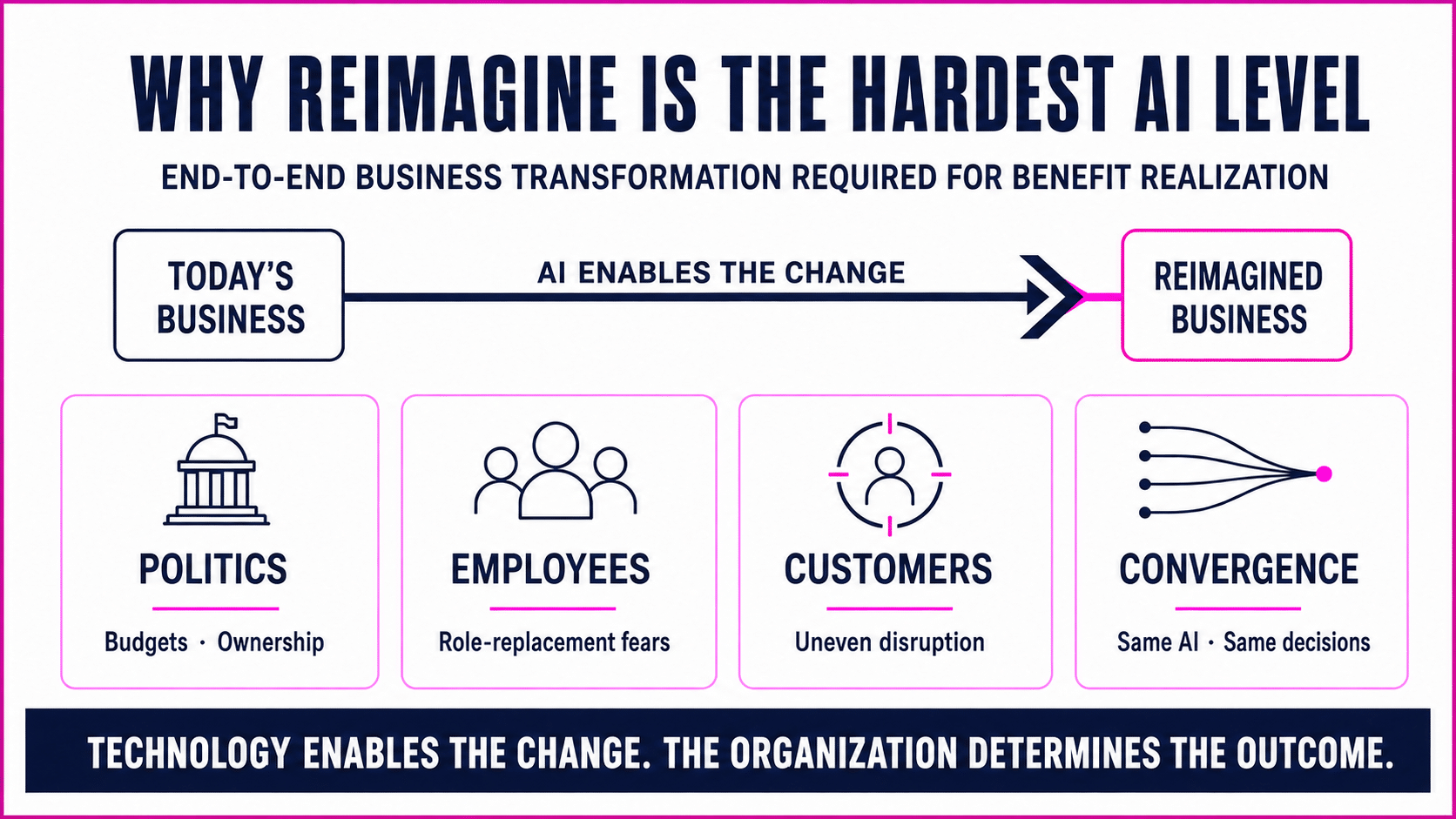
Organizational change fails for organizational reasons:
- Politics. Budget disputes, arguments over ownership, stakeholders who engage enthusiastically in the early stages and disengage when the implications become real: these are people problems, not AI ones, and no amount of technical sophistication resolves them.
- Employee concerns. Reimagine-level projects raise genuine questions about whether certain roles will exist at all, and whether whole departments retain their current relevance. How you talk about transformation can cause irreparable damage to the project, as the CEO of Standard Chartered, Bill Winters, learned the hard way.(opens in new tab)
- Customer impact. Many Reimagine projects aim to improve the customer experience, but not every customer segment will benefit equally. Managing the customer side of a Reimagine project deserves as much deliberate attention as managing the internal one.
There is also a risk specific to this level of AI deployment — and design conversations rarely account for how far along it already is.
When multiple organizations in the same market use the same AI tools, trained on similar data and optimized for similar outcomes, their systems can independently arrive at the same decisions. Harvard Business Review (May 2026)(opens in new tab) named this the agentic convergence trap: independent agents acting autonomously who effectively synchronize behavior across a market without any explicit coordination.
The result is the erosion of the competitive differentiation the project was supposed to create — and, in some cases, regulatory scrutiny.
What Pattern Connects Failure Across All Four TSAR Levels?
At every level of the TSAR framework, the technology itself is rarely the primary cause of failure.
Table Stakes works because the technology is genuinely accessible, easy to use, and useful. Solutions struggle because organizations haven't done the business design work needed to make it contextually relevant. Automation fails on data, bottlenecks, and people. Reimagine fails because organizations fail to achieve the level of stakeholder buy-in required, and treat it as a technology project rather than a transformation.
| Why Solutions-level AI feels generic: packaged vs context-built | |||
|---|---|---|---|
| Table Stakes | Working, but capped | Nothing to fix; the low ceiling is the point | Low: a missed edge, not lost money |
| Solutions | Lukewarm uptake | Generic advice with no read on the actual deal | Moderate: stalled tools and sunk licence cost |
| Automation | Real gains, or costly misses | Downstream bottlenecks, dirty data, teams left out of the design | High: visible spend that's hard to defend |
| Reimagine | Frontier, rarely attempted | Run as a technology project, not a transformation | Highest: the whole operating model |
The pattern is consistent: the further up the framework you go, the more the failure causes shift from technical to organizational, and the more expensive the consequences become.
The implication is that fixing AI in sales is both a business design and organizational problem, not purely a technology one.
The failure reasons described in this article are the starting point for GSP's ARMS RACE framework, our approach to building AI for sales that addresses these failure modes directly. Read the full guide for the complete picture.
Where to Go From Here
At GSP Solutions, AI in sales implementation is core to what we do — built on decades of Salesforce consultancy and deep expertise in how B2B sales organizations work.
Whether you are at the very beginning of the AI implementation journey, have already tried but haven't realized the benefits, or are ready to move fast and are looking for the expertise to get there without reinventing every wheel, we can help. Get in touch or scan the QR code and book a free call.

AI in Sales Project Failure FAQs
AI adoption has surged to 81% in just two years(opens in new tab). Performance for many teams hasn't kept pace with it. Usually, the reason is a bolt-on approach, a handful of point solutions stacked on top of each other, none of them talking to one another, so you end up with more admin work and more data silos rather than less.
Adoption of the tool is critical, however. Many Solutions-level tools offer real productivity gains on paper, yet they often fail to deliver the anticipated benefits because reps never embraced them. A tool nobody uses is worth nothing, no matter how the demo looked.
- AI in Sales: A Complete Guide for Sales Leaders — The full pillar guide
- The Four Levels of AI Benefit: The TSAR Framework — Understanding what kinds of benefits are available and at what cost
- The GSP ARMS RACE Framework — How to build AI in B2B Sales the Right Way — The four Design Pillars and four Architecture Layers explained in full
- Best Practices for Implementing AI in Sales — Ten practical recommendations from real implementations
- What AI Means for Your Sales Team — Role design, headcount, and the future of B2B selling