

A Guide to Forecasting Recurring Revenue
Learn how to forecast recurring revenue. Discover 4 recurring revenue forecasting strategies, best practices, and get our recurring revenue forecast template.
Last updated October 22, 2026

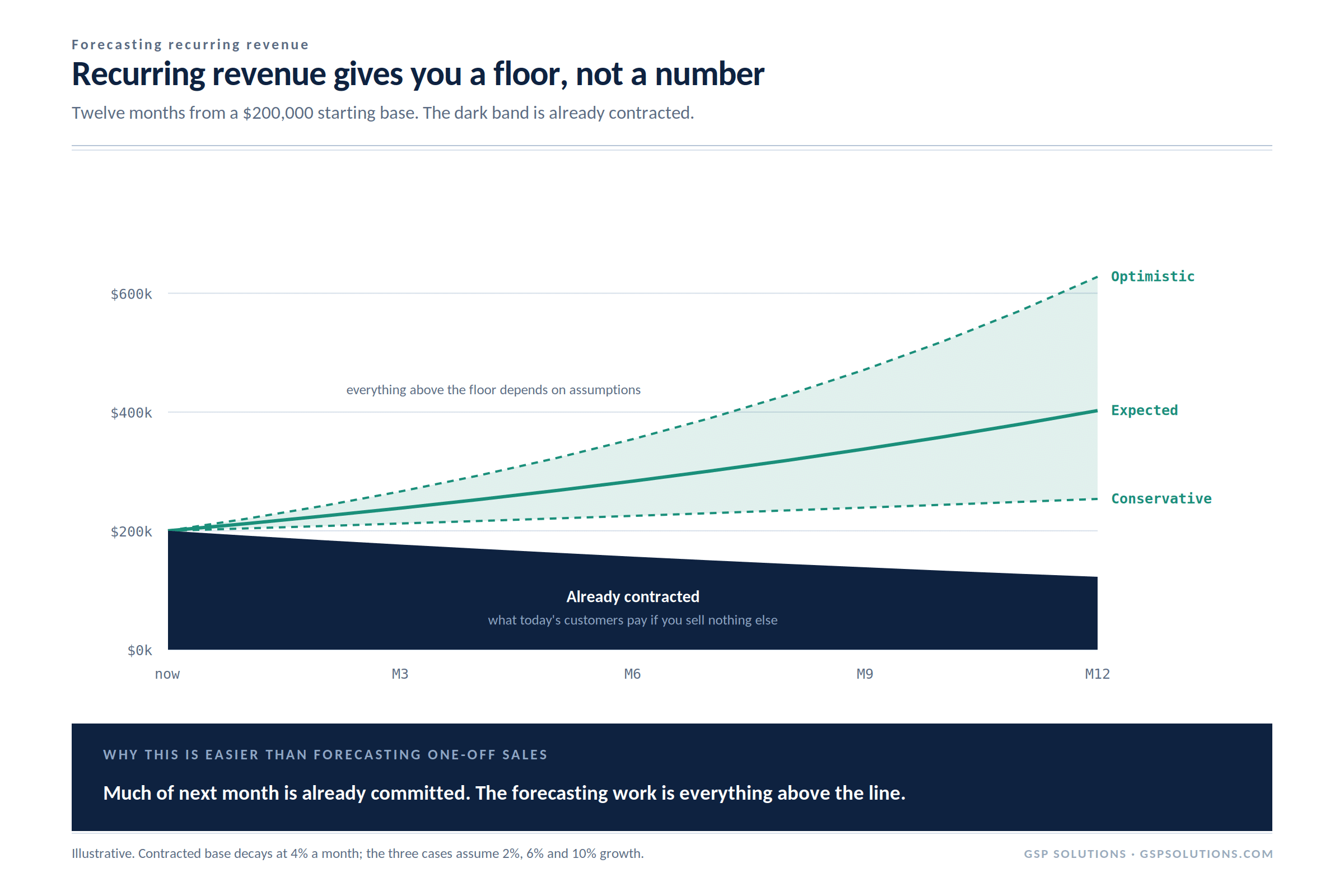
Businesses use various methods to forecast their recurring revenue, including:
- Cohort forecasting
- Churn-adjusted forecasting
- Expansion revenue forecasting
- Scenario planning
In this guide, we explain how each one works, what inputs they need, and when to use each. We also provide a simple MRR forecast template and share best practices for recurring revenue.
Forecasting is one area where recurring revenue businesses have a genuine advantage. Because much of next month’s revenue is already committed through existing contracts, forecasting is inherently more reliable than for a business relying purely on new sales.
The article helps you choose the right model and implement it effectively for reliable revenue forecasting.
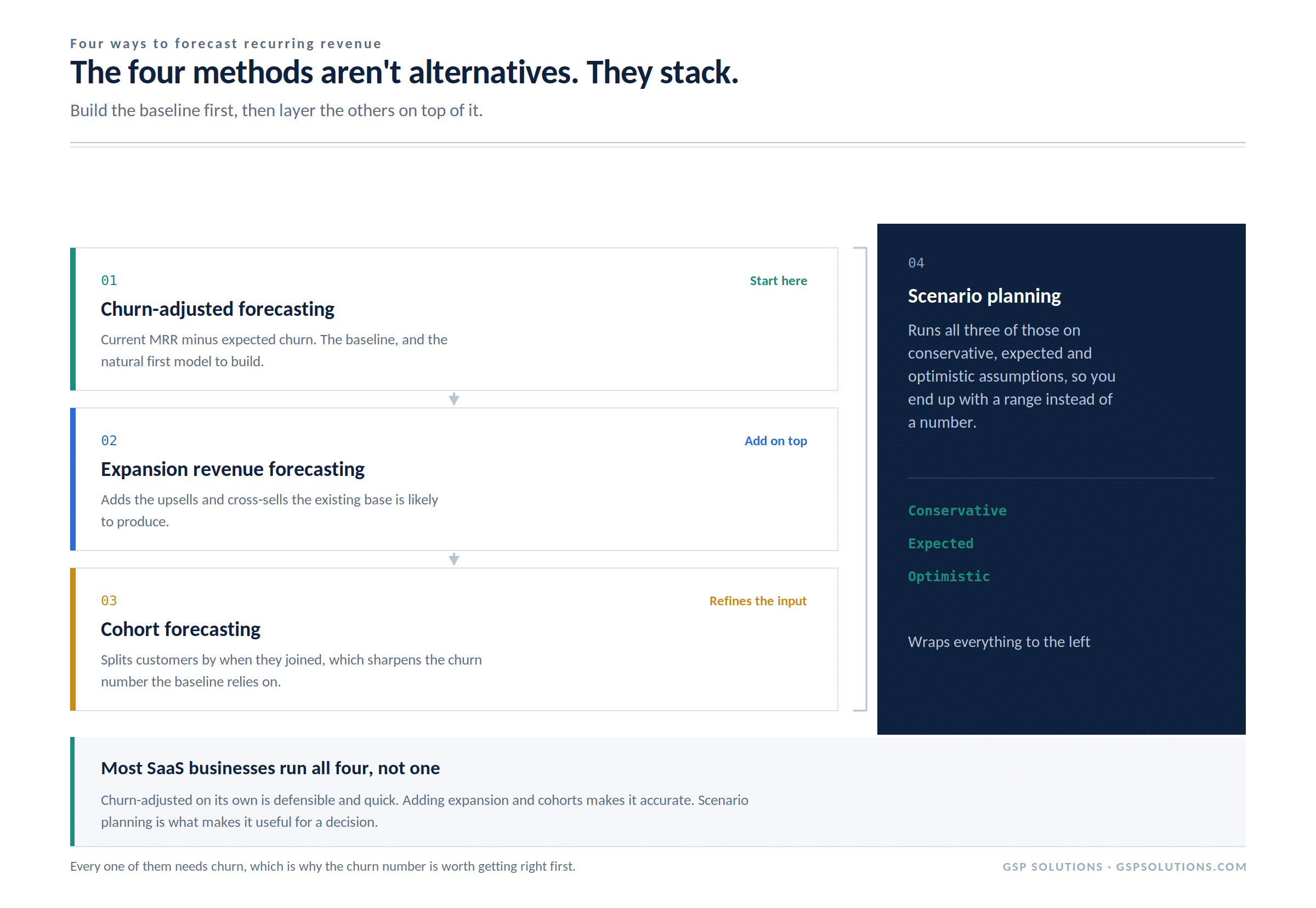
Recurring Revenue Methods at a Glance
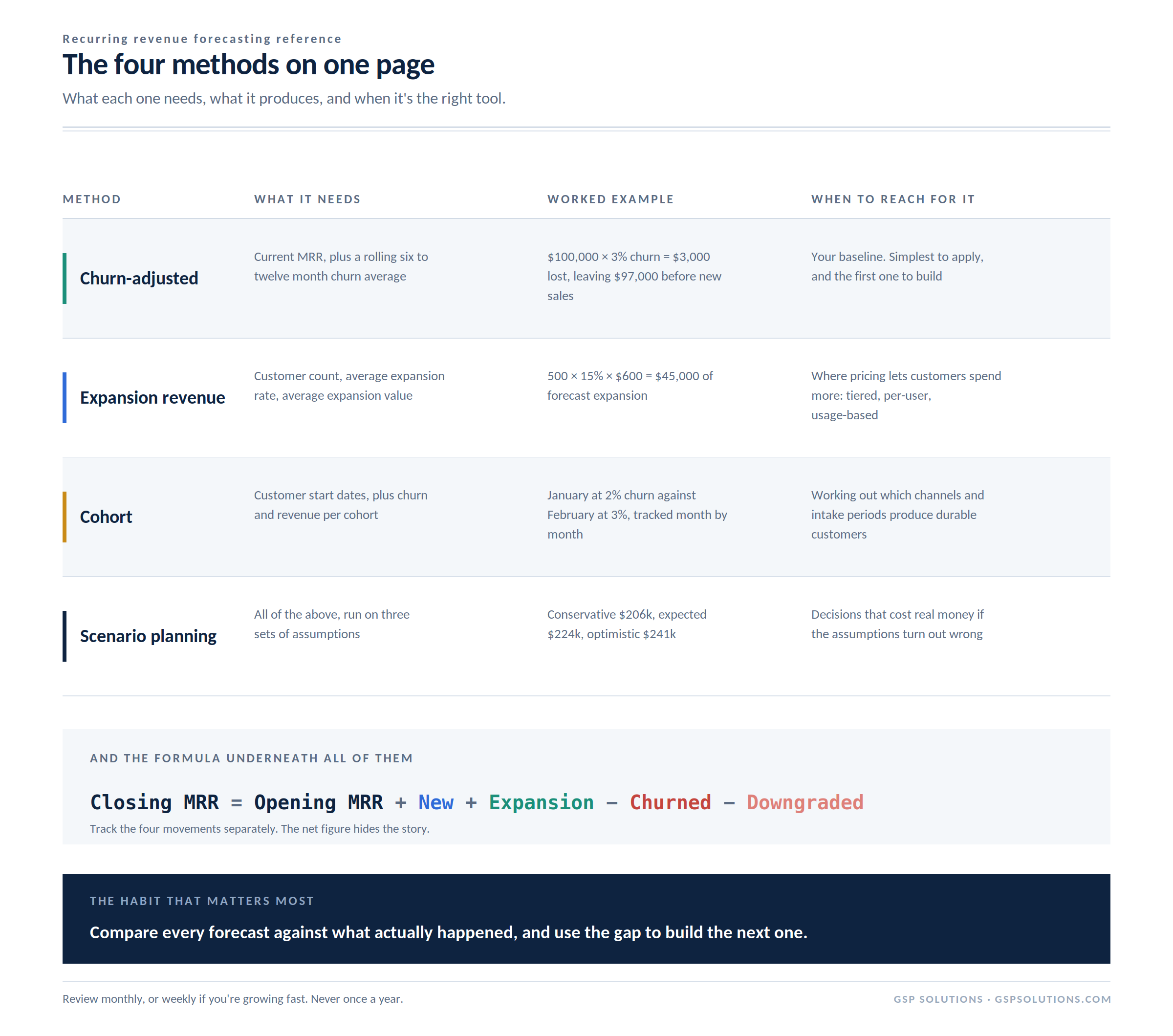
| Cohort forecasting | Group customers by when they joined, then track how each group's revenue changes over time. | Customer start dates, plus churn and revenue per cohort | Working out which acquisition channels and intake periods produce the most durable customers |
| Churn-adjusted forecasting | Current MRR, and a rolling six to twelve-month churn average | A fast, defensible baseline. The simplest of the four to apply | Added complexity; risk of downgrades; the feature split between tiers is hard to get right |
| Expansion revenue forecasting | Projects the additional revenue likely to come from upsells and cross-sells into the existing base | Customer count, average expansion rate, average expansion value | Businesses where growth from existing accounts is material |
| Scenario planning | Builds conservative, expected, and optimistic versions of the forecast rather than a single number | All of the above run on three sets of assumptions | Decisions that hinge on how the future actually unfolds |
Cohort Forecasting
Cohort forecasting groups customers by when they first became customers, then tracks how each group’s revenue changes over time.
Rather than treating every customer as identical, it recognizes that groups that joined at different points often behave differently.
For example, a cohort acquired through a paid campaign might churn at a different rate than one acquired through referral.
| January | 140 | 2% |
| February | 93 | 3% |
| March | 125 | 1.6% |
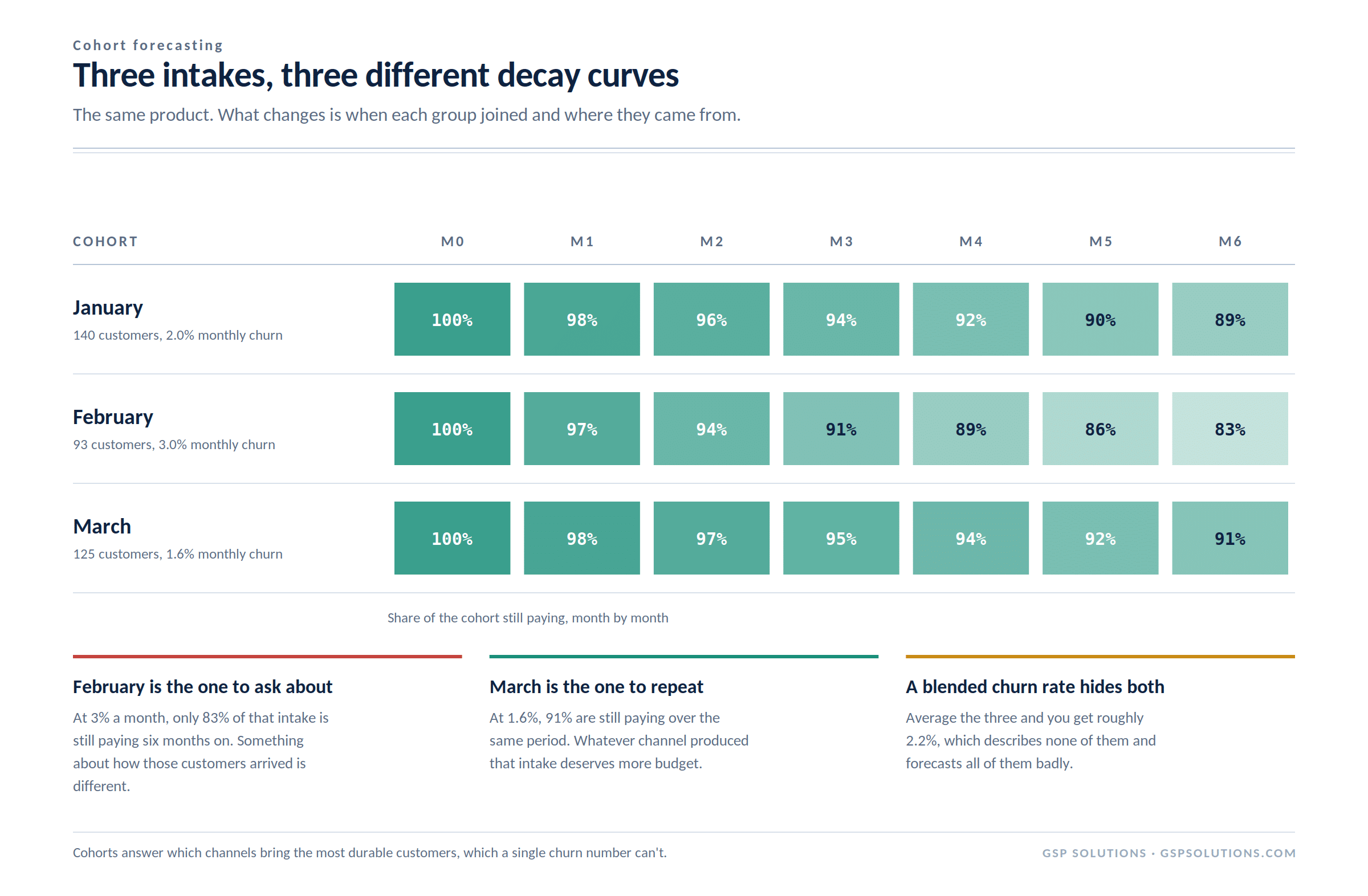
Tracking cohorts this way helps answer questions like which acquisition channels bring in the highest-value customers, which groups renew most reliably, and how customer lifetime value trends across different intake periods.
Best for: SaaS businesses, subscriptions, memberships, and any business with a growing customer base.
Churn-Adjusted Forecasting
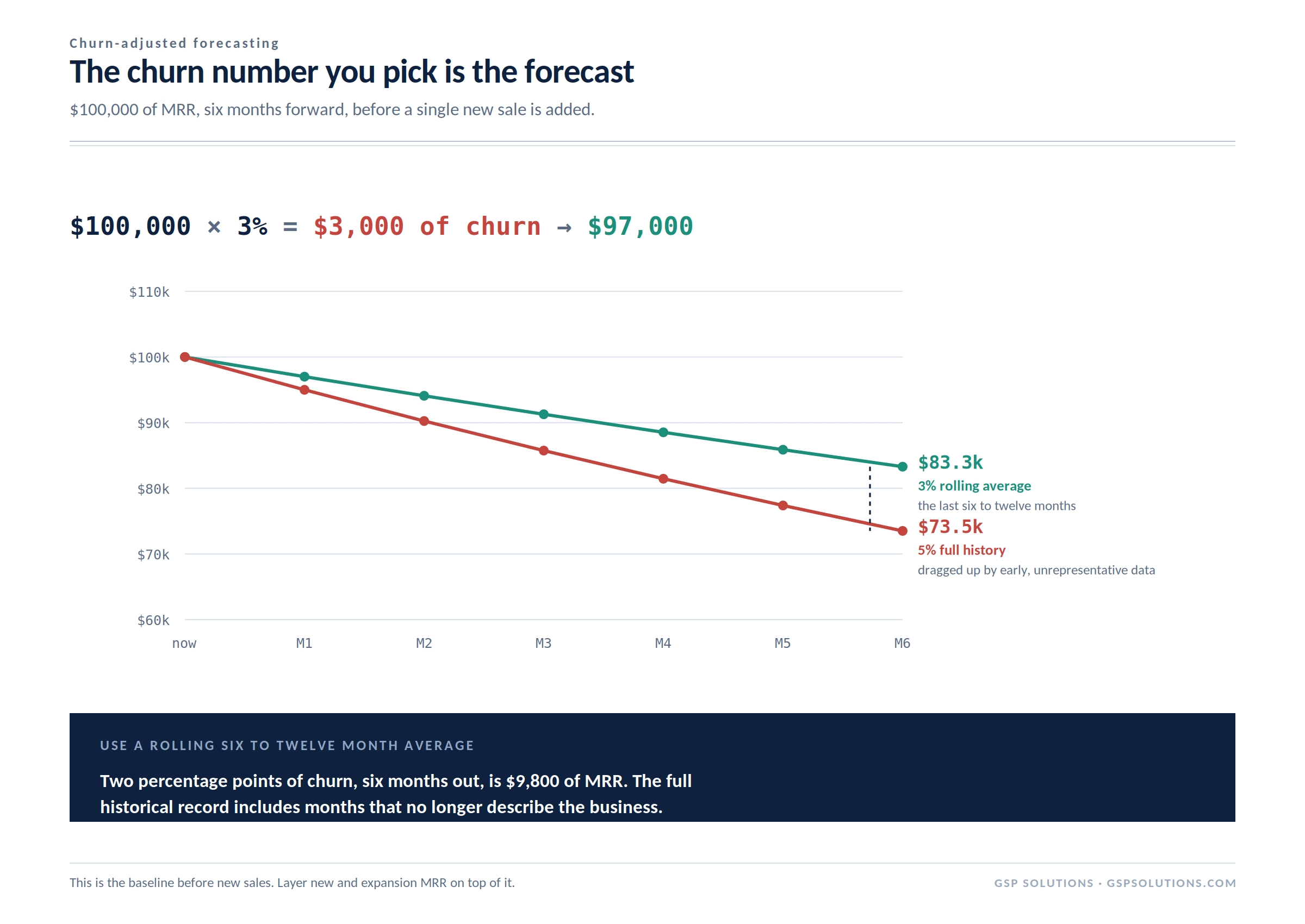
Churn-adjusted forecasting uses monthly recurring revenue (MRR) and average churn rate to project future monthly revenue.
If the current MRR is $100,000 and the average monthly churn is 3%, the expected churn next month is $100,000 × 3% = $3,000, leaving a projected MRR of $97,000 before any new sales are added.
Best practice is to use a rolling six- to twelve-month average for churn rather than the full historical record, so the forecast reflects recent performance. It doesn’t get skewed by early, less representative data.
Every recurring revenue business experiences some churn, so churn-adjusted forecasts give you a more realistic picture of what you can expect in the following months.
Best for: any recurring revenue business with six months or more of churn history; it's the simplest of the four to apply, and the natural first model to build before layering others on top.
Expansion Revenue Forecasting
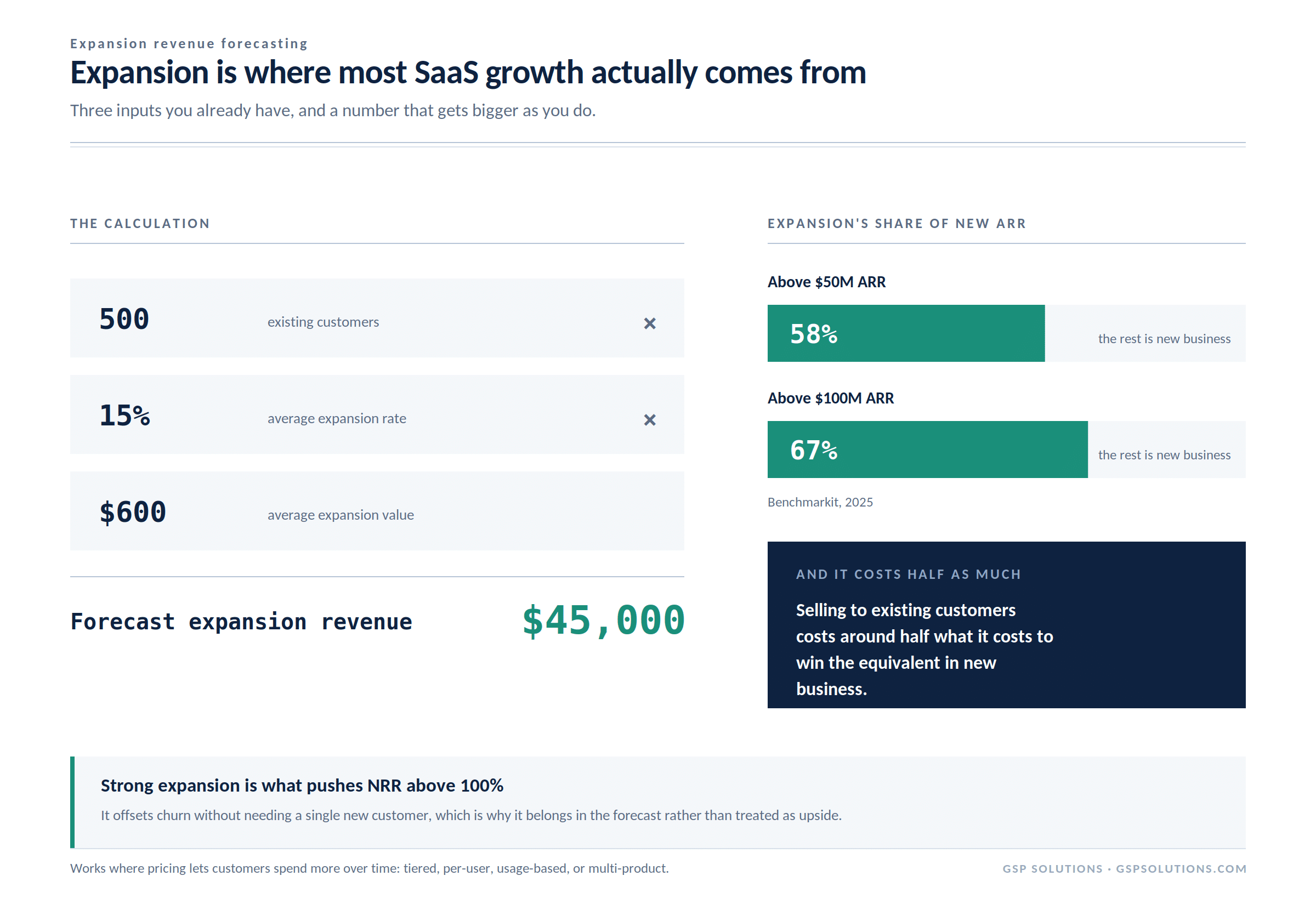
Expansion revenue forecasting uses historical data on how much existing customers typically expand their spend to project the additional revenue likely to come from upsells and cross-sells.
For example, 500 existing customers, an average expansion rate of 15%, and an average expansion value of $600 per customer, give a forecast expansion revenue of 500 × 15% × $600 = $45,000.
Strong expansion revenue is often what pushes Net Revenue Retention above 100%, effectively offsetting the impact of churn. What’s more, selling to existing customers 50% of what it costs to acquire the equivalent in new business, according to Benchmarkit’s 2025 data.
Which is why businesses focus on growing revenue from existing customers as much as on winning new ones.
Best for: businesses whose pricing lets customers spend more over time, like tiered, per-user, or usage-based models, and anyone selling more than one related product.
Scenario Planning
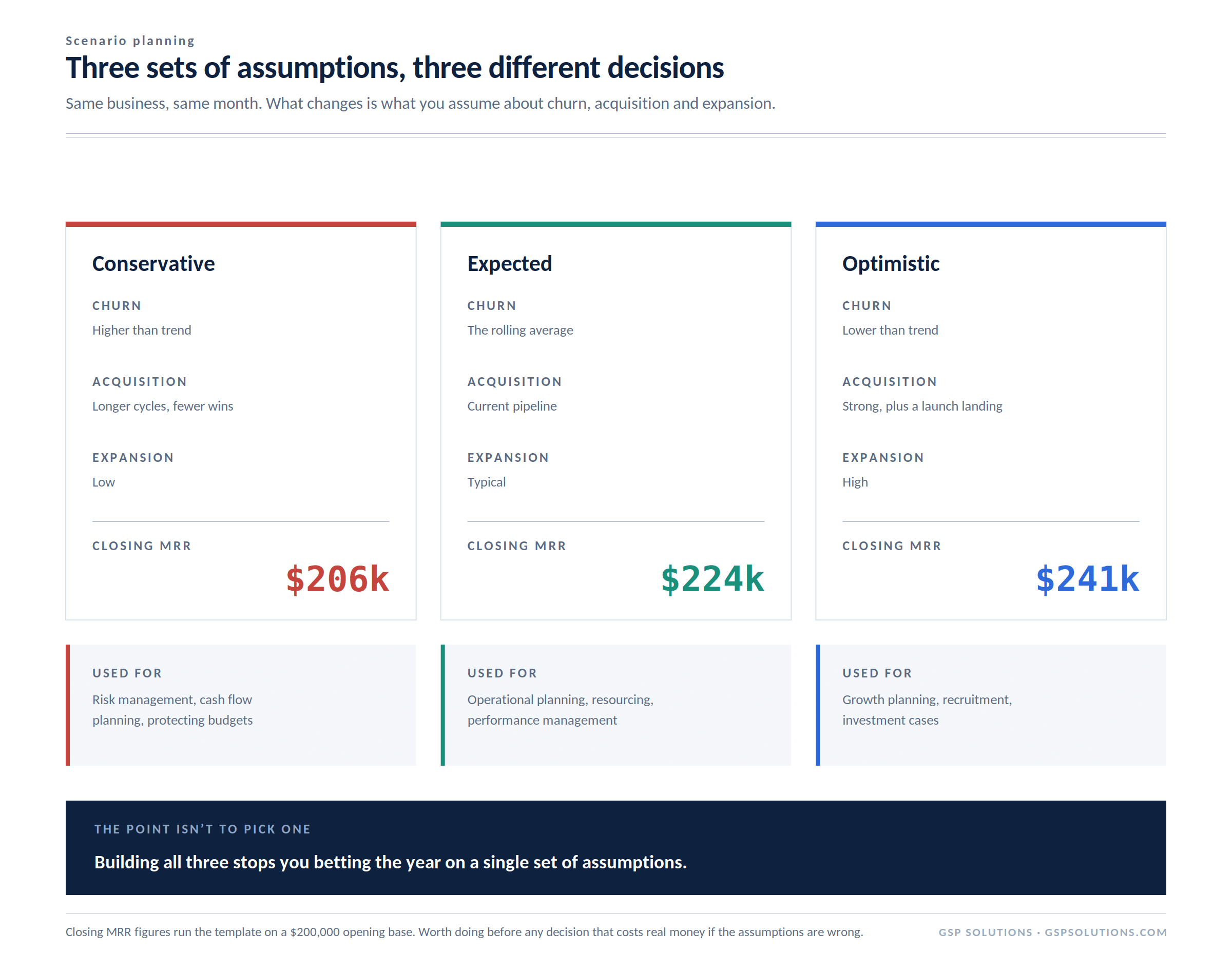
Scenario planning builds three versions of the future:
- Conservative — assumes higher churn, longer acquisition cycles, and low expansion revenue. Used for risk management, cash flow planning, and protecting budgets.
- Expected — based on historical data, current pipeline, average churn, and typical expansion revenue. Used for operational planning, resourcing, and performance management.
- Optimistic — assumes strong acquisition, lower churn, higher expansion, and successful product launches. Used for growth planning, recruitment decisions, and evaluating investment scenarios.
Building all three means you don’t rely on a single model or assumption and gives you the broadest possible view before making decisions.
Best for: decisions that carry real cost if the assumptions turn out wrong, like annual budgets, hiring plans, and investment or fundraising cases.
A Simple MRR Forecaste Template
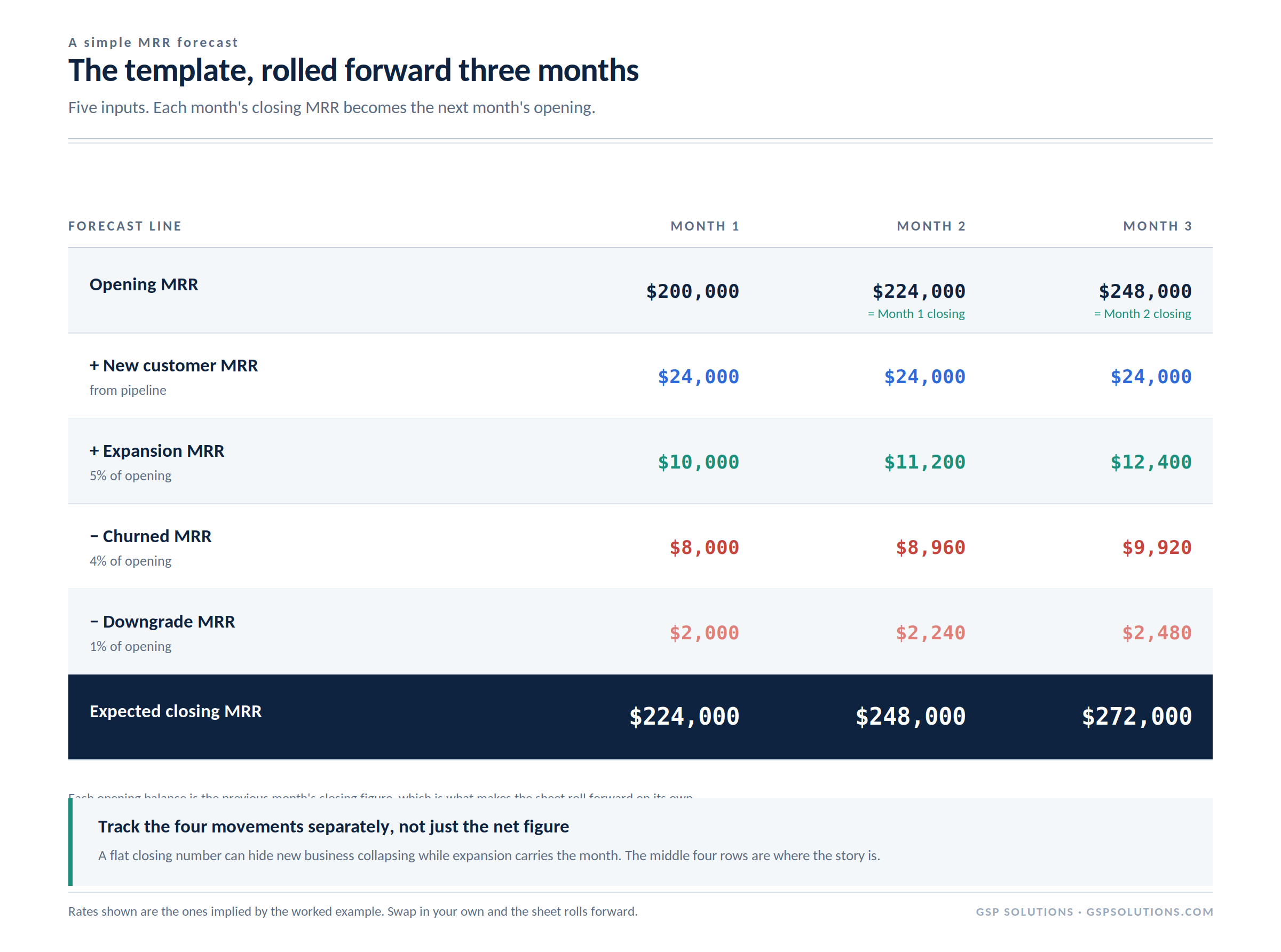
You can build a closing MRR forecast from five inputs:
Closing MRR = Opening MRR + New MRR + Expansion MRR − Churned MRR − Downgraded MRR
| Opening MRR | $200,000 |
| + New customer MRR | $24,000 |
| + Expansion MRR | $10,000 |
| − Churned MRR | $8,000 |
| − Downgrade MRR | $2,000 |
| Expected closing MRR | $224,000 |
Every MRR forecast is anchored on two reference points. Opening MRR is the recurring revenue already on the books on day one of the period, before anything moves. Closing MRR is what's left after new customers, expansions, churn, and downgrades have been applied.
Recurring Revenue Forecasting Best Practices
Businesses that forecast recurring revenue well follow these best practices:
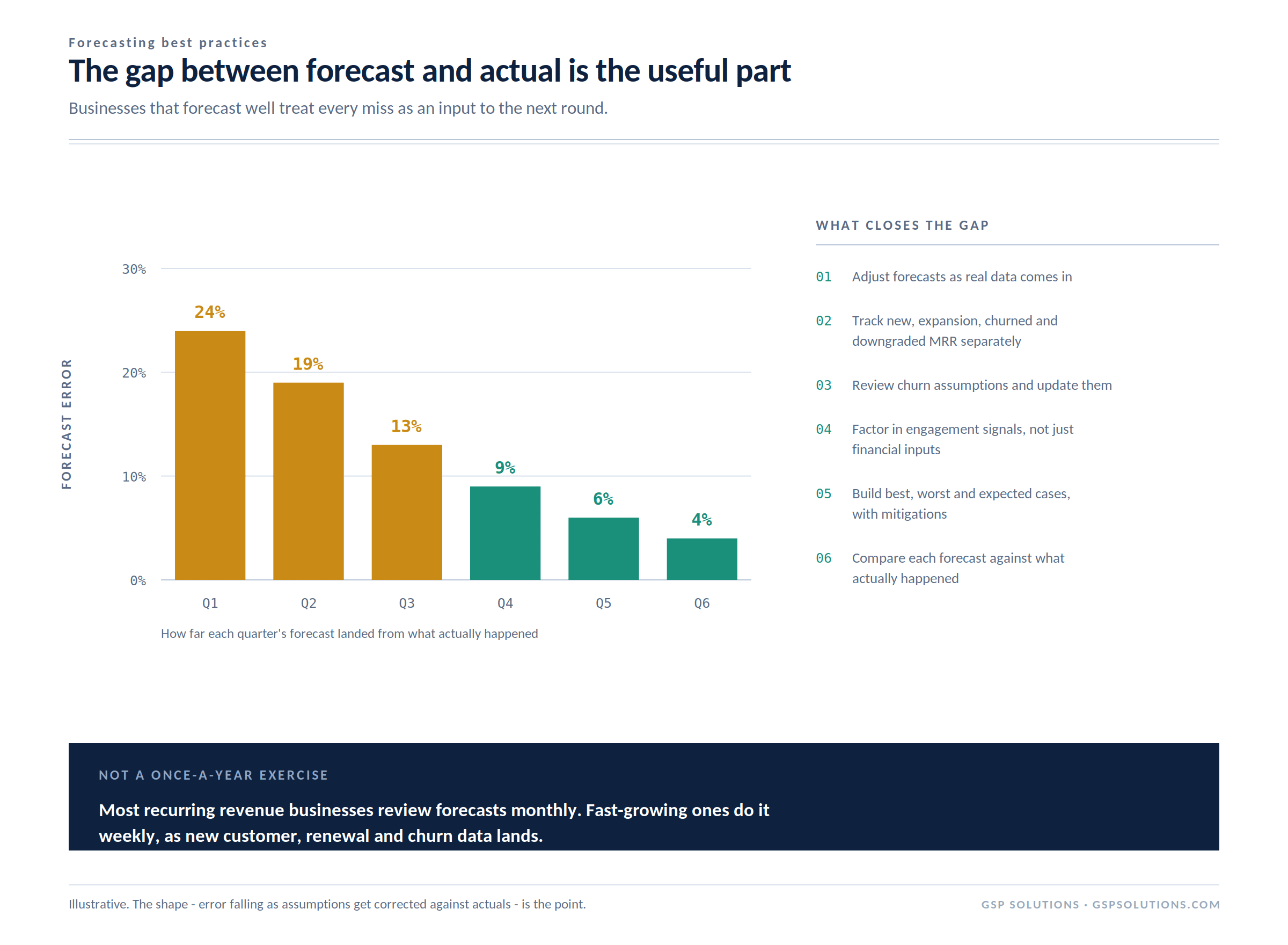
- Continually adjust forecasts as real data comes in. Not reviewing your forecasts means missed opportunities.
- Track different types of MRR (new, expansion, churned, downgraded) at a granular level, not just the net total, for a better understanding of where your revenue is coming from.
- Review churn assumptions regularly and update them with the latest data.
- Factor in other data-driven signals, such as customer engagement levels, alongside the pure financial inputs.
- Build best-case, worst-case, and expected scenarios, and plan mitigations for each.
- Compare forecasts against what actually happened, and use the gap to refine the next round of forecasts.
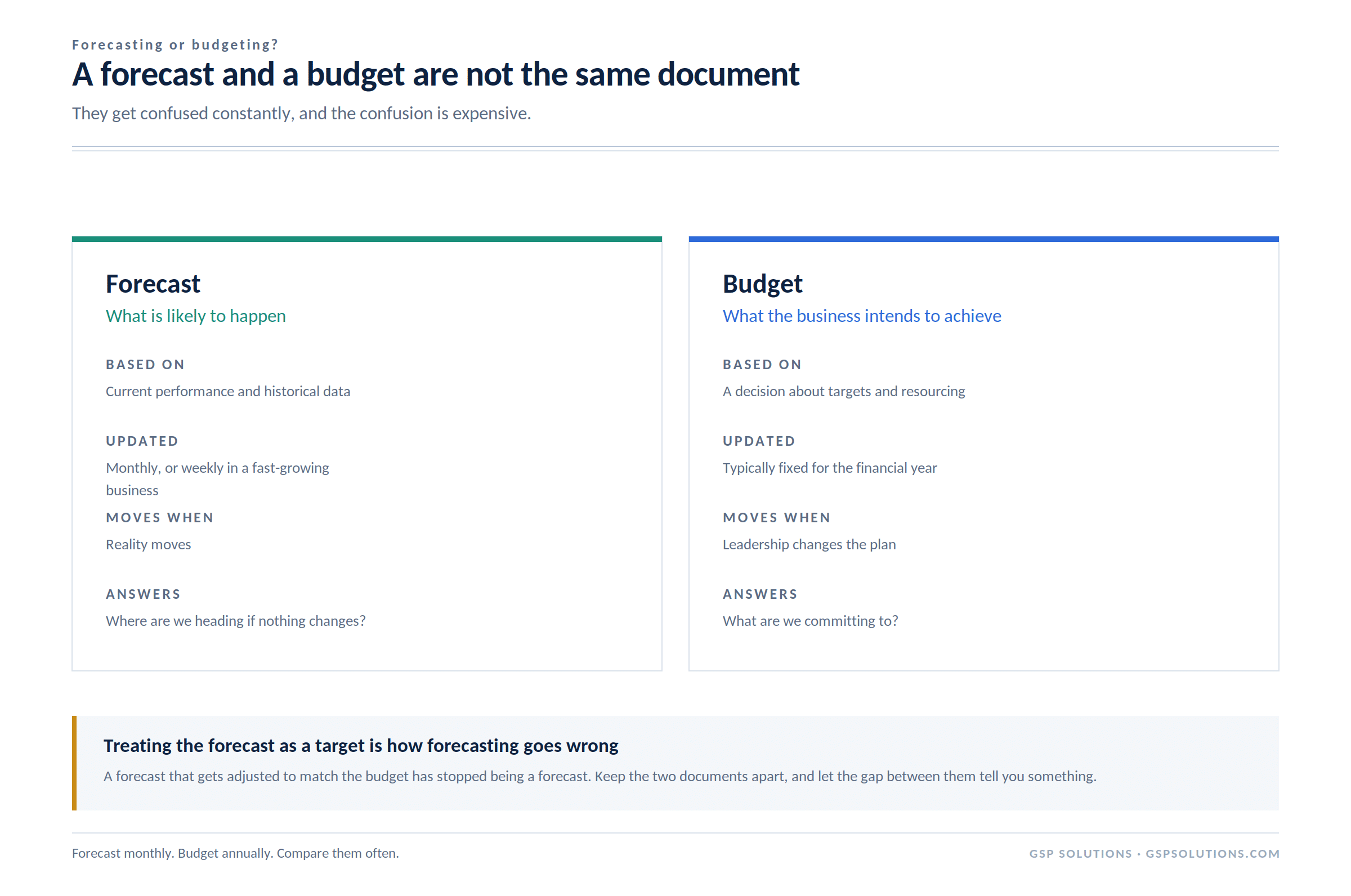
Overall, don’t treat forecasting as a one-off exercise at the start of the financial year. Make it an ongoing process that is revisited and refined as new data emerge.
Building Forecasts That Drive Better Decisions
Forecasting is about understanding what’s really driving the business and what needs to change to hit a better outcome.
As your business grows and generates more data, make that data the foundation of every forecasting decision.
Businesses that forecast well are better positioned to allocate resources, manage risk, and build scalable revenue.
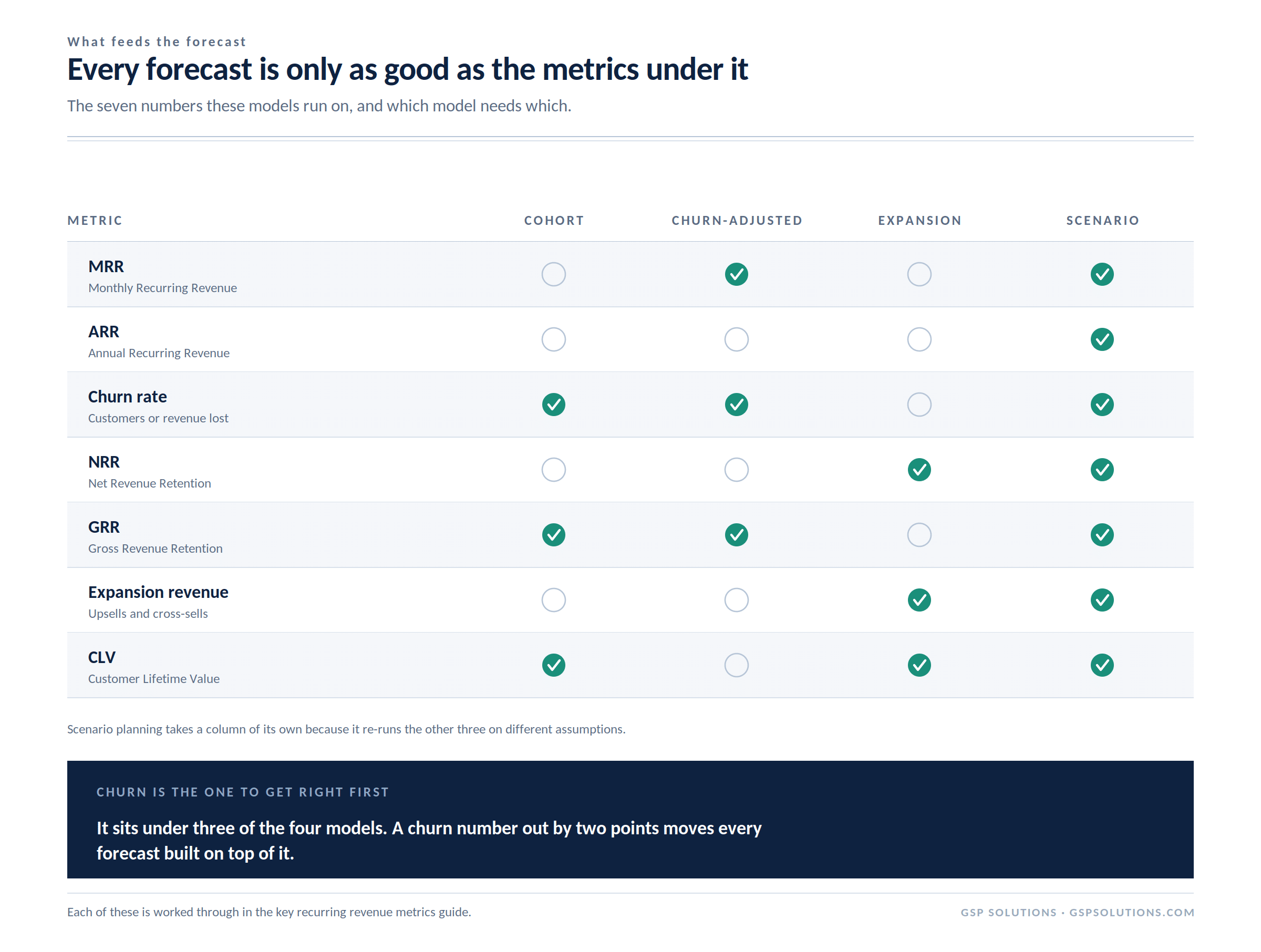
For the metrics that feed directly into these models, see our guide to key recurring revenue metrics; for the tools that can automate much of this reporting, see our guide to the best tools for managing recurring revenue.
FAQs
Recurring revenue forecasting is the process of estimating future revenue using predictable income from existing customers. It combines recurring revenue metrics such as Monthly Recurring Revenue (MRR), churn, customer renewals, expansion revenue, and new sales to help businesses predict future financial performance and make informed strategic decisions.
