

Recurring Revenue: The Complete Guide for Sales & RevOps Leaders
Everything sales and RevOps leaders need on recurring revenue: how to build it, price it, forecast it, and grow it, backed by current benchmarks.
Last updated November 13, 2026

In This Guide
Key Takeaways
Recurring revenue is the income a business earns from customers who pay at regular intervals, usually monthly, quarterly, or annually, for continued access to a product or service. Unlike a one-off sale, it builds a revenue base that carries over from one period to the next, which makes income far easier to forecast.
- Recurring revenue is ongoing income, not a one-off sale. It comes from subscriptions, retainers, memberships, licenses and usage-based billing.
- Its main advantage is predictability. You start each period with income already committed instead of starting from zero.
- Retention matters as much as new sales. Every cancellation or downgrade shrinks the base everything else is built on.
- Start by tracking MRR, ARR, churn and net revenue retention. An NRR above 100% means expansion is outpacing losses.
- Pricing shapes everything. It affects acquisition, retention and margin at the same time, so it deserves regular review.
- Most mature businesses blend models. A platform fee plus usage charges is a common example.
About This Guide
This guide brings together everything a Sales leader, RevOps manager, or Sales Operations professional needs to understand about recurring revenue: what it is, why it matters, how to build, price, forecast, grow, and manage it.
Whatever your role — sales leadership, revenue operations, or finance — the shift from one-off sales to recurring revenue is one of the biggest strategic decisions a business can make. It changes how you price, how you sell, how you measure success, and how customers experience your business long after the initial deal is signed.
Each section in this guide covers the essentials of that shift — for a deeper dive on any single topic, follow the linked article.
The complete guide is also available as a free eBook — read what's inside or download the PDF.
Prefer to watch a video?
What is Recurring Revenue?
Recurring revenue is income a business earns from customers who pay regularly for continued access to a product or service. Payments typically arrive monthly, quarterly, or annually through subscriptions, retainers, memberships, or ongoing service agreements. Usage-based billing can also generate recurring revenue, although the amount varies with consumption.
The main benefit is a more predictable revenue base. A business that depends on one-off sales must continually win new orders to sustain its income. With recurring revenue, existing customers contribute to future revenue, giving the business a clearer view of what it can expect to earn.
For example, a SaaS company charging $50 per user per month can forecast revenue from its current subscribers before closing a single new deal. New customers and account expansion add to that base; cancellations and downgrades reduce it. That makes customer retention just as important as winning new business.
The model extends well beyond software. Managed IT providers, marketing agencies, and accounting firms earn recurring revenue through ongoing services and retainers. Gyms and membership organizations use the same principle: customers keep paying for something they continue to value.
Why Does Recurring Revenue Matter?
Recurring revenue matters because it gives businesses predictability.
Traditional businesses that depend heavily on one-off transactions see revenue fluctuate significantly with seasonality, market conditions, or shifting customer demand.
In contrast, a recurring revenue business maintains a dependable income base that compounds over time. This gives companies greater control over cash flow, forecasting, and strategic planning, and makes them more attractive to investors and buyers.
That predictability delivers four concrete advantages:
- Financial stability. When customers pay on an ongoing basis, a business can estimate future income before a single new deal is closed. A marketing agency on monthly retainers, or a SaaS company tracking active accounts, can plan spending and manage cash flow with far more confidence than a business relying on one-off transactions.
- Higher valuations. Investors and buyers consistently pay a premium for predictable revenue. SaaS businesses, in particular, are often valued at multiples of Annual Recurring Revenue (ARR), with metrics like Net Revenue Retention and churn rate factored directly into the price. Salesforce is a well-known example of a company that scaled its valuation rapidly on the back of a subscription model.
- Stronger customer relationships. In a one-off sale, the relationship often ends at the point of purchase. In a recurring revenue business, retention is existential — so the focus shifts towards onboarding, support, and ongoing value delivery. Spotify’s constant personalization and Salesforce’s seasonal feature releases are both retention plays as much as they are product decisions.
- Operational efficiency. Predictable revenue makes it easier to plan staffing and budgets, and automated billing systems (Stripe, Xero, and similar platforms) reduce the administrative overhead of manually chasing payments, freeing teams to focus on growth rather than collections.
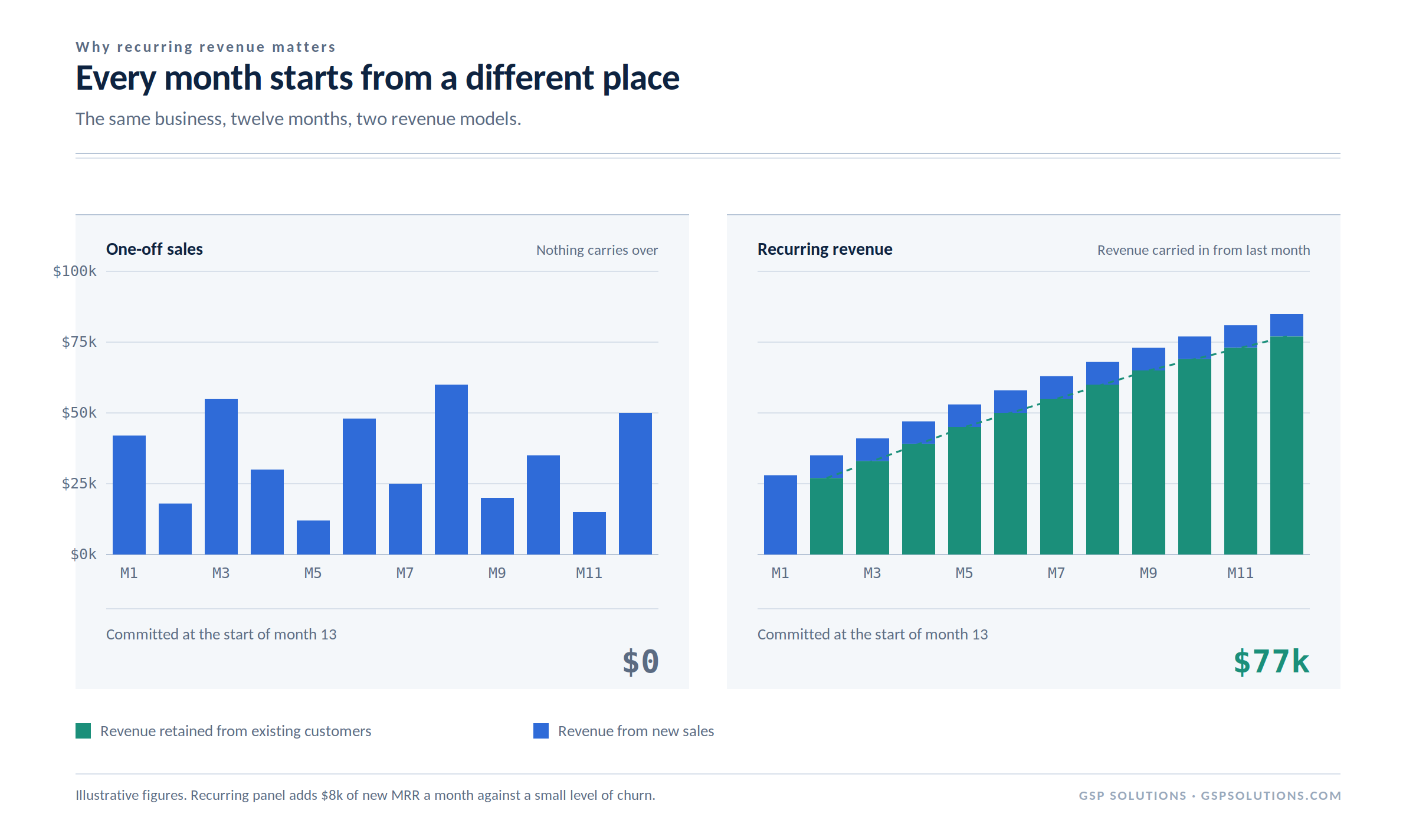
Taken together, these advantages explain why businesses in so many industries — from software to streaming to professional services — have converged on recurring revenue as the default growth model, even where a one-off sale was traditionally the norm.
What Are the Types of Recurring Revenue Models?
Recurring revenue relies on multiple models, and most mature businesses combine more than one.
| Subscription | Fixed fee at regular intervals for continued access | Netflix, Microsoft 365 |
| Usage-based | Billed on consumption (API calls, storage, transactions) | Visa, cloud storage providers |
| Retainer | Ongoing fee for professional services, invoiced regardless of use | Marketing agencies, law firms |
| Membership | Exclusive access to content, community, or facilities | Gyms, professional associations |
| Licensing | Recurring fee to use the software or IP | CRM and software vendors |
| Maintenance & support | Ongoing service tied to a hardware or software purchase | Warranty and support contracts |
| Hybrid | Combines two or more models, e.g., a platform fee plus usage charges | Just Eat (platform fee + per-order charge) |
| Renewable | Fixed-term contract that must be actively renewed | Annual software or insurance contracts |
| Evergreen | Continues indefinitely until canceled, with no fixed end date | Netflix, ongoing memberships |
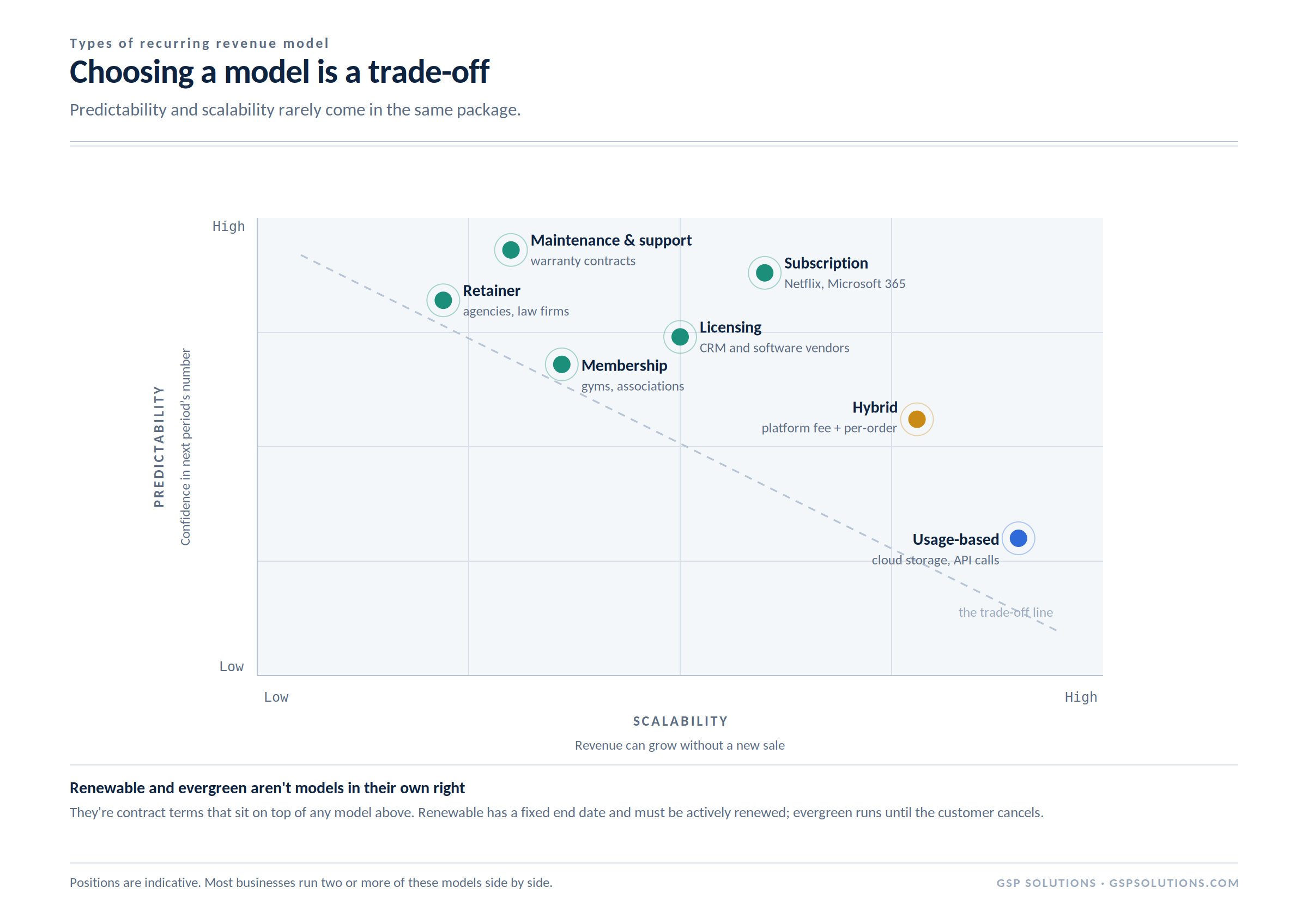
The model choice depends on your product, your customers’ buying behavior, and how they derive value from what you sell.
Many businesses blend models as they scale: Salesforce, for instance, charges a platform access license fee alongside usage-based pricing for AI credits, and Just Eat combines a flat platform fee with a per-transaction charge.
When comparing models, weigh up predictability, scalability, the level of customer commitment each requires, and the stability of the resulting revenue.
Subscription, retainer, membership, and licensing models tend to score well on predictability and stability; usage-based and hybrid models trade some predictability for greater scalability as customer usage grows.
Key Recurring Revenue Metrics
Revenue alone doesn’t tell you whether a recurring revenue business is healthy. To understand how well you’re retaining customers and how much value each one generates, you need additional metrics, including:
- Monthly Recurring Revenue (MRR) — guaranteed monthly income from active customers. MRR = active customers × average monthly price.
- Annual Recurring Revenue (ARR) — MRR annualized, used by investors to gauge long-term value. ARR = MRR × 12.
- Churn rate — the percentage of customers lost in each period. Churn = (customers lost ÷ customers at start of period) × 100.
- Customer Lifetime Value (CLV) — total expected revenue from a customer over the relationship. CLV = average monthly revenue per customer × average customer lifespan (months).
- Customer Acquisition Cost (CAC) — what it costs to win a new customer, assessed alongside CLV. CAC = total sales and marketing cost ÷ new customers acquired.
- Net Revenue Retention (NRR) — recurring revenue after expansion, downgrades, and churn (i.e., excluding new customers); widely seen as the single most important recurring revenue metric. A figure above 100% means expansion revenue is outpacing losses from churn and downgrades.
- Gross Revenue Retention (GRR) — retained revenue excluding any expansion, isolating the impact of churn and downgrades alone.
- Average Revenue Per User (ARPU) — average recurring spend per customer. ARPU = total recurring revenue ÷ total active customers.
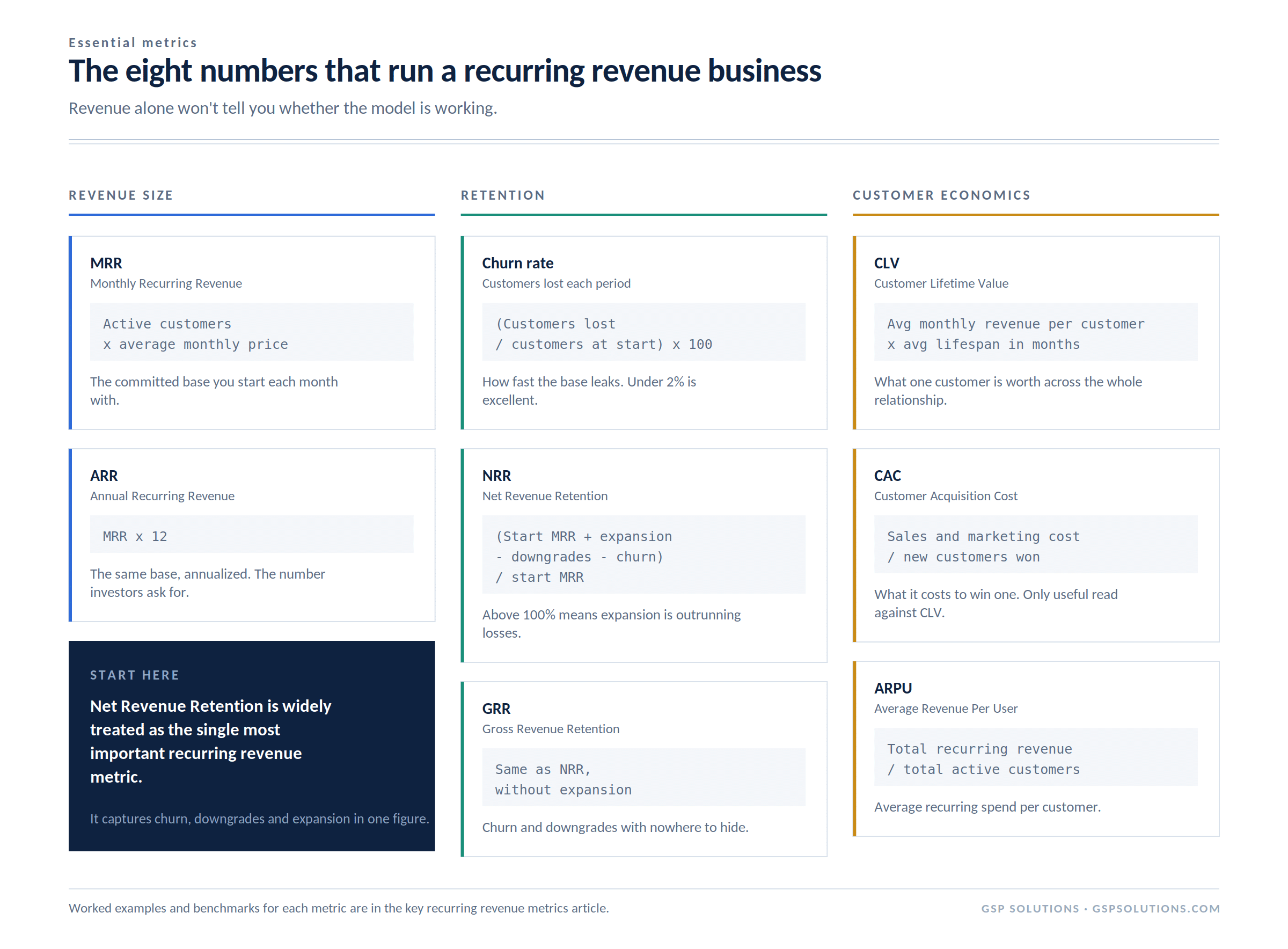
Tracked together, these metrics tell a business how efficiently it acquires customers, how well it retains them, and how much value each one generates over time — and they should sit at the center of any recurring revenue strategy, not just the finance team’s dashboard.
For the full calculations, worked examples, and benchmarks behind each metric, see the article on key recurring revenue metrics.
How to Build a Recurring Revenue Business
Whether you’re launching software, a consultancy, or a membership business, the same process applies, and each step builds on the last:
- Identify a repeatable customer problem — recurring revenue only works when customers need continuous access to a solution, not a one-off fix. Xero solves an ongoing finance and invoicing problem; Amazon Prime solves an ongoing entertainment one. The more frequently the underlying problem recurs, the stronger the case for a recurring revenue model.
- Choose a revenue model — align subscription, usage-based, retainer, licensing, or hybrid pricing model to how customers actually derive value. A customer paying for app access suits a subscription model; one paying per API call suits usage-based billing.
- Define a pricing strategy — pricing needs to reflect value delivered while still supporting growth and margin. This is rarely a one-off decision (more about pricing below).
- Build retention systems — structured onboarding, proactive support, regular account reviews, and usage monitoring all reduce churn. The sooner customers realize value from a product, the more likely they are to renew.
- Improve the customer experience continuously — high-quality products, new features, responsive support, and regular communication keep customers satisfied and engaged. This is why companies like Spotify and Salesforce invest so heavily in constant iteration rather than treating a product as “finished.”
- Automate billing and renewals — automated invoicing, payment collection, and renewal reminders reduce admin costs and improve cash flow consistency so that teams can focus on new business and retention.
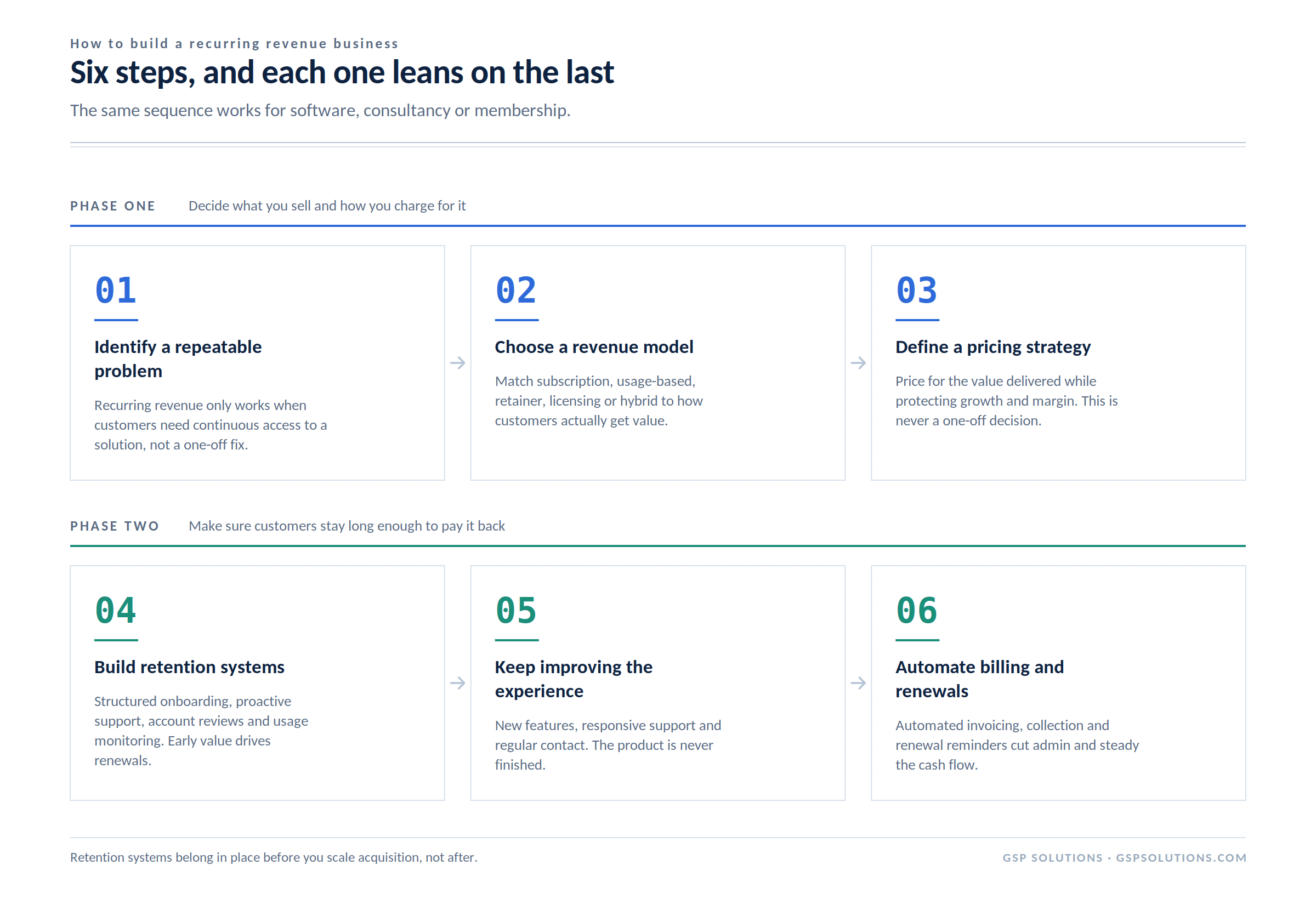
Our article on building a recurring revenue business walks through each step with worked examples and a summary framework.
What Are Main Recurring Revenue Pricing Strategies?
The main recurring revenue pricing approaches are:
- Flat-rate pricing — one fixed fee for full access; simple to sell, but limits expansion revenue.
- Tiered pricing — multiple price points tied to features or usage limits, giving customers room to upgrade.
- Per-user pricing — cost scales with the number of users, so revenue grows alongside customer headcount.
- Usage-based pricing — cost scales with consumption; highly scalable but less predictable month to month.
- Freemium — a free entry tier converts to paid once customers see value.
- Hybrid pricing — combines a fixed base fee with variable, usage-linked charges.
To fine-tune their recurring revenue models, businesses use tactics like:
- Anchoring — leading with a premium tier to make mid-tier pricing look reasonable.
- Annual discounts — trading a modest price reduction for upfront cash and lower churn.
- Feature gating — reserving advanced functionality for higher tiers all help fine-tune whichever model you choose.
Pricing is one of the highest-leverage decisions a recurring revenue business makes — it shapes acquisition, retention, and margin all at once.
Unlike a one-time purchase, recurring pricing must work for the customer month after month, which means it must continue to deliver perceived value long after the initial sale.
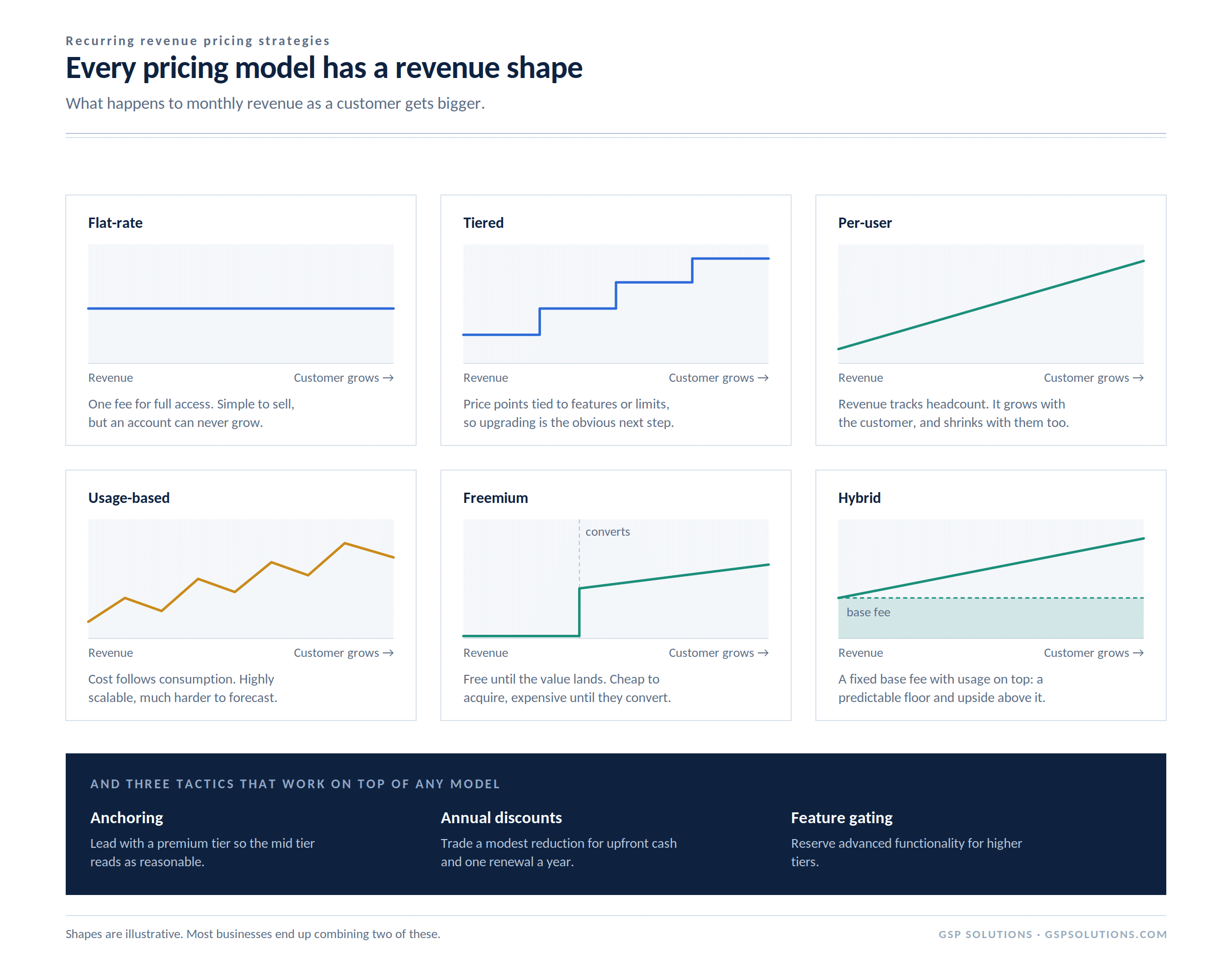
The full article on recurring revenue pricing strategies covers each model’s advantages, trade-offs, and worked examples in depth.

FREE EXECUTIVE GUIDE
Want the whole guide as a PDF?
The models, the metrics and the MRR forecast, laid out to take into a board meeting.
26 pages · PDF
What Are Common Recurring Revenue Challenges?
The six most common challenges recurring revenue businesses face are:
- High churn — usually driven by poor onboarding, weak perceived value, or unresolved product issues.
- Failed renewals — often the result of poor engagement throughout the contract, not just at the renewal moment itself.
- Pricing misalignment — pricing that no longer reflects the value delivered, visible in frequent objections or customers clustering on the cheapest tier.
- Low expansion revenue — a limited product range or weak customer success function leaves money on the table.
- Customer (subscription) fatigue — customers increasingly scrutinize every recurring cost and cut what isn’t clearly earning its keep.
- Overdependence on discounts — a warning sign that pricing, not the discount, is the real problem. Customers who sign up primarily for a discount tend to be the least loyal, and heavy reliance on discounting erodes margins over time.
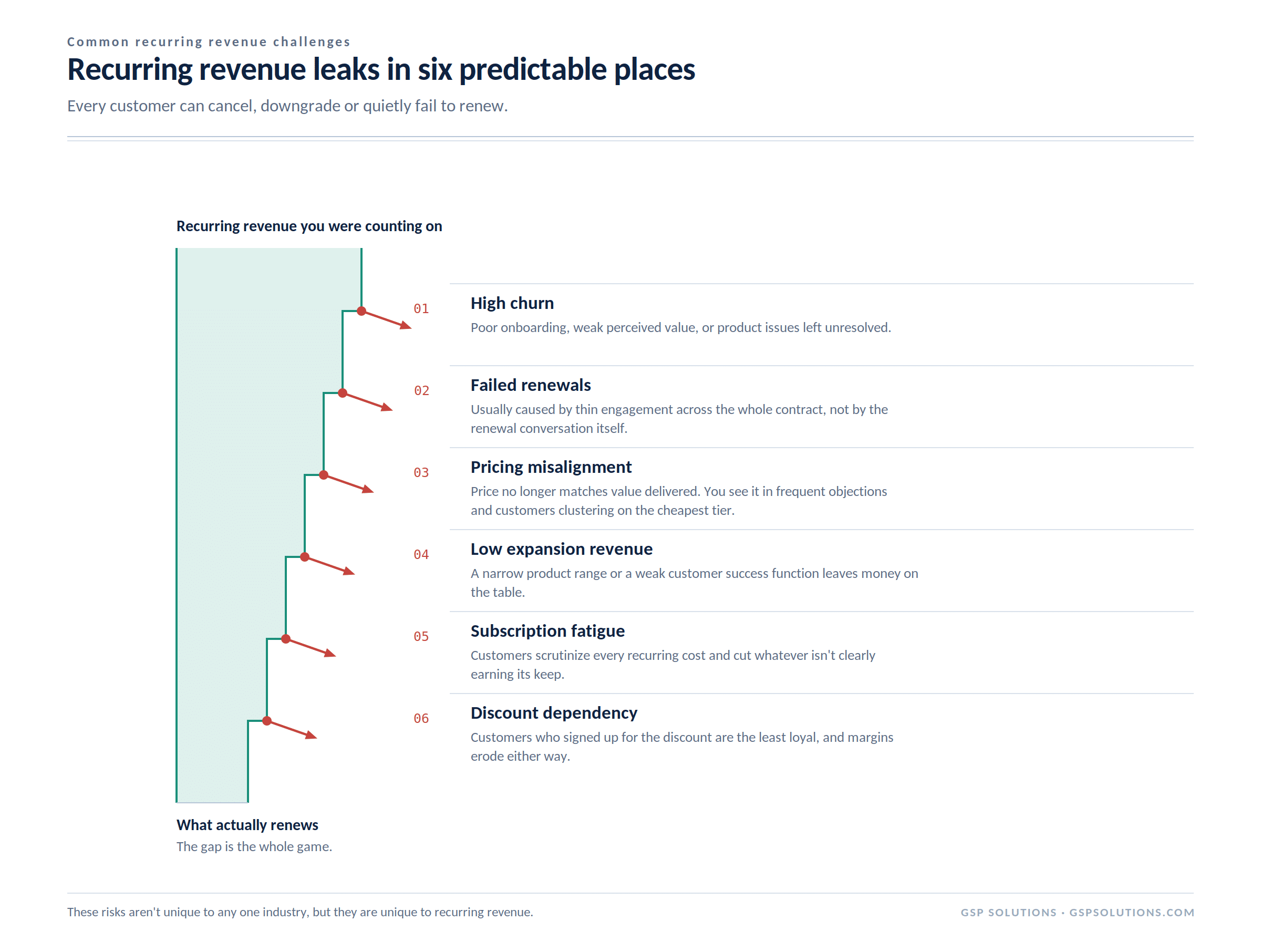
These risks aren’t unique to a particular industry. Still, they are unique to recurring revenue businesses because every customer can cancel, downgrade, or fail to renew at almost any point in the relationship.
Every lost customer represents revenue lost today and future revenue they would otherwise have generated.
The challenges stem from gaps in onboarding, communication, or pricing. Understanding them and their root causes — and putting preventive measures in place — is critical to sustaining growth.
The articles on strategies to increase recurring revenue and pricing cover the specific fixes in detail.
How Do You Forecast Recurring Revenue?
Because so much future revenue is already committed under contracts, recurring revenue businesses have a genuine head start in forecasting accuracy compared with companies that rely solely on new sales.
The most common approaches to recurring revenue forecasting are:
- Cohort forecasting — grouping customers by start date to track how churn and value evolve across different groups.
- Churn-adjusted forecasting — applying historical churn rates to current MRR to project a realistic starting point.
- Expansion revenue forecasting — estimating additional revenue from upsells and cross-sells within the existing customer base.
- Scenario planning — building conservative, expected, and optimistic forecasts to support risk management, operational planning, and growth decisions, respectively.
Forecasts are built around two reference points.
- Opening MRR is the recurring revenue already committed at the start of the period
- Closing MRR is what remains at the end, once new customers, expansions, churn, and downgrades have been accounted for. Each month's closing MRR becomes the next month's opening MRR, which is what makes the model compound:
Closing MRR = Opening MRR + New MRR + Expansion MRR − Churned MRR − Downgraded MRR
Good forecasting isn’t a one-and-done exercise at the start of the fiscal year. It should be revisited continually as new data come in, using best-, worst-, and expected-case scenarios to inform decisions rather than relying on a single fixed number.
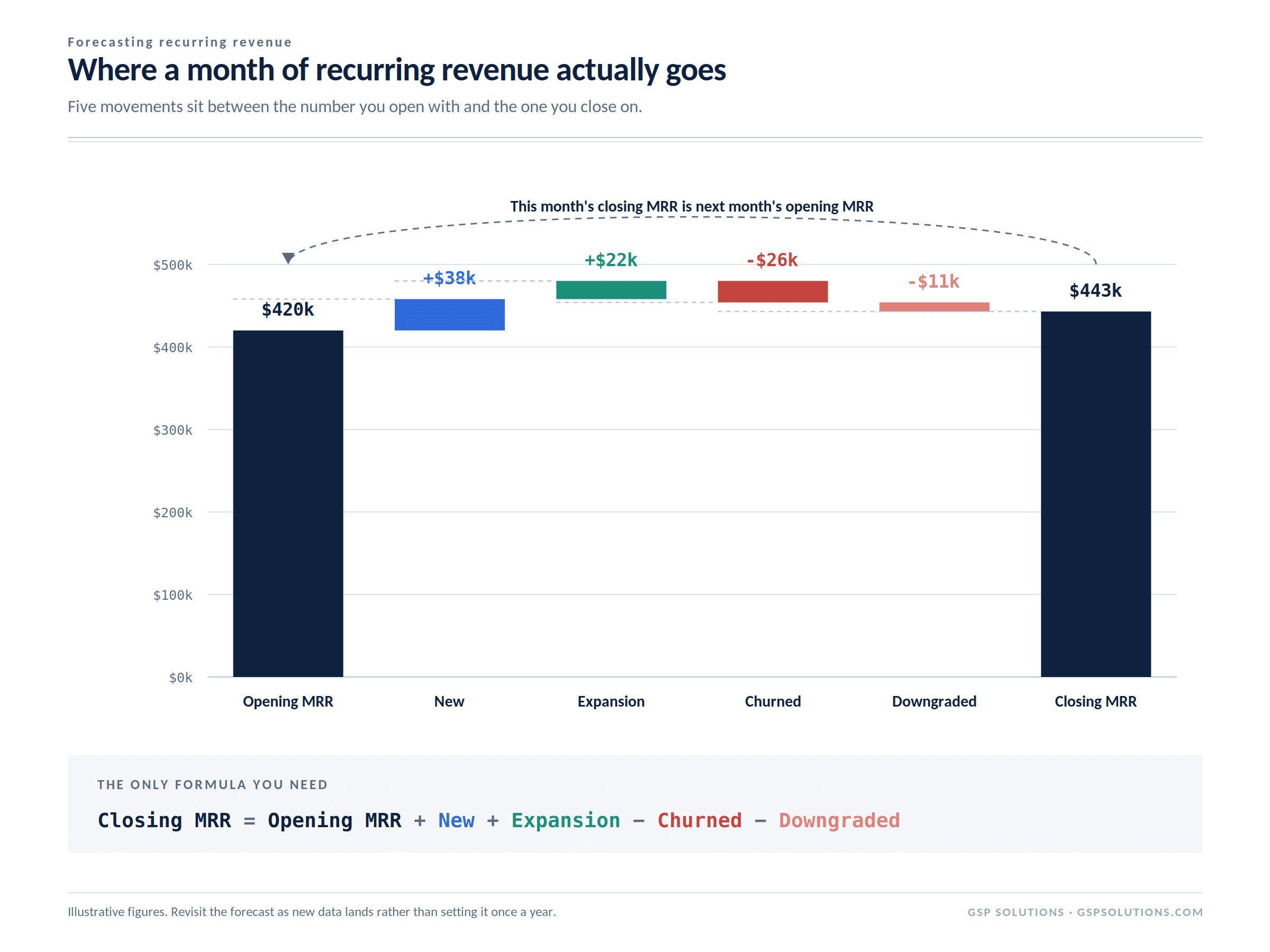
The full article on forecasting recurring revenue includes worked templates and a comparison of each forecasting model.
What Are the Strategies to Increase Recurring Revenue?
Growing recurring revenue involves signing new customers while retaining and expanding the existing ones by:
- Improving retention through better onboarding, support, and communication.
- Upselling customers to higher-value plans or products.
- Cross-selling complementary products into the existing base.
- Encouraging annual contracts, which improve cash flow and cut cancellation opportunities from twelve a year to one.
- Product bundling to increase average contract value.
- Investing in customer success to protect renewals and surface expansion opportunities.
- Reducing failed payments — often overlooked, but a real source of involuntary churn, which constitutes about a third of all churn.
Retaining and expanding existing accounts is usually cheaper and more reliable. According to Benchmarkit's 2025 benchmarks, on average, SaaS companies spent $2.00 in sales and marketing to acquire $1.00 of new customer ARR, but only $1.00 to generate $1.00 of expansion ARR.
Recurring revenue compounds: every month a customer stays, both MRR and their lifetime value grow, which is why the strongest recurring revenue businesses place as much emphasis on retaining existing customers as they do on winning new ones.
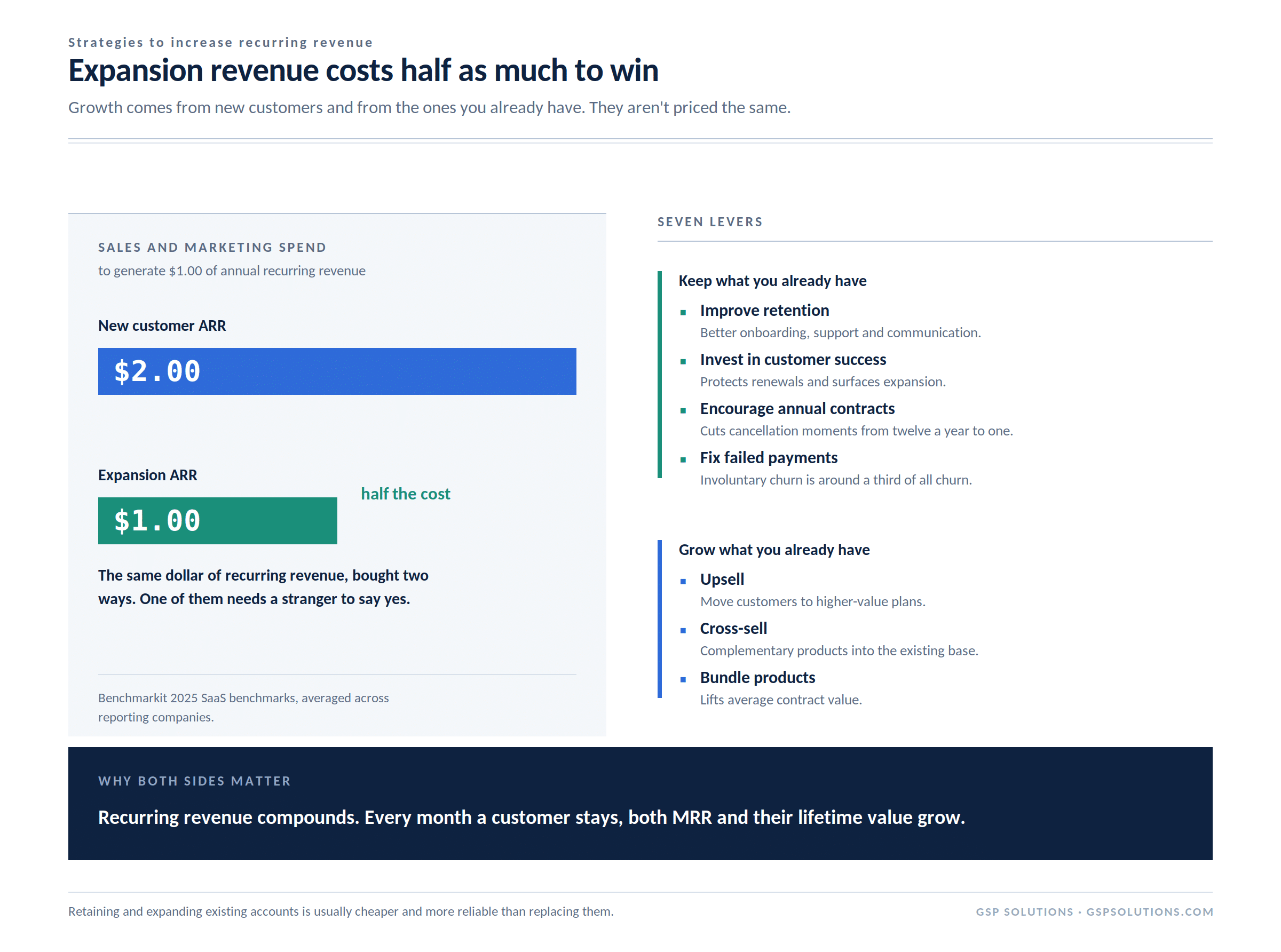
The full article on strategies to increase recurring revenue ranks each strategy by impact and implementation difficulty.
What Are the Best Tools for Managing Recurring Revenue?
As a recurring revenue business scales, spreadsheets stop being a viable way to track subscriptions, renewals, and forecasts. They need the right tooling to automate subscription management, improve billing accuracy, reduce failed renewals, forecast revenue accurately, and monitor key metrics without manual reporting.
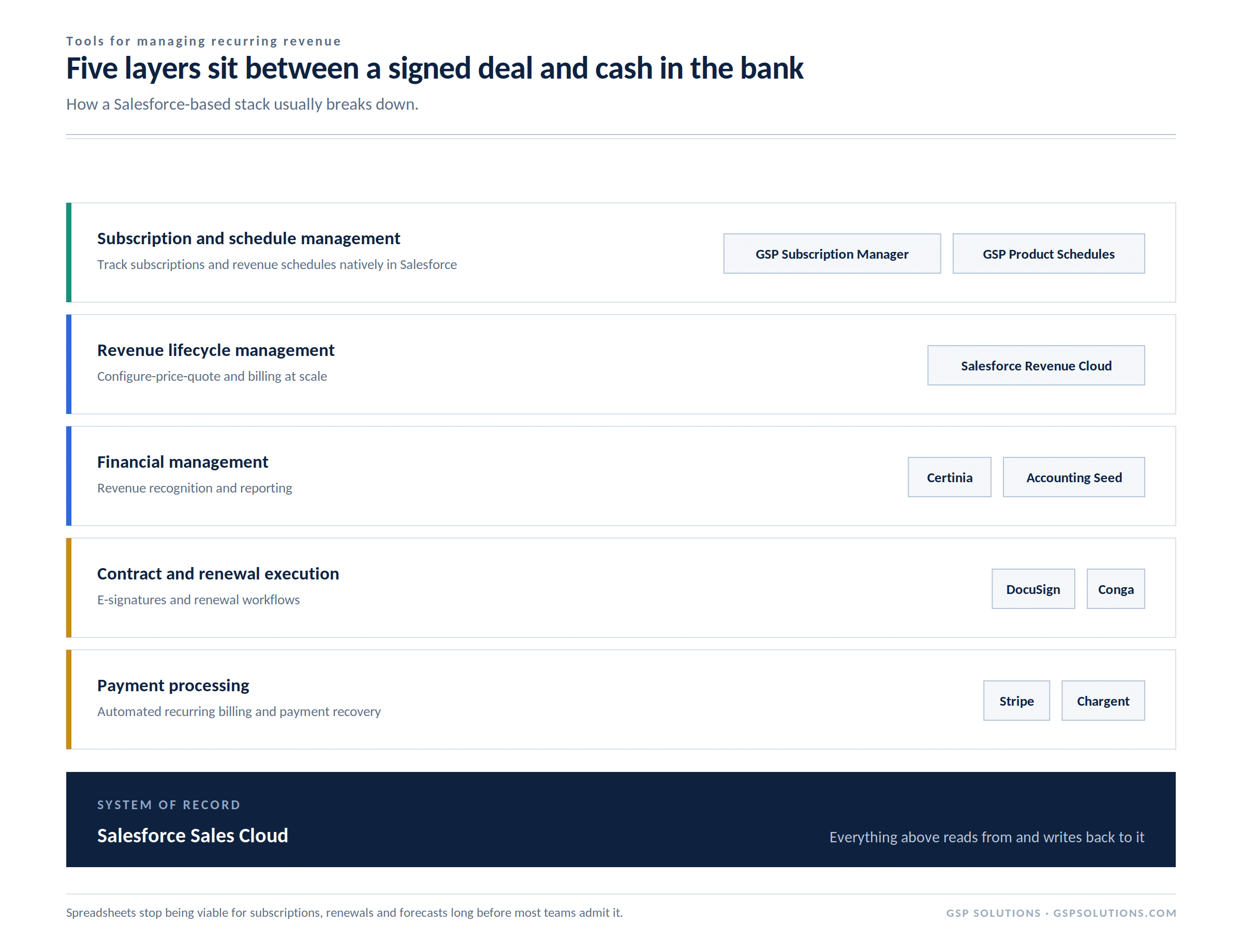
For example, businesses running on Salesforce typically combine several categories of tools:
- Subscription and schedule management — tools like GSP Subscription Manager and GSP Product Schedules for tracking subscriptions and revenue schedules natively in Salesforce.
- Revenue lifecycle management — Salesforce Revenue Cloud for configure-price-quote and billing at scale.
- Financial management — Certinia and Accounting Seed for revenue recognition and reporting.
- Contract and renewal execution — DocuSign and Conga for e-signatures and renewal workflows.
- Payment processing — Stripe and Chargent for automated recurring billing and payment recovery.
The full article on the best tools for managing recurring revenue compares categories and outlines what to look for when choosing a stack.
Future Trends in Recurring Revenue
Recurring revenue models will continue to evolve as AI, automation, and shifting customer expectations reshape how businesses price and deliver value. As more businesses adopt recurring models and competition and customer expectations increase, the businesses that get ahead of these shifts stand to gain a real competitive advantage.
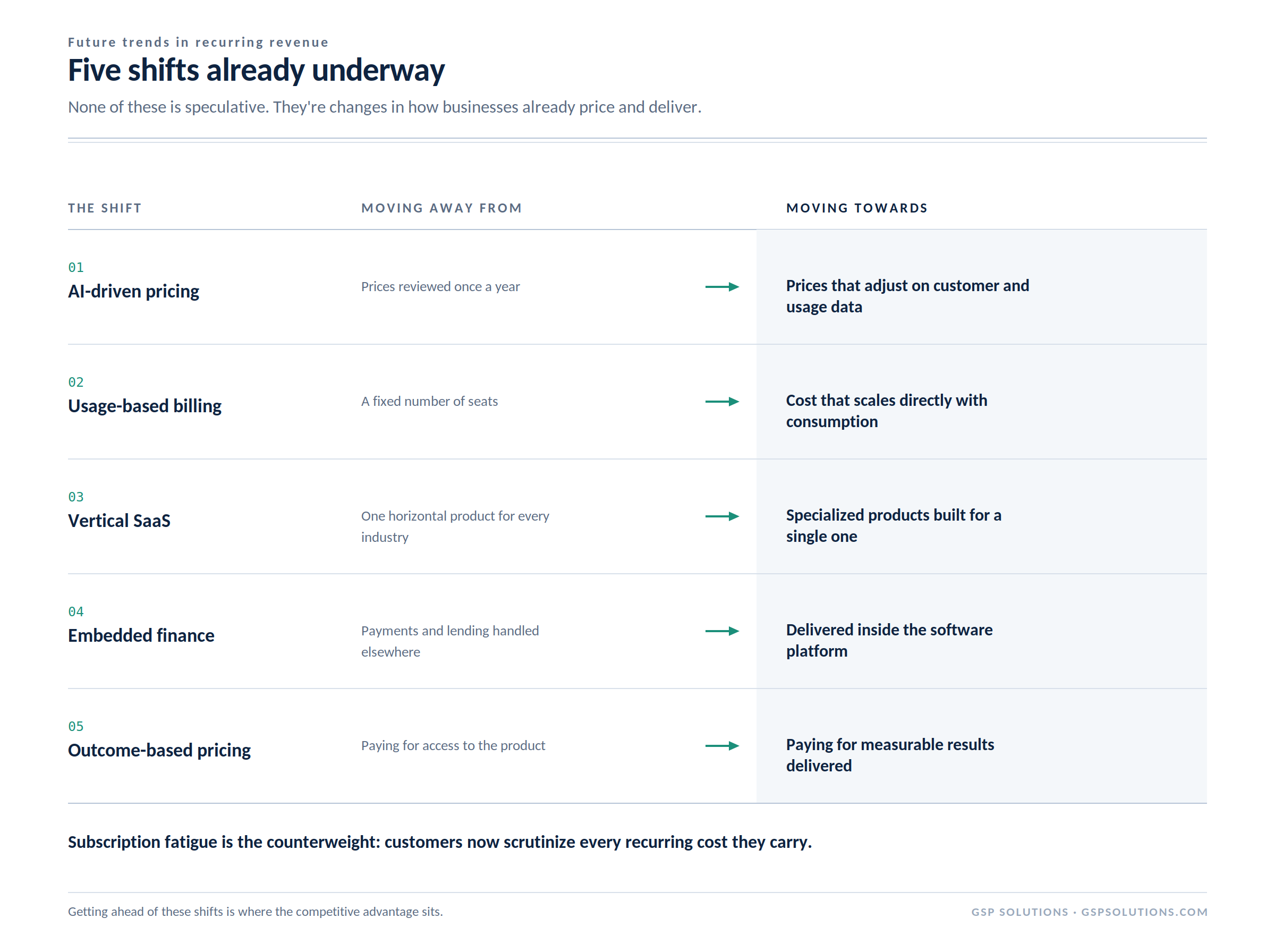
The recurring revenue trends most likely to matter over the next few years include:
- AI-driven pricing — using customer and usage data to set and adjust prices dynamically, rather than relying on annual price reviews.
- Growth of usage-based billing — particularly in cloud and technology, where cost scales directly with consumption.
- Growth of vertical SaaS — specialized products built for a single industry, which tend to command stronger retention and pricing power.
- Embedded finance — payments, lending, and insurance delivered directly inside software platforms.
- Outcome-based pricing — charging based on measurable results delivered, rather than access alone.
The full article on future trends in recurring revenue explores each trend, including subscription fatigue and how businesses are responding to it.
Recurring Revenue FAQs
These are the questions we’re asked most often by sales and revenue leaders getting to grips with recurring revenue — whether they’re new to subscription models or refining an existing strategy.
Recurring revenue is predictable income a business receives on an ongoing basis from customers who pay regularly — usually monthly, quarterly, or annually — for continued access to a product or service, through subscriptions, memberships, retainers, or similar recurring billing models.
Getting Started With Recurring Revenue
This guide is for anyone responsible for revenue growth in a mid-sized or large organization — whether that’s a VP of Sales weighing up a shift to subscription pricing, a RevOps leader trying to get forecasting under control, or a Sales Operations professional tasked with tightening up renewal processes. The principles apply whether you’re launching a new recurring revenue line or optimizing an existing one.
If you’re building a recurring revenue business from scratch, start in this order: identify the repeatable problem you solve, choose the model and pricing that best reflect how customers get value, and put retention systems in place before you scale acquisition.
If you’re already running one, the highest-leverage next step is usually to get your core metrics — MRR, churn, and NRR — visible and accurate, since every other decision, from pricing changes to forecasting to hiring, depends on trusting that data.
Recurring revenue rewards businesses that treat it as an ongoing discipline rather than a one-time change to the billing model.
The metrics, pricing decisions, and retention systems covered in this guide all need to be revisited regularly as your customer base, product, and market evolve. There’s no finish line — the businesses that do this well treat recurring revenue as a living system, not a project with a defined end date. Use the articles linked throughout to go deeper into whichever area matters most to your business right now.

Related Resources
FREE 26-PAGE GUIDE · RECURRING REVENUE SERIES
Prefer a guide you can keep and share?
Recurring Revenue: A Complete Guide covers the models, the metrics that matter, the six steps to building a recurring revenue business, and the opening-to-closing MRR forecast.
26 designed pages · PDF, sent to your inbox · For VPs of Sales, RevOps and Sales Operations
