

6 Best Tools for Managing Recurring Revenue
Discover 6 excellent recurring revenue tools for your team. Learn about their use cases and how they can help your recurring revenue business grow.
Last updated November 2, 2026

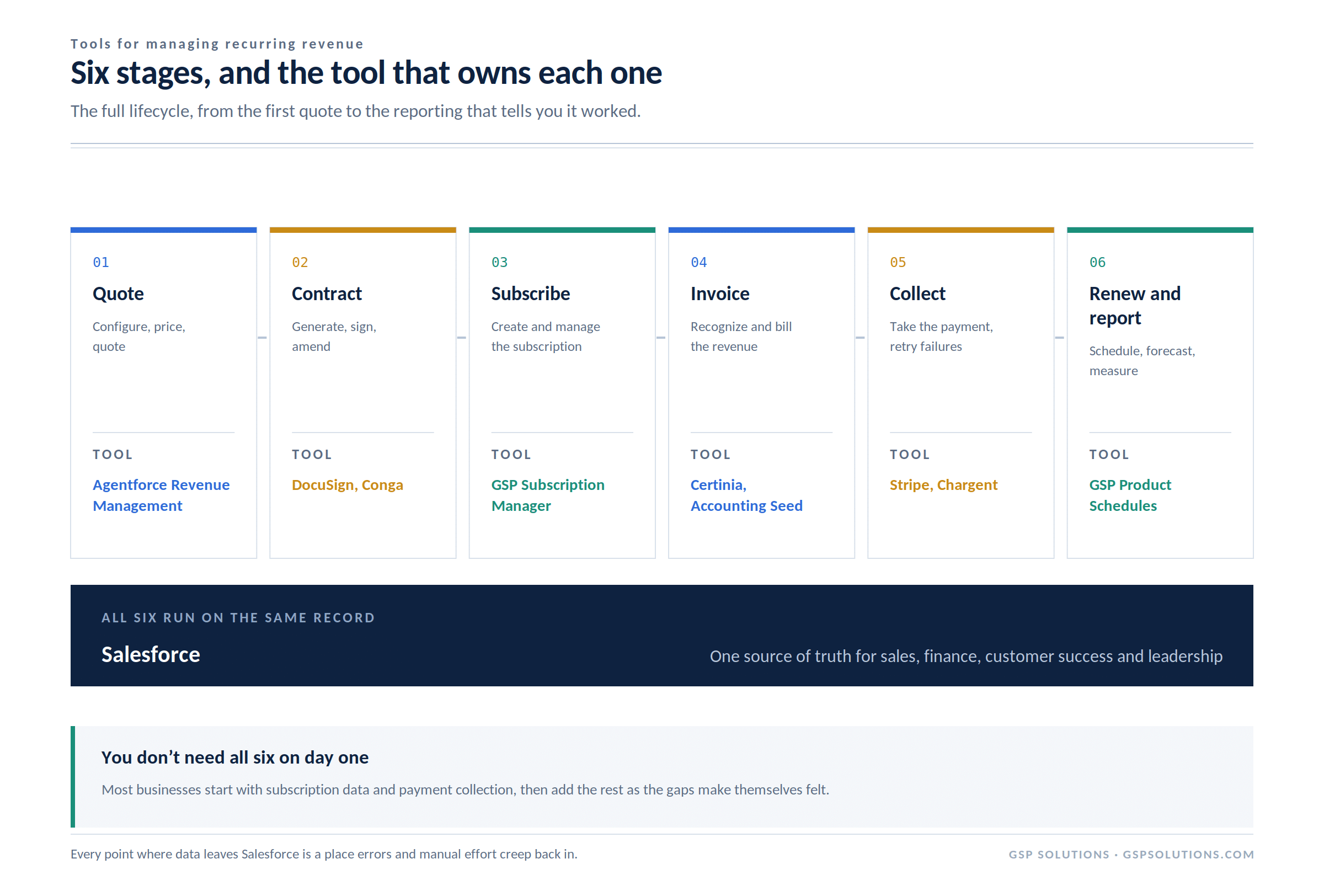
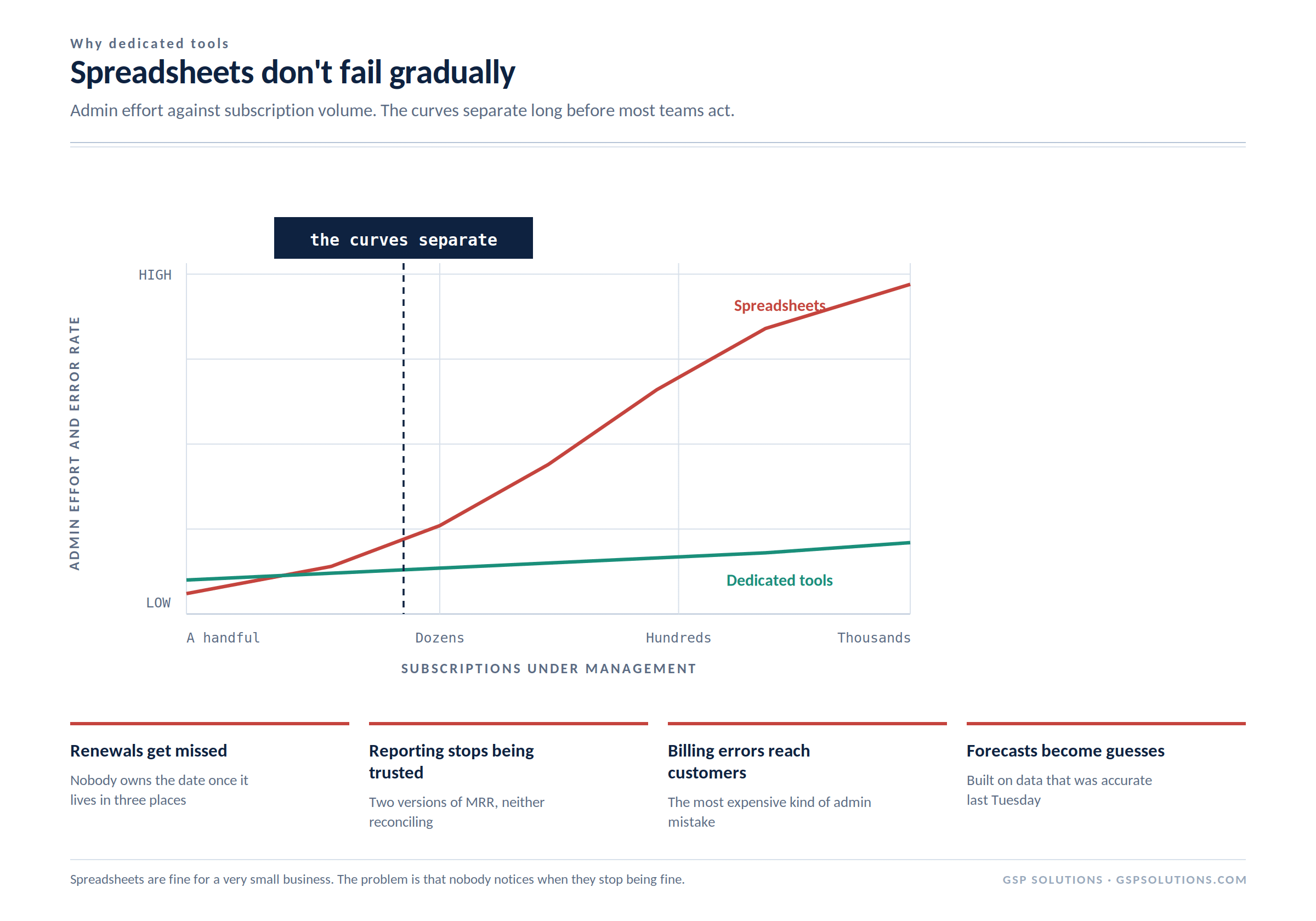
As a recurring revenue business grows, you need the right tools to automate subscription management, improve billing accuracy, reduce failed renewals, reliably forecast revenue, monitor key metrics without manual reporting, simplify contract and renewal management, and deliver a better overall customer experience.
In this article, we share 6 best tools for teams running on Salesforce, covering the full recurring revenue lifecycle from subscription management through to payment collection.
Best Recurring Revenue Management Tool Overview
| GSP Subscription Manager | Managing subscriptions directly in Salesforce | Visibility of key recurring revenue metrics, subscription, and renewal management |
| GSP Product Schedules | Scheduling revenue over time in Salesforce | Automated schedule generation and clear visibility into won and forecasted revenue |
| Agentforce Revenue Management | The quote-to-cash process | Configure, price, quote (CPQ) functionality |
| Certinia & Accounting Seed | Financial management within Salesforce | Native accounting, invoicing, and revenue management |
| DocuSign & Conga | Contract and renewal execution | Electronic signatures, contract automation, and approval workflows |
| Stripe & Chargent | Online and native Salesforce payment processing | Secure recurring payment collection and automated retries |
GSP Subscription Manager
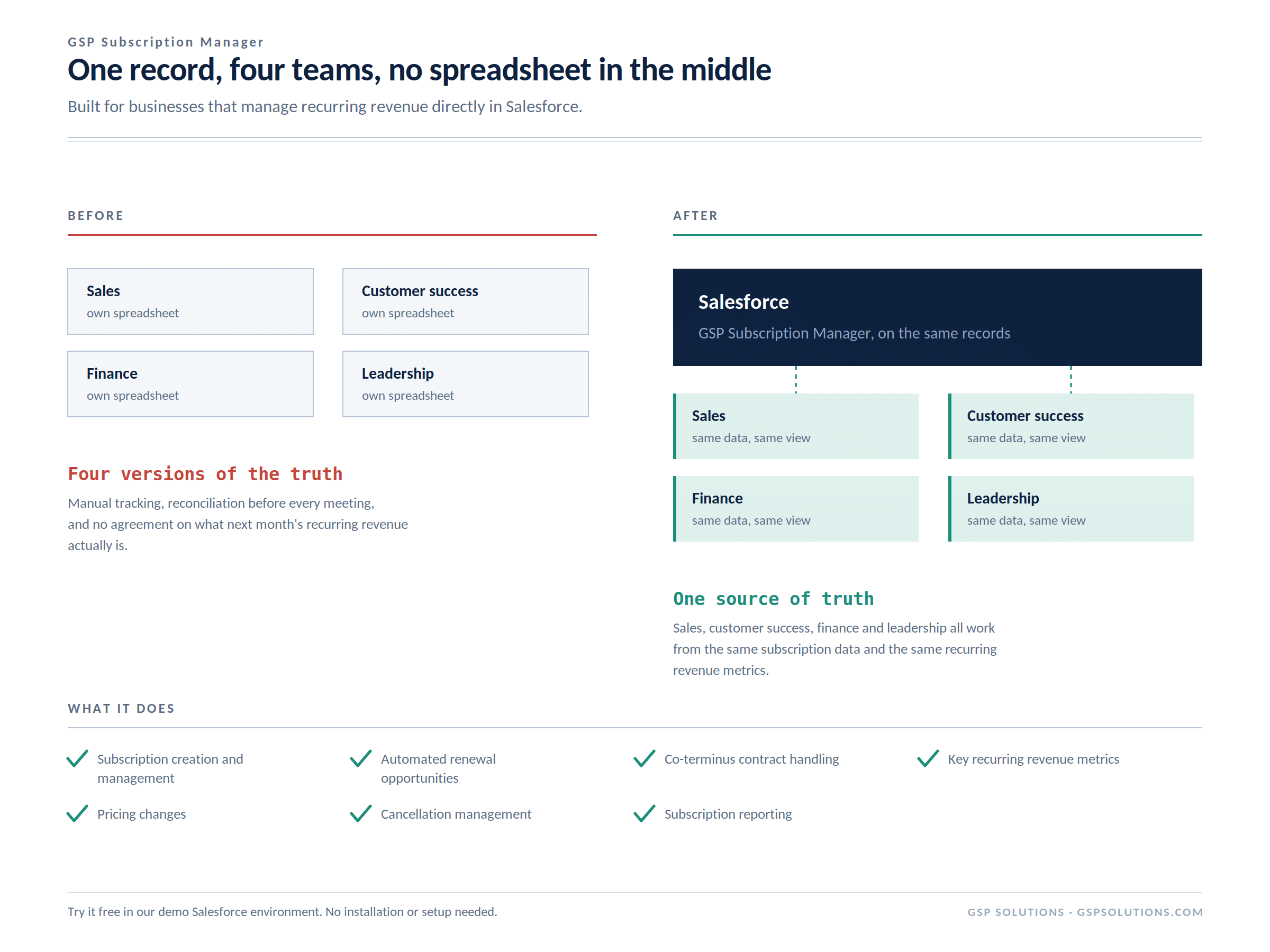
GSP Subscription Manager was built for businesses that manage recurring revenue directly in Salesforce.
It eliminates the need for external spreadsheets and manual tracking, giving customers complete visibility into the subscription lifecycle.
GSP Subscription Manager’s key capabilities include:
- Subscription creation and management
- Automated renewal opportunities
- Co-terminus contract handling
- Key recurring revenue metrics
- Pricing changes
- Cancellation management
- Subscription reporting
Using it turns Salesforce into the single source of truth for subscriptions, so sales, customer success, finance, and leadership work from the same data and insights.
GSP Product Schedules
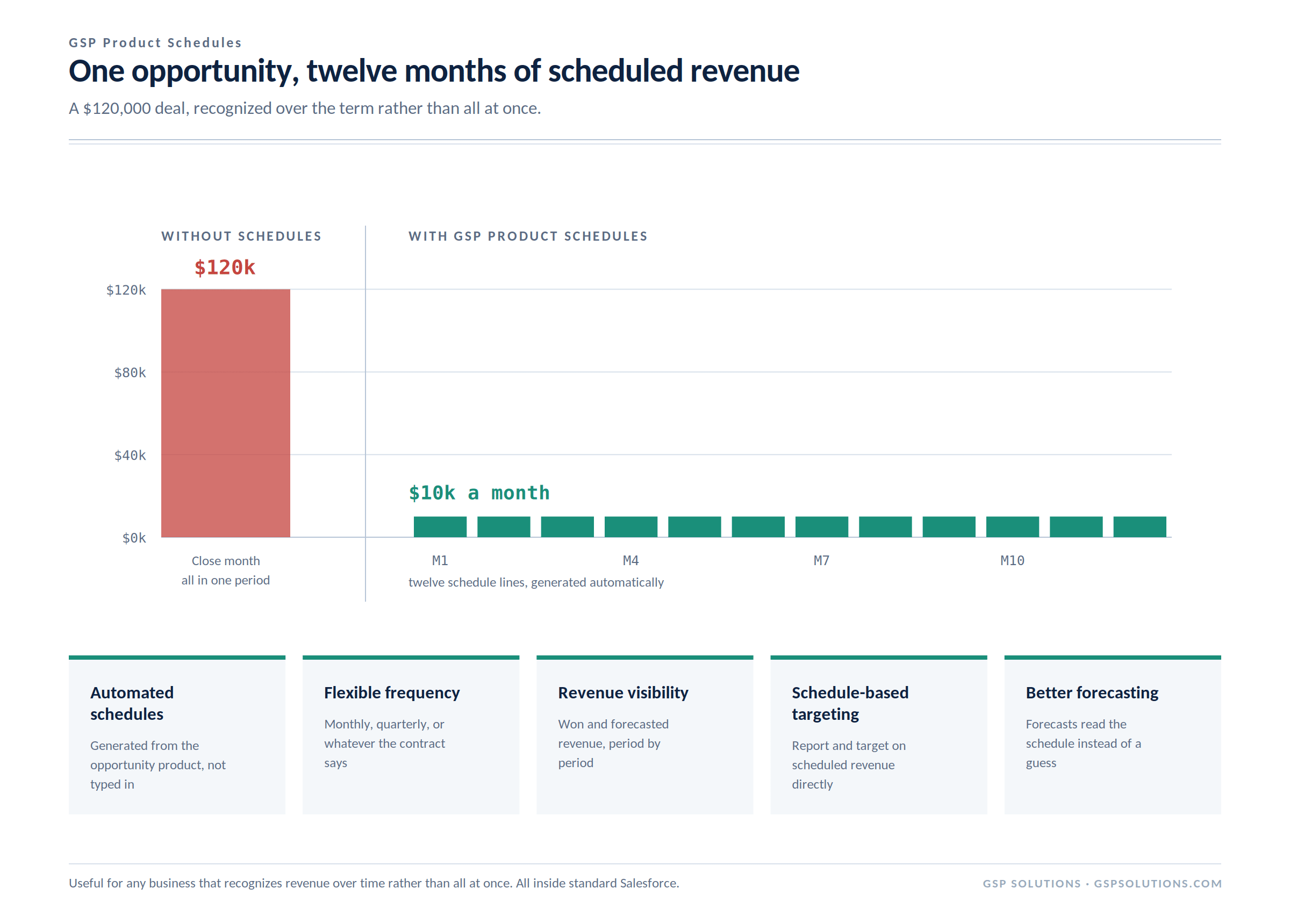
GSP Product Schedules lets businesses schedule revenue for opportunity products directly in Salesforce — useful for any business that recognizes revenue over time rather than all at once.
GSP Product Schedules offers:
- Automated recurring product schedules
- Flexible scheduling frequency
- Revenue visibility
- Schedule-based targeting
- Improved forecasting
All this is available without leaving standard Salesforce.
Agentforce Revenue Management
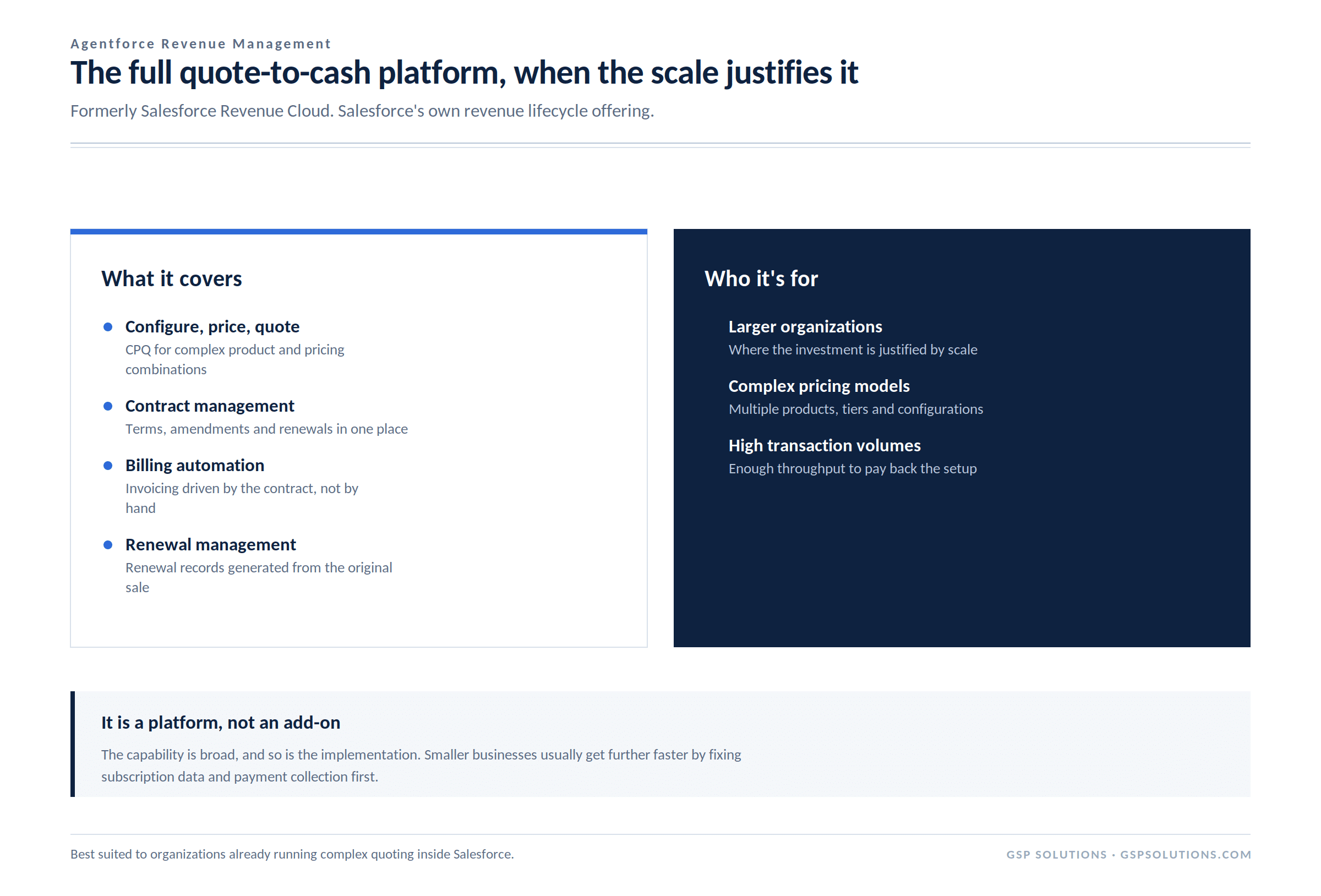
Agentforce Revenue Management, formerly Salesforce Revenue Cloud, is the platform’s native revenue lifecycle management offering, covering configure-price-quote (CPQ), contract management, billing automation, and renewal management.
It’s best suited to larger organizations with complex pricing models and high transaction volumes, where the scale justifies the investment in a fuller platform.
Certinia and Accounting Seed
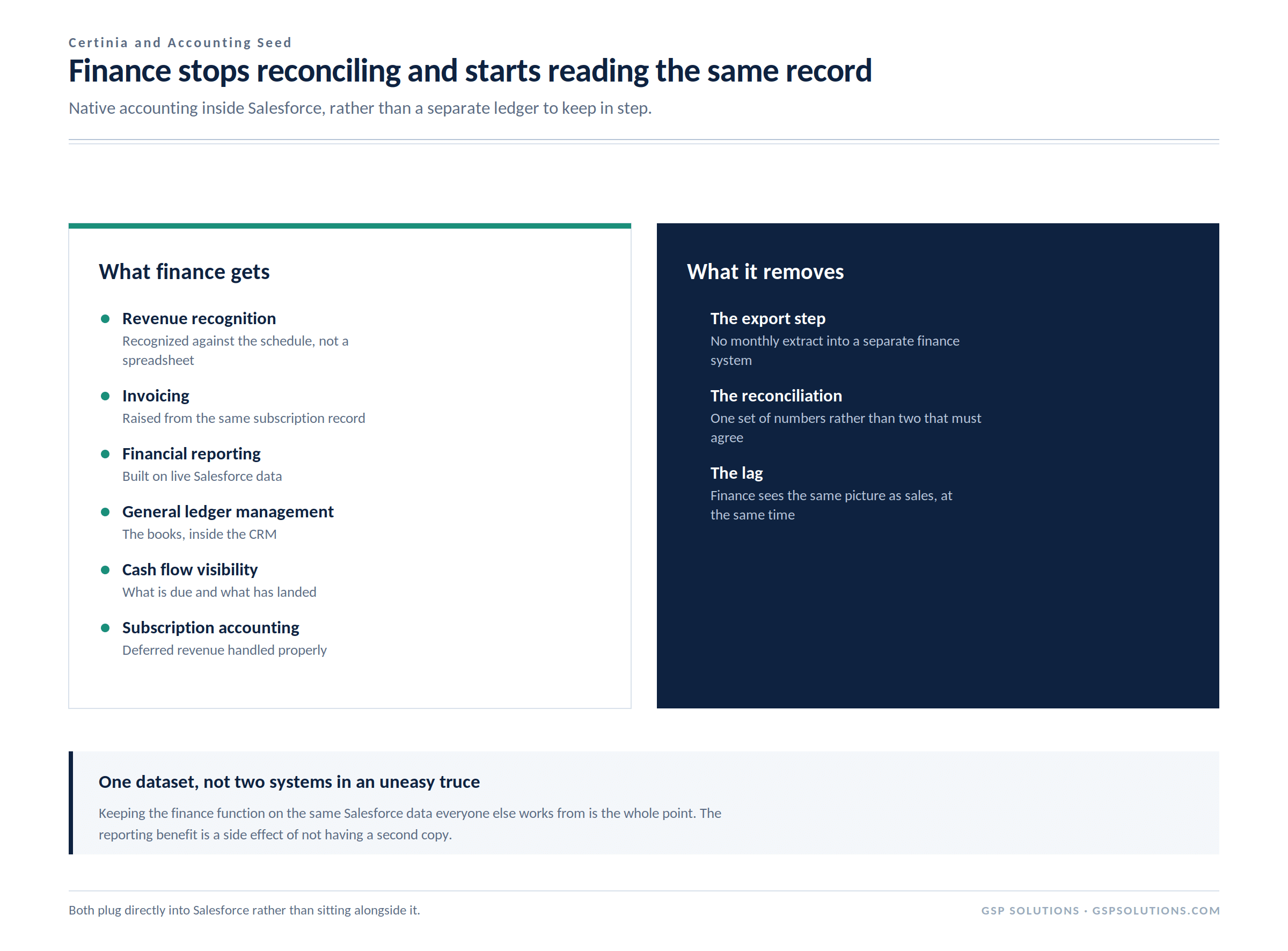
Certinia and Accounting Seed plug directly into Salesforce to give finance teams revenue recognition, invoicing, financial reporting, general ledger management, cash flow visibility, and subscription accounting.
This helps keep the finance function aligned with the same Salesforce data everyone else is working from.
DocuSign and Conga
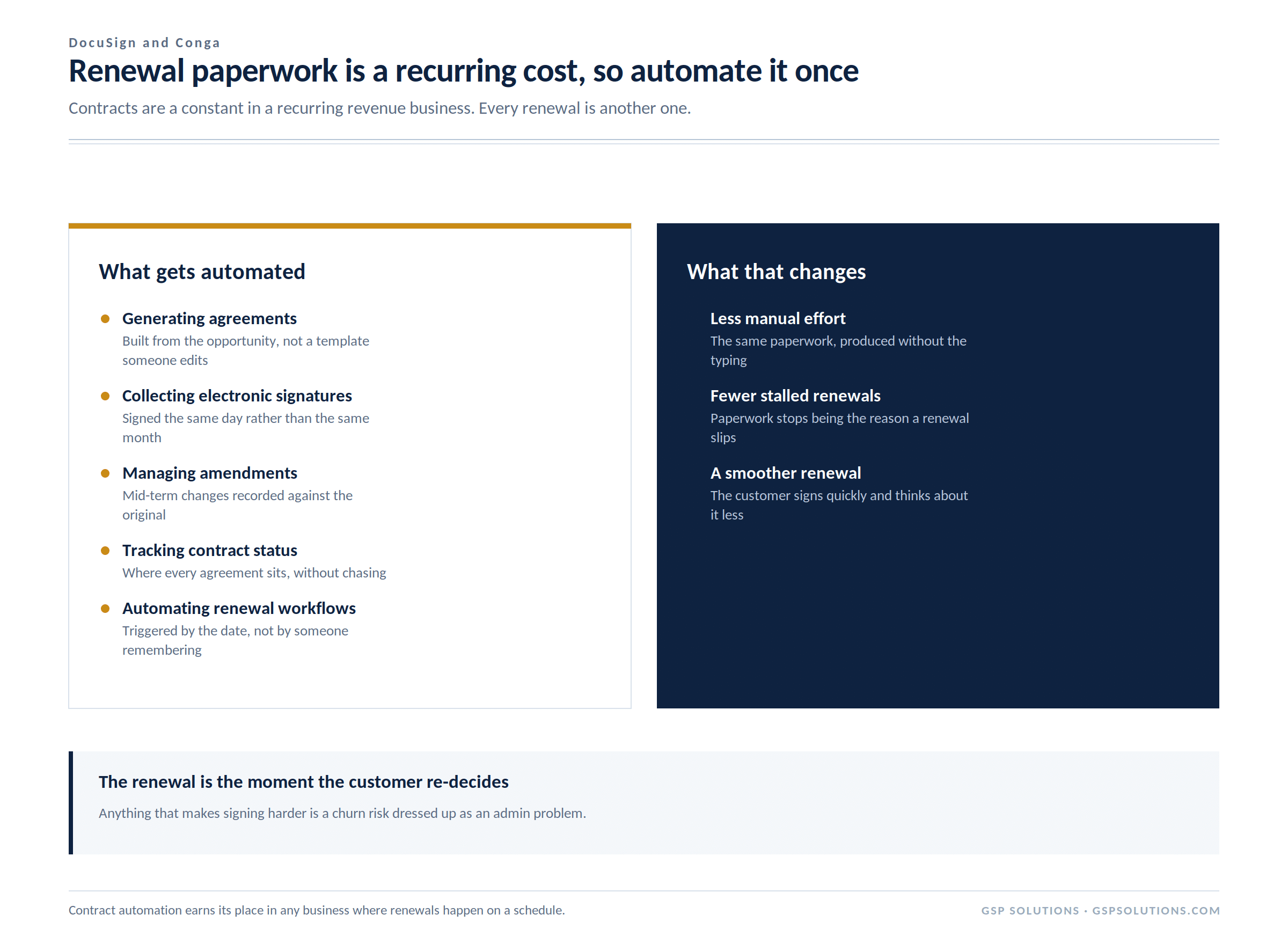
DocuSign and Conga handle the contract paperwork:
- Generating agreements,
- Collecting electronic signatures,
- Managing amendments,
- Tracking contract status,
- Automating renewal workflows.
The result is less manual effort in creating and sending contracts, which are a constant in recurring revenue businesses, and a smoother experience for the customer at every renewal.
Stripe and Chargent
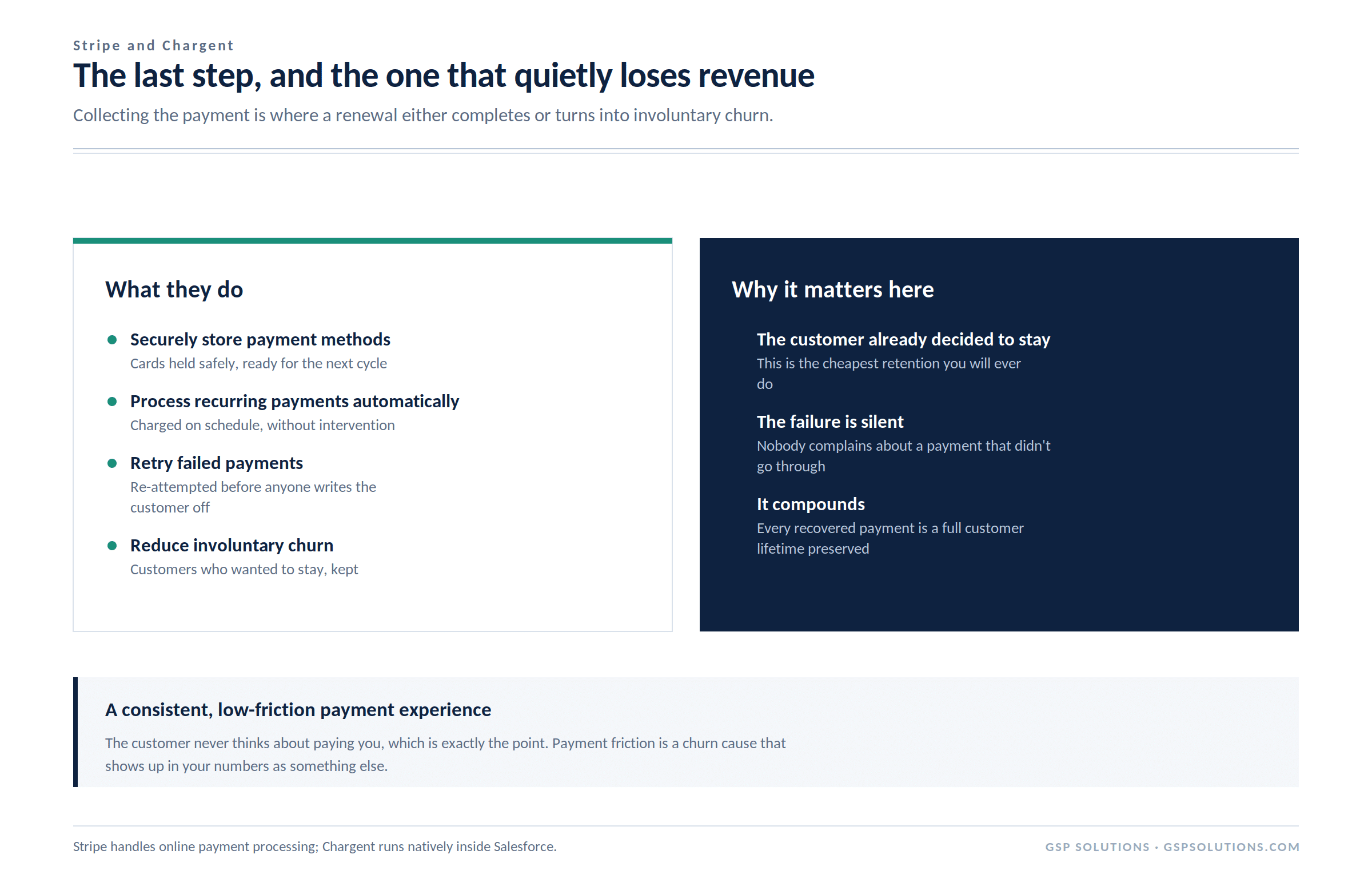
Stripe and Chargent handle the last step in the recurring revenue process: collecting payments.
They securely store payment methods, process recurring payments automatically, retry failed payments, and help reduce involuntary churn — while giving customers a consistent, low-friction payment experience.
How Do You Choose the Right Recurring Revenue Tools?
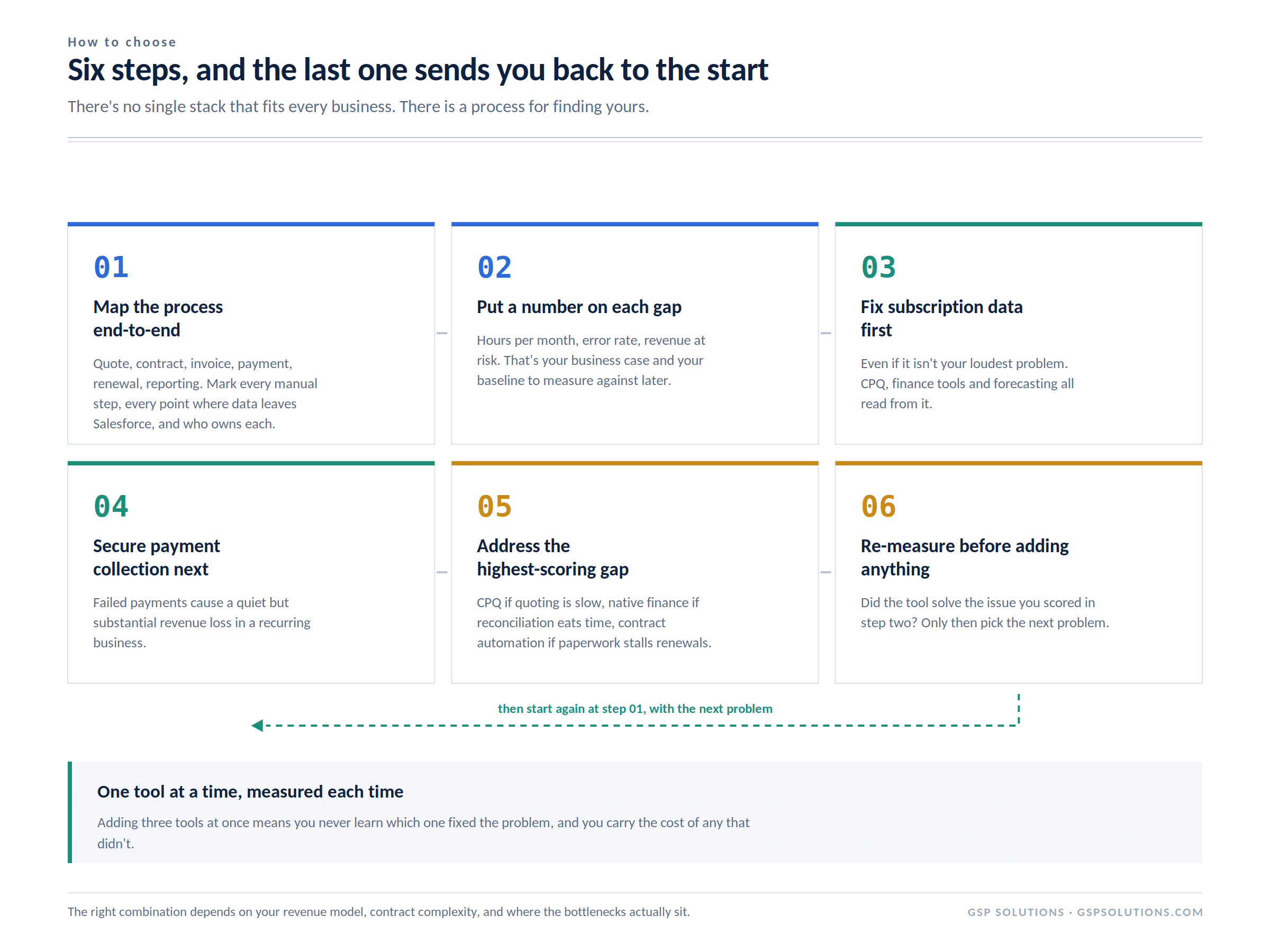
There’s no single stack that fits every business, so before you start adding tools to your tech stack, follow this process:
- Map the process end-to-end — quote, contract, invoice, payment, renewal, reporting. Mark every manual step, every point where data leaves Salesforce, and who owns each.
- Put a number on each gap. Hours per month, error rate, revenue at risk. That’s how you build a business case and get a baseline to measure against later.
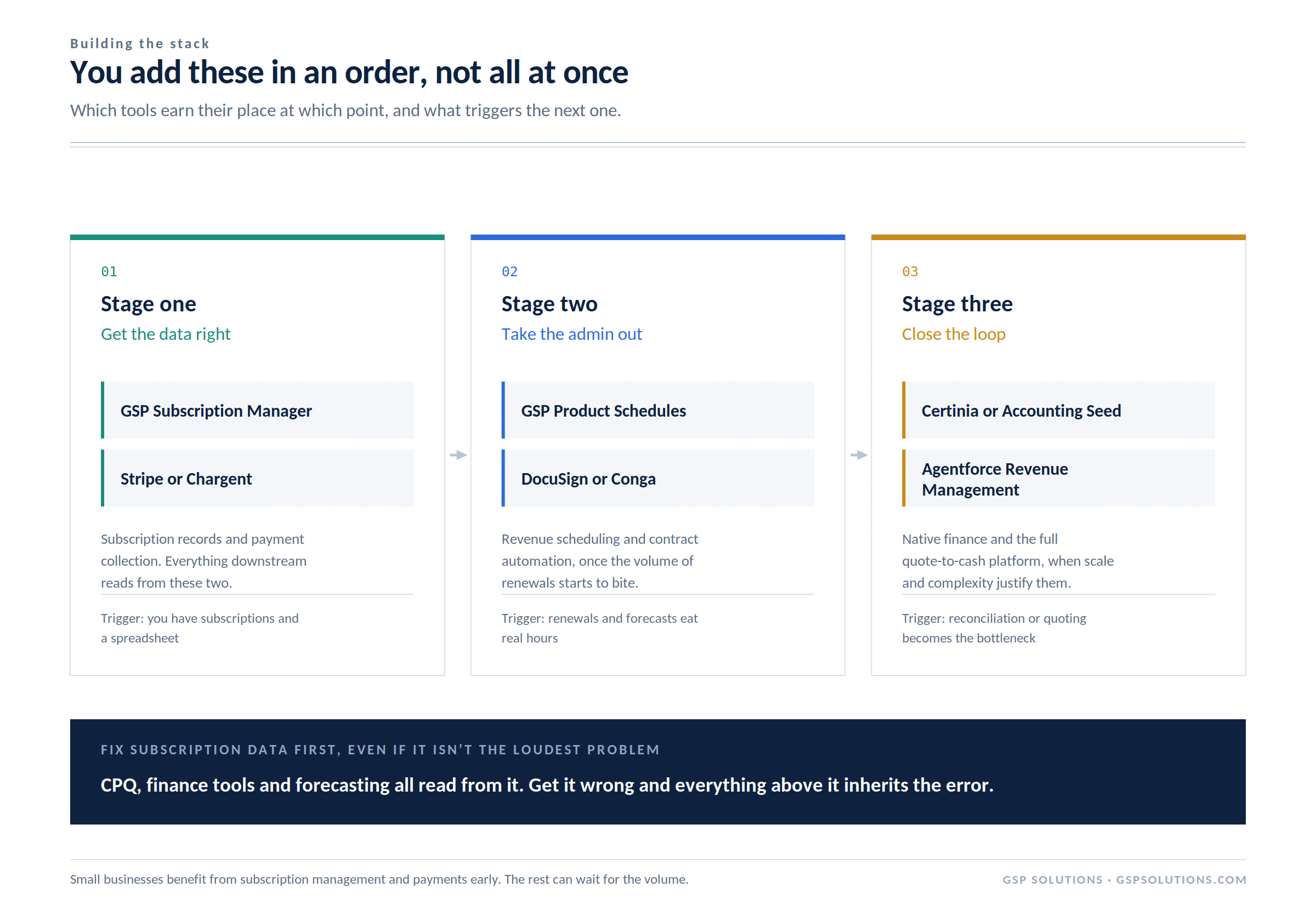
- Fix subscription data first, even if it isn't your loudest problem. CPQ, finance tools, and forecasting all read from it.
- Secure payment collection next. Failed payments cause a quiet yet substantial revenue loss in a recurring business.
- Address whichever gap scored highest in step 2: CPQ if quoting is slow or error-prone, native finance tools if reconciliation is eating time, contract automation if paperwork stalls renewals.
- Re-measure before you add the next thing. Did the tool solve the most pressing issue from step 2? Only when you’re satisfied with the answer, pick the next tool to solve the next problem.
Building a Scalable Technology Stack
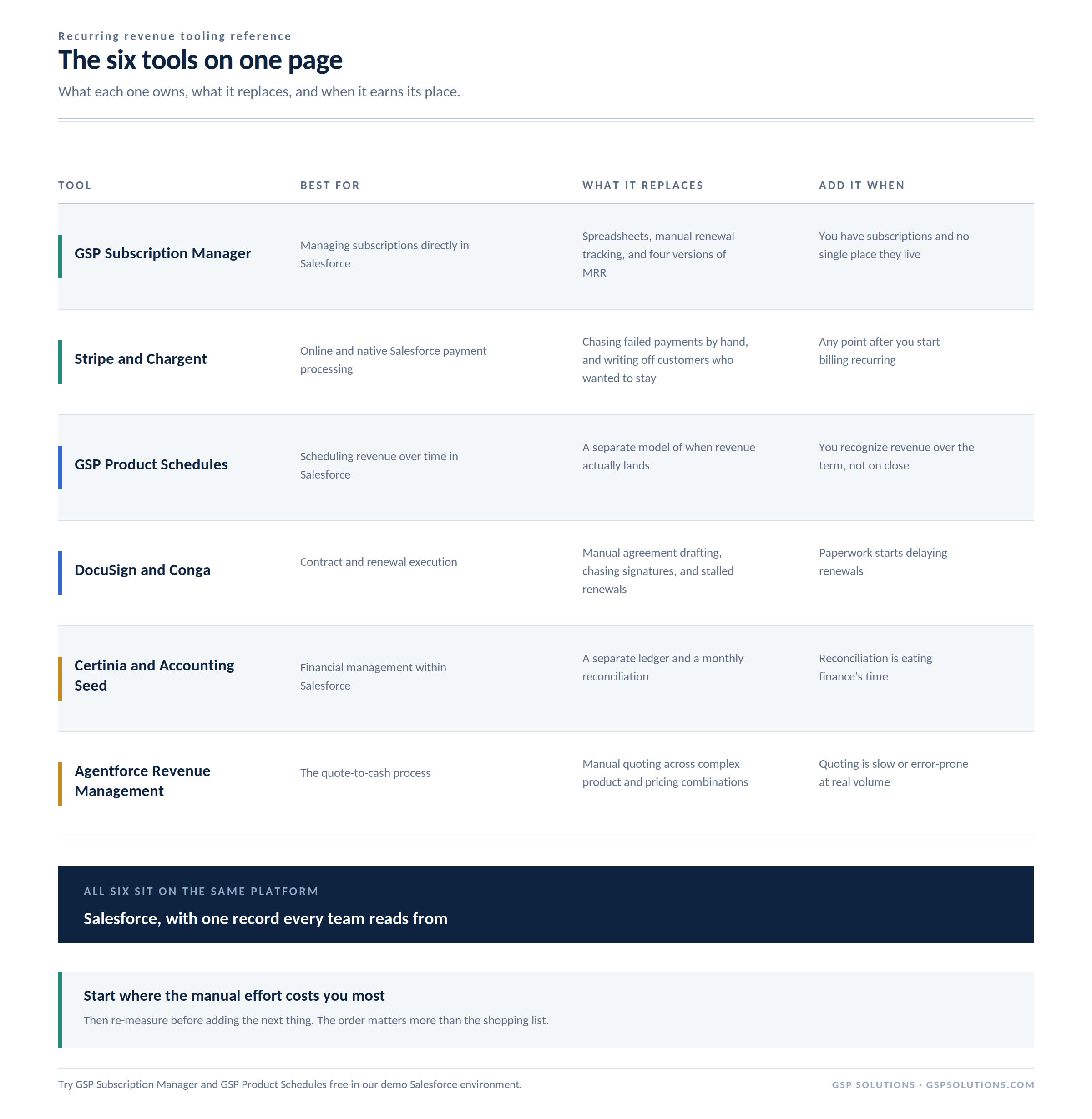
The 6 tools help businesses reduce manual effort and put Salesforce at the center of the recurring revenue process — giving every team, from sales to finance, the same reliable, real-time picture of the business.
The right combination of tools depends on your revenue model, contract complexity, and where the current bottlenecks sit — whether that’s inaccurate forecasting, slow renewals, or manual billing errors. Start by identifying where manual effort is costing you the most time or introducing the most risk, and prioritize tooling there first.
If subscription management or revenue scheduling are your top priorities and you’d like to learn more about GSP Subscription Manager or GSP Product Schedules, click the links and try them out for free in our demo Salesforce environment. No installation or setup needed.
FAQs
Most recurring revenue businesses need tools for subscription management, billing, payment collection, forecasting, contract management, financial reporting, and customer renewals.
The exact technology stack depends on the size of the business, its revenue model, and the complexity of its sales process.
