

How to Write Better AI Prompts for B2B Sales
Your competitors use the same AI tools — so do your buyers. What separates a weak sales prompt from one that works, with ten prompts for B2B sales teams.
Last updated October 8, 2026

On This Page
The Short Answer
A strong B2B sales prompt gives an AI tool three things: relevant source material, a specific commercial task, and rules for separating fact from inference.
The biggest improvement most salespeople can make is to stop asking AI to generate based on a company name and start asking it to analyze transcripts, notes, proposals, and other evidence they already have.
That single shift accounts for most of the gap between output a salesperson deletes and output they take into a meeting.
Why Does Prompt Quality Matter If Everyone Has the Same Tools?
GSP Solutions' TSAR framework sets out four levels of AI benefit in B2B sales. The first is Table Stakes: individual salespeople using AI for isolated tasks. Researching an account. Drafting an email. Tightening a proposal. Summarizing a call.
Almost everyone is already there. Salesforce's 2026 State of Sales report found that 87% of sales organizations use AI in some form. The tools are ubiquitous, mostly free at the point of use, and genuinely good.
Which is exactly the problem.
If every seller in your market has ChatGPT open in a browser tab, using ChatGPT is not an advantage. It's the price of entry. Much of the remaining advantage at this level comes from using the tools better than the person selling against you.
The complete guide is also available as a free eBook — read what's inside or download the PDF.
Newton's Law of AI
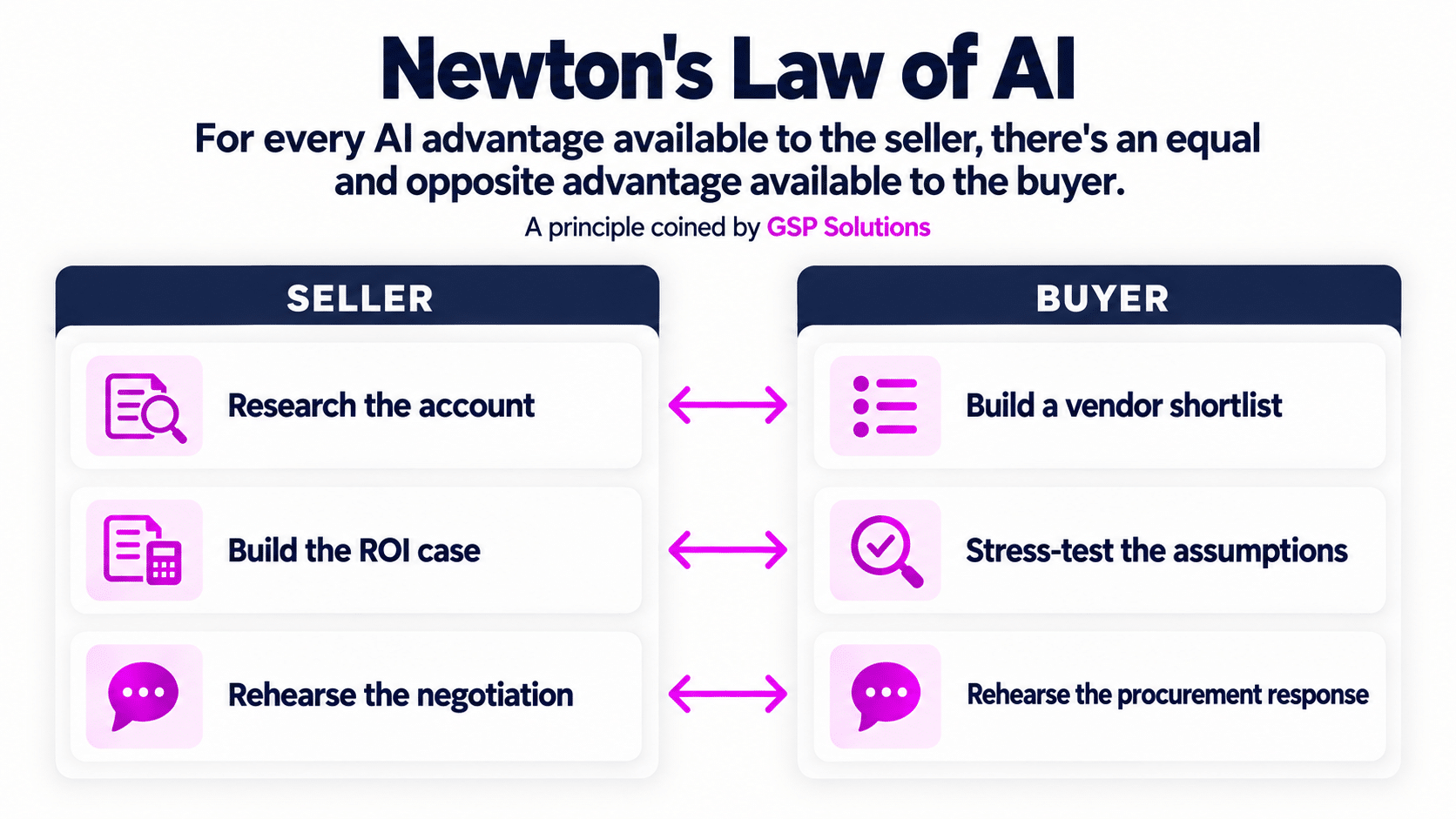
GSP Solutions' Newton's Law of AI states that every AI advantage available to a B2B seller has an equal and opposite advantage available to the buyer.
| Research the account before the first call | Build a vendor shortlist before you know they exist |
| Write a personalized cold email | Triage an inbox and filter out anything that pattern-matches to outreach |
| Build the ROI case in your proposal | Stress-test that ROI case and find the assumption it rests on |
| Prepare discovery questions | Prepare answers, and research your pricing against benchmarks |
| Draft the proposal | Line your proposal up against two competitors' and diff the scope |
| Rehearse the negotiation | Rehearse the negotiation, with a model that has read more procurement playbooks than you have |
AI in B2B Sales: Key Statistics
That raises the bar for what a seller brings to the meeting. Generic AI output doesn't clear it, because the buyer has already generated the generic version themselves.
- 94% of B2B buyers used AI during their buying process, up from 89% the year before (Forrester, Buyers' Journey Survey, 2025).
- Twice as many buyers rated generative AI or conversational search as their most meaningful source of information than named any other — ahead of vendor websites, product experts, and sales (Forrester, Buyers' Journey Survey, 2025)
- The average B2B purchase involves 13 people inside the buyer's organization and nine outside it (Forrester, Buyers' Journey Survey, 2025).
- 69% of B2B buyers prefer to validate AI-generated insights with a sales rep, and 51% say they are more likely to encounter misleading information from generative AI than from other sources (Gartner, survey of 645 B2B buyers, 2026).
- 87% of sales organizations use AI in some form (Salesforce, State of Sales, 2026).
- Assigning an AI model an expert persona yields no reliable improvement in factual accuracy and sometimes worsens results (Wharton Generative AI Labs, 2025).
What the Advantage Actually Looks Like
Two reps are preparing for the same first meeting with the CFO of a mid-sized manufacturer.
Rep A pastes in the company name and asks for a briefing. Back comes a competent summary: what the company makes, roughly how big it is, recent press releases, and some generic questions about operational efficiency. It's fine. It's also, more or less, the same briefing the CFO's own team generated when they researched Rep A's company last week.
Rep B feeds the model the last two earnings call transcripts, the annual report, and notes from three similar deals her company won and lost in the same sector.
Then she asks a narrower question: where do the priorities this CFO states publicly diverge from what the operational details in these documents suggest is actually happening?
She walks in with an observation that the buyer hasn't heard from anyone else. That's not a better tool. It's a better question, asked of better inputs.
What Makes a Good Prompt?
Take a prompt that a salesperson might realistically type and watch it improve.
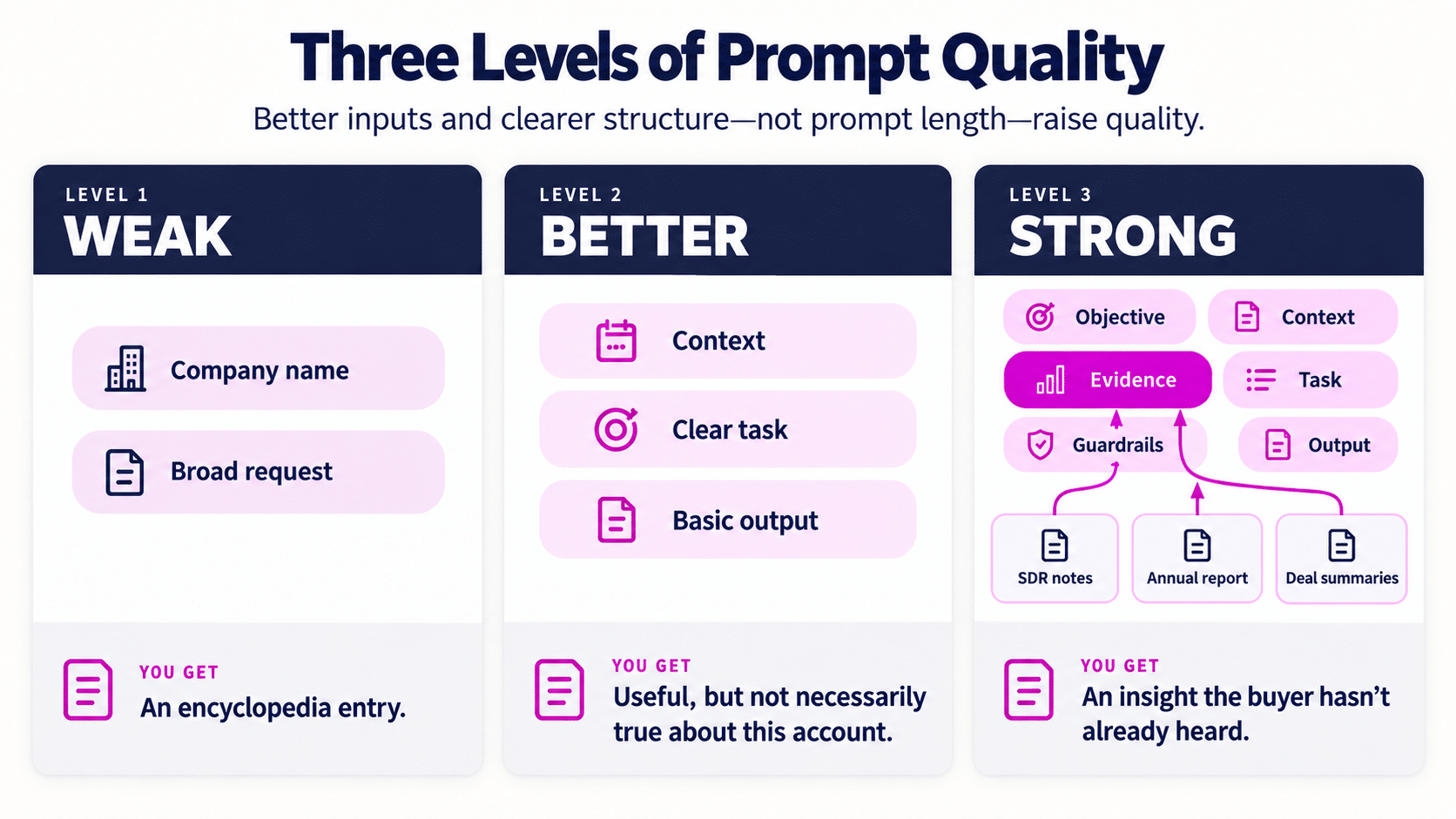
Level 1: The one-liner
"Tell me about Acme Manufacturing."
You get an encyclopedia entry: public, stale, and not about selling. The model has no purpose, no audience, and nothing to work with.
Level 2: Context and a job
"I'm meeting the VP of Operations at Acme Manufacturing next week. We sell warehouse automation software to mid-market manufacturers. Give me a briefing covering their business model, likely operational pressures, and five questions that would show I'd done my homework."
Much better, and this is where most decent prompts stop. The model now knows who's asking, who's being met, and what the output is for.
The weakness is that everything in the answer comes from general model knowledge or whatever public information the tool can retrieve. Plausible, but not necessarily true about this account, and not informed by anything your team already knows.
Level 3: Your material, analyzed
Same meeting, same seller. The difference is what goes in.
"I'm meeting Sarah Chen, VP of Operations at Acme Manufacturing, next Tuesday. My objective is to work out whether there's a real problem worth exploring, not to pitch.
Below are three things:
(1) our SDR's qualification call notes
(2) Acme's latest annual report, (3) call summaries from two similar deals last year.
Read all three, then give me:
- Three plausible operational pressures that may be relevant to Sarah, each supported by a specific passage in the source material and labeled as a hypothesis
- Anything in our SDR notes that contradicts the annual report
- Six discovery questions that test those pressures without leading the witness
- The one thing about our category she's most likely to be skeptical about
Don't tell me anything you can't point to in the source material. Label inferences as inferences."
What changed:
- Real inputs — The model isn't guessing. It's reading.
- A source requirement — Asking the model to show what supports each conclusion is one of the simplest ways to expose unsupported claims, though you still have to check that the source says what the model claims it says.
- A contradiction check — Cross-referencing sources is something models do well, and humans do badly under time pressure
- A request for bad news — Asking where you're weak is what a good sales manager does and what a prompt rarely does.
- Permission to say "I don't know" — Separating evidence from inference stops the model from filling gaps with confident invention.
What Should a Strong Sales Prompt Include?
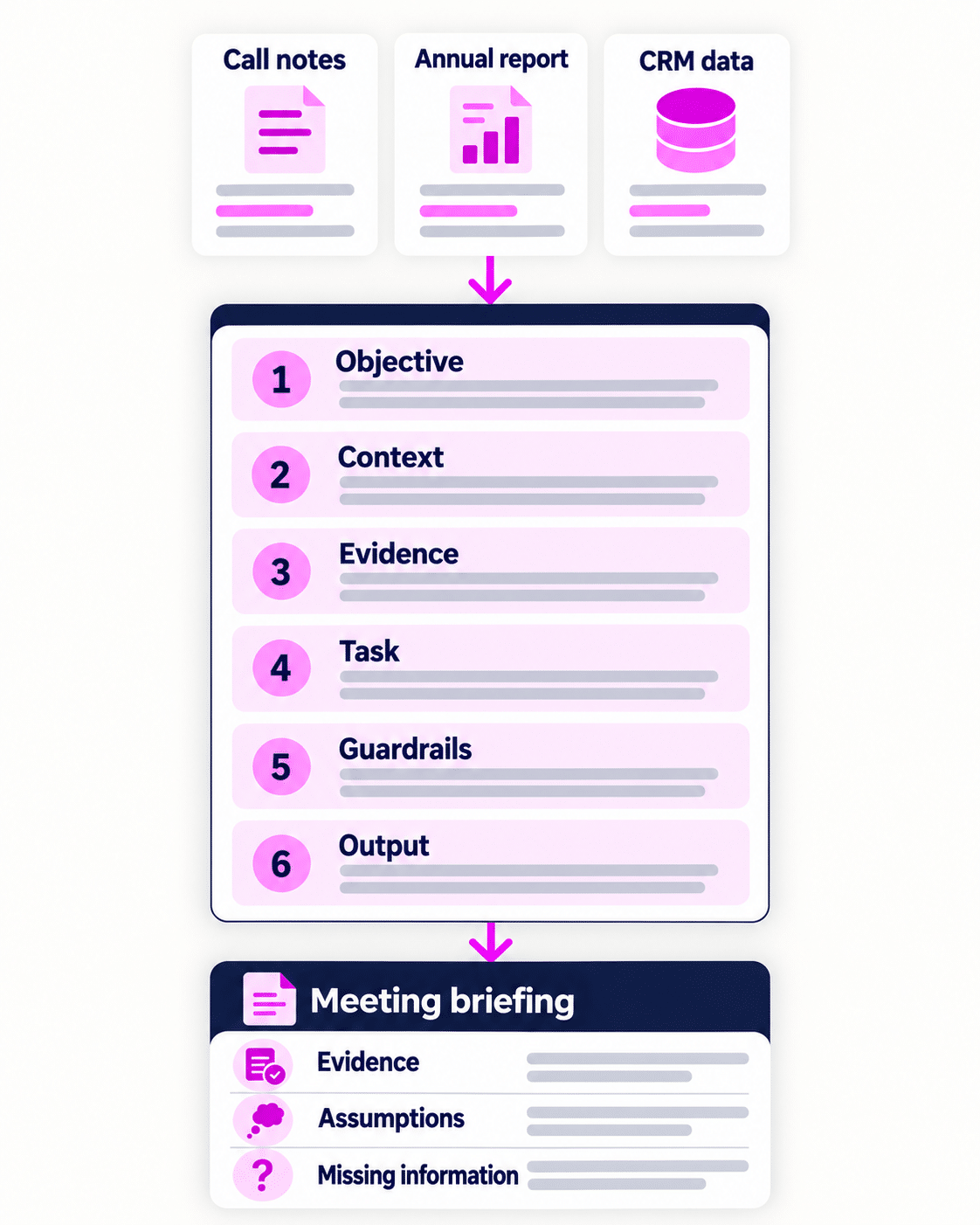
GSP Solutions uses a six-part structure for B2B sales prompts: objective, context, evidence, task, guardrails, and output. It adapts published guidance from OpenAI and Anthropic to the needs of a sales conversation.
Together, the six elements tell the model what commercial outcome matters, what evidence it may use, what it must not assume, and what a useful answer looks like. You don't need the labels every time, but the underlying questions should be answered.
- Objective - what decision, conversation, or action should this improve?
"Prepare me to test whether a problem exists" beats "research this account."
- Context - who you are, what you sell, who the buyer is, the stage of the relationship, and what's happened so far.
"First meeting, inbound inquiry, no budget discussed." - Evidence - the transcript, notes, proposal, CRM data, or approved source material.
The element most sellers skip, and the one that most affects output. - Task - exactly what you want analyzed, compared, drafted, or challenged.
One job, or a short list of related ones. Not fifteen. - Guardrails - what the model must not assume or invent, where to label hypotheses, what to flag as missing.
Don't infer a pain point from the job title. - Output - audience, format, length, and the test a good answer has to pass.
"A one-page briefing I can review on my phone five minutes before the meeting"
A Reusable AI Prompt Template for B2B Sales
Copy this and adapt it. Delete anything that doesn't matter for the task.
OBJECTIVE
[What decision, conversation, or action should this improve?]
CONTEXT
I am [role] at [company]. We sell [product/service and the outcome it delivers].
The customer is [company]. The stakeholder is [name/role].
Current situation: [deal stage, history, timing, constraints].
EVIDENCE
Use the material below. [Paste transcript, notes, CRM data, proposal, or links.]
TASK
[Exactly what to analyze, compare, draft, or challenge.]
GUARDRAILS
Separate verified facts from assumptions. Don't invent figures, quotes,
relationships, or customer priorities. Identify missing information that
would materially change the answer.
OUTPUT
[Structure, audience, length, tone.]
Useful follow-up: "What important information is missing, and which parts of your answer are you least confident about?"
What Prompting Mistakes Should You Avoid?
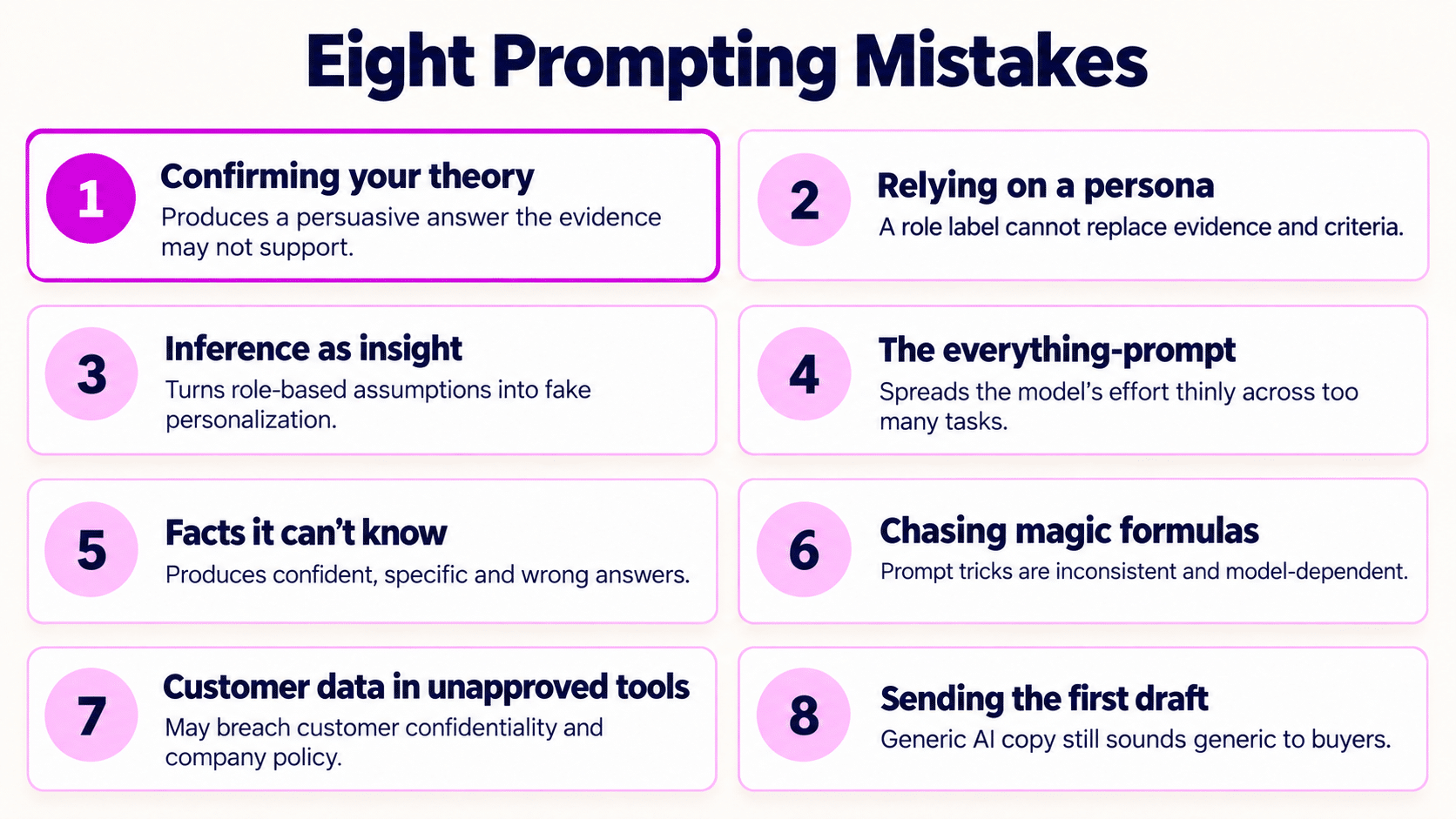
Some are the inverse of good practice. Several are not, and those are worth reading closely, because they feel like good practice or explain Why AI in Sales Projects Go Wrong.
Don't ask the model to confirm your theory
"Explain why this company needs our product" invites a persuasive answer, whether the evidence supports it or not. You will get one. You'll then walk into a meeting holding a case the buyer can dismantle in ninety seconds.
Ask instead: what supports this hypothesis, what contradicts it, and what would I need to discover to know either way?
This one is particularly costly because it sends a salesperson into a meeting ready to defend a problem the buyer has never said they have.
Don't assume the persona is doing the work
Almost every sales prompt library in circulation opens with "Act as a world-class enterprise sales strategist."
The research on whether this helps is not encouraging. Wharton's Generative AI Labs ran six models across two graduate-level benchmarks and found that assigning an expert persona produced no reliable improvement in accuracy against no persona at all. Where it did make a measurable difference, it was more often negative than positive. An earlier study across four model families and 2,410 questions reached the same conclusion.
The Wharton team also found that when a model was given an expert persona that didn't match the question, it sometimes refused to answer, on the grounds that it lacked the relevant expertise. A role instruction that's too narrow can make a model use less of what it knows, not more.
Personas aren't useless. They shape tone, and naming a role often helps the human frame a sharper question. But if you think "act as a CFO" is what makes the output good, you're crediting the wrong part of the prompt.
Instead: keep the role if it helps you think, but never let it substitute for criteria. "Review this proposal the way a CFO would, focusing on whether the payback period is defensible" is worth more than "Act as a CFO" plus a vague request.
Don't treat inference as customer insight
A job title and an industry do not reveal a person's priorities, budget, frustrations, or politics. A model that produces "as a VP of Operations, Sarah is likely frustrated by manual processes" has told you nothing about Sarah.
Use role-based assumptions to generate questions. Never to make claims, and never as the basis for fake personalization.
Don't build the everything-prompt
A typical public prospect research prompt asks for a company overview, business model, recent news, strategic priorities, growth objectives, operational challenges, recruitment challenges, technology initiatives, buying triggers, decision makers, risks, five conversation starters, ten discovery questions, and three recommendations.
You'll get all of it, at two sentences each, because the model has budgeted its effort across fourteen headings.
Three good discovery questions grounded in a real transcript beat ten generated from a company name.
Don't ask the model to know things it can't know
A general-purpose model works from training data with a cutoff date plus whatever it can pull in a quick search. Ask who the current CRO is, what a private company billed last year, or whether a deal closed, and it may produce a confident, specific, wrong answer.
This is the failure mode that embarrasses someone in front of a customer.
Split the work. Use a search-grounded tool — Perplexity, or the search modes in ChatGPT and Claude — for anything that needs to be currently true, and check the citations. Use the model's reasoning for analysis, structure, and drafting, where "true" isn't the relevant test.
Then apply the meeting test: would I be comfortable being asked where I got this? If not, verify it or drop it.
Don't go looking for the magic formula
There's a cottage industry in prompt tricks: tipping the model, threatening it, extreme politeness, telling it to take a deep breath.
Wharton tested this, too. In Prompting Science Report 1, politeness helped with some questions. It hurt others, with individual questions swinging by up to 60 percentage points either way, and the effects washing out entirely across the full dataset. Their second report found that "think step by step," the most famous prompting trick of all, now delivers little when using newer reasoning models, while costing significantly more time and tokens.
Formulas don't travel. Clear context, real evidence, and a specific task do.
Don't put customers' data into an unapproved tool
Free and personal-tier accounts often have different data-handling terms than business accounts. Pasting a customer's contract, pricing, or roadmap into a personal ChatGPT account could result in a procurement conversation nobody wants to have.
Practical rule: never give an AI tool information you wouldn't be comfortable handling under your company's security, privacy, and customer-confidentiality policies. Consumer and business accounts can have different data controls, so the plan and the settings matter, not just the product name.
This is a policy question, not a prompting one. But every sales team should have a one-page answer to the question, "What am I allowed to paste in?"
For Salesforce teams, an approved Agentforce implementation can reduce the need to copy customer information into a separate AI tool. It can work with relevant CRM records and approved knowledge sources while applying existing Salesforce permissions. Salesforce also says information sent to external model providers is subject to zero-data-retention arrangements.
Those protections matter, but they don't mean every piece of sensitive information is automatically masked or appropriate to use. Your organization must still decide what an agent may access, what it may do, and when human approval is required.
Don't send the first draft
Buyers may not always know an email was written by AI. They can tell when it could have been sent to forty other accounts.
However many merge fields a draft contains, that isn't personalization. The last edit should be human, and it should be the part only you could have written.
FREE EXECUTIVE GUIDE
Want all of this as a visual PDF?
TSAR, ARMS RACE, and the $450,000 case study, laid out for you to take into a leadership meeting.
10 AI Prompt Examples for B2B Sales
Each prompt is built on the same principle: give the model your material and give it a specific job. Replace anything in [brackets].
Where a prompt asks you to paste something in, that instruction is the point.
The follow-up under each prompt matters as much as the prompt itself. See the section after this one for why.
- Research a prospect without inventing a reason to buy
- Prepare for a first meeting
- Find the blind spots in an outreach message
- Pressure-test a cold call opener
- Prepare discovery questions
- Find what you missed on a call
- Turn call notes into a CRM update
- Pressure-test a proposal through the buying committee
- Prepare for price pressure without reaching for a discount
- Challenge a forecast rather than summarize it
1. Research a prospect without inventing a reason to buy
We sell [solution] to [ideal customer profile], helping them [outcome you can evidence]. I'm researching [Prospect] to decide whether to pursue the account.
Use the company website, recent filings or annual reports, earnings commentary, and credible news. Give me:
- The business model and current stated priorities, in five lines
- Three recent changes that could affect those priorities, with source links and dates
- Three problems we might be able to address, labeled as hypotheses
- For each hypothesis, the evidence that weakens it
Use current public sources. If you cannot access the web or the sources I've supplied, say so clearly and don't fill the gaps from memory.
Don't infer a pain point from the industry or job title alone. Distinguish facts, reasonable inferences, and unknowns.
Why it works: it turns research into qualification and stops the model from manufacturing a convenient buying trigger.
Follow-up: "Which two hypotheses are best supported, and what would I need to verify in a first conversation?"
2. Prepare for a first meeting
I have a [duration]-minute first meeting with [Name], [Role] at [Company], on [date]. We provide [solution and outcome]. The meeting was arranged because [known reason].
My objective is to find out whether there's a real problem worth exploring, not to pitch.
Here's the research and correspondence so far: [paste]
Give me:
- An opening that confirms the purpose of the meeting in two sentences
- Five prioritized discovery questions, each tied to a specific unknown
- Three assumptions I should avoid making
- One way this meeting creates value for the buyer, even if there's no opportunity
Keep the language conversational. Don't write a word-for-word script.
Why it works: it prepares the seller to listen and adapt, rather than perform an AI-written script.
Follow-up: "Role-play a skeptical buyer and challenge these questions before I use them."
3. Find the blind spots in an outreach message
Here's a prospecting message I'm about to send: [paste the email, LinkedIn message, or voicemail script].
The reader is [role] at [type of company]. My legitimate reason for contacting them is [reason and the evidence for it].
Review it from their point of view and identify:
- What's genuinely relevant to them, and what's really about us
- Any personalization that isn't supported by the evidence I've given you
- Phrases that sound generic, inflated, or AI-written
Then rewrite it in under [word count] words, keeping only claims the evidence supports.
Give me one version, not a list of alternatives, and explain the three most important changes.
Why it works: the critique comes before the rewrite, so the model exposes weak thinking instead of polishing it.
Follow-up: "On a busy Tuesday morning, does this get a reply? Why or why not?"
4. Pressure-test a cold call opener
I'm planning to use this opening on a cold call: [paste your opener].
Evaluate it against five criteria: does it lower resistance, is it easy to answer, does it sound conversational rather than scripted, is it about them rather than me, and does it earn the right to keep talking?
Where the answer is no, explain why, then rewrite it so it meets all five. Give me two versions with different tones.
Why it works: five explicit criteria produce specific feedback. "Improve this opener" produces a rewrite you can't evaluate.
Follow-up: "Give me three plausible responses I might get, labeled as hypotheses rather than predictions, and how I'd handle each."
5. Prepare discovery questions
Discovery call with a [role] at a [industry] company of around [size]. We're exploring [the problem you think exists].
Give me eight questions grouped by what each is designed to uncover: the business problem, its measurable impact, who else is involved, and how urgent it is.
For each question, tell me what an answer would need to contain for the point to count as established, and what kind of answer would leave it unestablished and warrant a follow-up.
Then flag the two most likely to make me sound like every other vendor, and replace them.
Why it works: asking what "established" looks like is what turns a question list into preparation. It also avoids treating every vague answer as deliberate evasion — buyers are often just busy or genuinely unsure.
Follow-up: "Which of these questions would a buyer find presumptuous this early in the relationship?"
6. Find what you missed on a call
Review this sales call transcript as an experienced B2B sales coach: [paste transcript].
Identify moments where I could have asked a stronger follow-up, clarified business impact or urgency, tested an assumption, or confirmed a commitment.
For each, quote only the minimum words needed to locate it, explain why it mattered, and give me the better question.
Then: the two coaching priorities that would most improve my next calls. Don't infer tone, intent, or emotion unless the transcript supports it.
Why it works: it anchors coaching to observable moments rather than producing a generic scorecard.
Follow-up: "What did the customer say that I should be worried about, and what did they say that's more encouraging than it sounds?"
7. Turn call notes into a CRM update
Convert the notes below into a CRM update, using only information explicitly stated in them.
Return: customer objective, current problem, business impact, stakeholders named and their stated roles, decision process and timing, competition mentioned, risks and open questions, our commitments, their commitments, next step with owner and date, and a recommended opportunity stage with a one-sentence rationale.
Use "Not established" for anything missing. Do not turn assumptions into CRM facts.
Our stage definitions: [paste your organization's actual definitions].
Call notes: [paste]
Why it works: "Not established" is more valuable than a confidently completed but inaccurate record. It also makes the gaps visible rather than burying them.
Follow-up: "Which three missing items create the greatest deal risk, and how would I resolve them?"
For Salesforce users, this can become a repeatable workflow rather than a prompt that every salesperson runs separately. Agentforce Pipeline Management can use connected notes, emails, and calls to suggest updates to opportunity fields such as Stage and Next Step, and the salesperson can see the source context and review, edit, or approve the proposed update before it changes the record.
The quality of the result still depends on the organization's stage definitions, source data, and business rules. Automating an ambiguous sales process only produces ambiguous CRM updates more efficiently.
If your stage definitions aren't clearly written enough to paste into a prompt, that's worth fixing first — see our guide to Salesforce opportunity stages.
8. Pressure-test a proposal through the buying committee
Below is a proposal we're about to send to [company] for [value].
[Paste.] Known stakeholders and their decision criteria: [list them; say so if unknown].
Review it four times, once from the perspective of: the CFO, the operational lead who'll use it, the technical stakeholder, and procurement. Use the stated decision criteria where I've given them. Treat anything inferred from a job title as a hypothesis, not a known priority, and label it as such.
For each reader, tell me:
- What they'll object to first
- What they'll skim past that we needed them to read
- What's missing that they'd need in order to say yes
Don't rewrite the whole proposal. Give me the five changes most likely to improve their decision quality, with revised wording for those sections only.
Why it works: it treats the proposal as a decision document rather than marketing copy, and the four-reader structure surfaces the objection that kills deals in committee.
Follow-up: "What would a skeptical CFO challenge first, and what evidence would answer it?"
9. Prepare for price pressure without reaching for a discount
A customer has asked for [discount or concession] on a [value] proposal.
Here's the proposal, the commercial context, and the exact wording of their request: [paste].
First, set out the plausible explanations: a genuine budget constraint, standard procurement practice, insufficient perceived value, or an unvoiced risk concern. For each, tell me what evidence supports it, what contradicts it, and what we don't know. Don't pick one unless the evidence clearly justifies it.
Then give me:
- Three questions that would distinguish between those explanations
- Three responses that hold the price, in language I'd actually say out loud
- Two concessions cheaper than the discount, and what we should ask for in return
Also, tell me the weaknesses in our value case that they're most likely to exploit.
Why it works: it forces diagnosis before prescription, without letting the model invent a buyer motive to be confident about. Most objection-handling prompts jump straight to responses, which is how sellers end up answering a question the buyer didn't ask.
Follow-up: "Role-play the procurement lead. Don't make this easy for me."
Related reading: 9 Expert Tips That Improve Discount Control in Salesforce
10. Challenge a forecast rather than summarize it
For sales leaders and RevOps.
Review the opportunity data below as a sales leader preparing the forecast. Use our stage definitions and forecast rules exactly as written.
For each material deal:
- The evidence supporting the current stage and forecast category
- Missing evidence or contradictions
- Close dates not supported by a customer event or decision plan
- Whether what's recorded is a customer commitment or a salesperson's activity
- The next question the manager should ask the rep
Then an executive summary: likely outcome, range of uncertainty, and the assumptions driving it.
Don't change stages, probabilities, amounts, or dates.
Don't treat a detailed CRM record as proof that a deal is healthy.
Stage definitions and forecast rules: [paste].
Opportunity data: [paste approved export].
Why it works: it looks for evidence and inconsistency rather than converting optimistic CRM data into polished commentary. The distinction between customer commitment and salesperson activity is where most forecast error lives.
Follow-up: "Which three assumptions, if wrong, would change the forecast most?"
Related reading: Why an Expected Revenue Forecast Stands Up to Scrutiny.
The Most Important Prompt Is Usually the Second One
Salespeople tend to judge these tools by the first response, which misses the main advantage of working conversationally.
Treat the first answer as a hypothesis. Tell it what it got wrong, supply the evidence it was missing, and ask it to argue the opposite.
Three follow-ups worth keeping in your head:
- "What are you assuming?"
- "What evidence would change this conclusion?"
- "What would a skeptical buyer challenge here?"
The goal isn't a perfect incantation. It's a disciplined working conversation with something that can research and critique at speed, but doesn't know your customer and doesn't carry the consequences.
How Do You Turn This Into a Team Capability?
Everything above is Table Stakes. One salesperson gets better at prompting, and one salesperson's output improves. Sharing prompts makes that work more consistent, but the benefit still depends on each salesperson using them. This is what GSP Solutions means by calling Table Stakes benefits freelance: they stay with the individual, they leave when the individual does, and they don't compound.
For Salesforce teams, Agentforce offers one route into the Solutions and Automation levels: embedding approved instructions, evidence requirements, and guardrails in workflows that consistently draw on CRM context. The prompt doesn't disappear — it stops being something each salesperson has to recreate.
You don't need to start with a platform project. Seven steps will strengthen your use of AI at the Table Stakes level and prepare you for that transition:
- Start with recurring, high-value tasks. Pre-meeting research, call review, CRM updates, proposal critique, forecast challenges — jobs where quality matters and the inputs already exist.
- Build the prompts around your actual sales process. Your opportunity stages, qualification criteria, buyer roles, proof points, and terminology. Generic prompts produce generic work, which is precisely the problem this article is about.
- Provide approved evidence. Your best discovery transcript. Your strongest case study. Your win/loss notes. Safe, sanctioned ways to get real material into a prompt. This is the single biggest lever.
- Test prompts against real examples. Compare the output against work your strongest reps and managers would actually accept. If it doesn't clear that bar, the prompt isn't finished.
- Share prompts with guidance, not as magic formulas. When it applies, what inputs it needs, what to check, and where judgment is still required.
- Fix the prompt when the output fails. If the team keeps correcting the same problem, update the shared prompt or the source material. Don't make forty salespeople rediscover the same fix.
- Make prompting part of coaching. In a deal review, ask what the rep asked the AI, not just what it told them. The prompt exposes the assumptions they made, the evidence they had, and the gaps they didn't notice. That's where the transferable learning sits.
Then measure the sales outcome — meeting quality, CRM completeness, proposal cycle time, forecast accuracy — rather than how many prompts got run.
These steps don't take you beyond Table Stakes on their own. But they make its benefits far more consistent and build a much stronger foundation for the Solutions and Automation levels of TSAR, where benefits stop being individual and start becoming measurable.
Where Does Human Judgment Still Matter?
AI can help a salesperson prepare, notice patterns, and improve a draft. It can't decide something is true because the answer sounded convincing, read the politics of a buying committee from a list of job titles, or tell whether an objection is a tactic, a genuine concern, or a polite way to end the conversation.
The salesperson still verifies the research, chooses the question, listens to the answer, and carries the consequence. More on the continuing role of the salesperson.
That's the actual route to better results: the speed and breadth of AI, combined with the context, skepticism, and commercial judgment of a capable seller.
Go Beyond Table Stakes
Prompting is the entry point and, deliberately, the least ambitious level of the TSAR framework: high adoption, real usefulness, low ceiling. The organizations pulling meaningfully ahead aren't the ones with the best prompt library. They're the ones who've worked out which end-to-end sales processes are worth rebuilding around AI, and then done the unglamorous work of rebuilding them.
In AI in B2B Sales: A Complete Guide for Sales Leaders — the TSAR framework, the ARMS RACE implementation model, why AI sales projects fail, and worked examples of AI applied across a B2B sales process.
Download the eBook: AI in B2B Sales: The Complete Guide for Sales Leaders eBook — the full guide in a 37-page PDF format you can share with your leadership team.
At GSP Solutions, AI in sales implementation is core to what we do, built on decades of Salesforce consultancy and deep experience in how B2B sales organizations actually work. If you're trying to get past Table Stakes, get in touch.
AI Prompts for B2B Sales: FAQs
What is an AI prompt in sales?
The instruction and context that a salesperson gives a generative AI tool to complete a sales task. A good prompt includes the commercial objective, the customer and deal context, supporting evidence, constraints on what may be invented, and the required output.
What is Newton's Law of AI?
Does it matter which AI tool I use?
Do I still need to write good prompts if my company uses Agentforce?
How long should a sales prompt be?
Do I need to say "act as an expert"?
Can AI write personalized sales emails?
Can salespeople put customer information into ChatGPT or Claude?
What's the biggest single improvement I can make to my AI prompts?
Sources and Further Reading
- Meincke, L., Mollick, E., Mollick, L. & Shapiro, D. (2025). Prompting Science Report 1: Prompt Engineering is Complicated and Contingent. Wharton Generative AI Labs.
- Meincke, L. et al. (2025). Prompting Science Report 2: The Decreasing Value of Chain of Thought in Prompting. Wharton Generative AI Labs.
- Basil, S. et al. (2025). Prompting Science Report 4: Playing Pretend: Expert Personas Don't Improve Factual Accuracy. Wharton Generative AI Labs.
- Zheng, M., Pei, J., Logeswaran, L., Lee, M. & Jurgens, D. (2024). When "A Helpful Assistant" Is Not Really Helpful: Personas in System Prompts Do Not Improve Performances of Large Language Models. Findings of EMNLP 2024.
- Forrester (January 2026). B2B Buyers Make Zero-Click Buying Number One, reporting Forrester's Buyers' Journey Survey, 2025.
- Forrester (2026). Three Realities About B2B Buying Networks, on buying group size, from the same survey.
- Gartner (May 2026). Gartner Survey Finds 69% of B2B Buyers Turn to Sales Reps to Validate AI-Generated Insights.
- Salesforce (2026). State of Sales.
- OpenAI. Prompt Engineering Guide and Sales Use Cases.
- Anthropic. Prompt Engineering Overview.
- Prompt patterns adapted from OpenAI Sales Use Cases, Cognism, HubSpot, and Zapier.
- Best Practices for Implementing AI in Sales: 10 Recommendations from the Field.
Related Resources
FREE 37-PAGE GUIDE · GSP AI IN SALES SERIES
A guide you can keep and share
AI in B2B Sales: A Complete Guide for Sales Leaders brings together TSAR, ARMS RACE, the six implementation stages, and the $450,000 manufacturing case study.
37 designed pages | PDF, sent to your inbox | For VPs of Sales, RevOps and Sales Operations
